Tiered water rates in the Cadillac Desert

From yesterday’s landmark California court ruling on the legality of tiered municipal water rates (pdf):

Southern California is a “semi-desert with a desert heart.”1 Visionary engineers and scientists have done a remarkable job of making our home habitable, and too many of us south of the Tehachapis never give a thought to its remarkable reclamation. In his brilliant – if opinionated – classic Cadillac Desert, the late Marc Reisner laments how little appreciation there is of “how difficult it will be just to hang on to the beachhead they have made.”2

In this case we deal with parties who have an acute appreciation of how tenuous the beachhead is, and how desperately we all must fight to protect it. But they disagree about what steps are allowable – or required – to accomplish that task. We are called upon to determine not what is the right – or even the more reasonable – approach to the beachhead’s preservation, but what is the one chosen by the state’s voters.

We hope there are future scientists, engineers, and legislators with the wisdom to envision and enact water plans to keep our beloved Cadillac Desert habitable.


Footnotes to Walter Prescott Webb (1) and Marc Reisner (2)

h/t Robert Glennon

Lake Powell spring runoff forecast this year now less than half of average

At the risk of nickel-and-diming you with bad forecast news, today’s Bureau of Reclamation mid-month report is bad forecast news.

April-July flow into Lake Powell is now forecast to be just 3.4 million acre feet, 47 percent of average (pdf). That’s down from 3.75 maf (52 percent) just two weeks ago. Runoff for the full water year (Oct. 1 – Sept. 3) is now forecast at 63 percent, down for 67 percent two weeks ago.

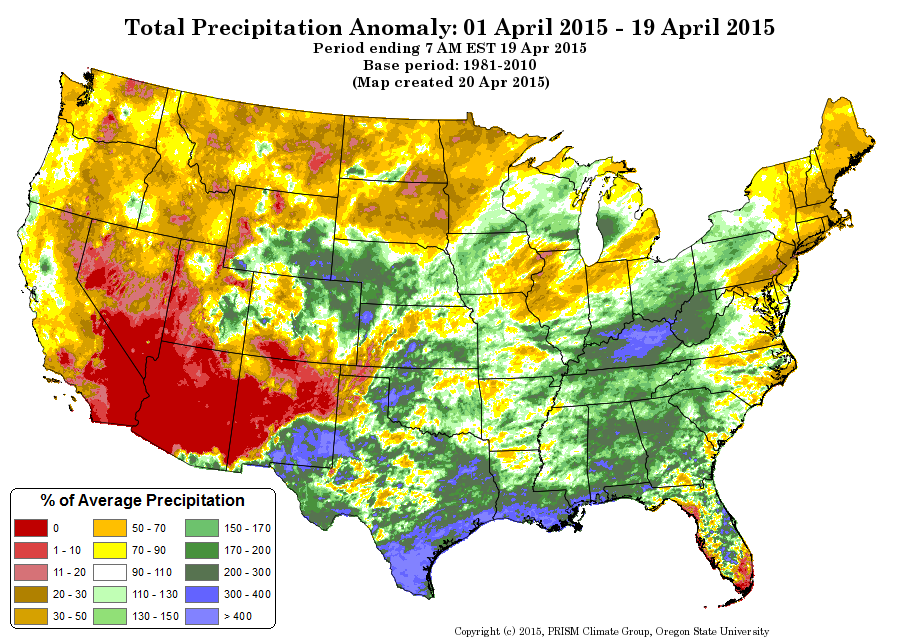
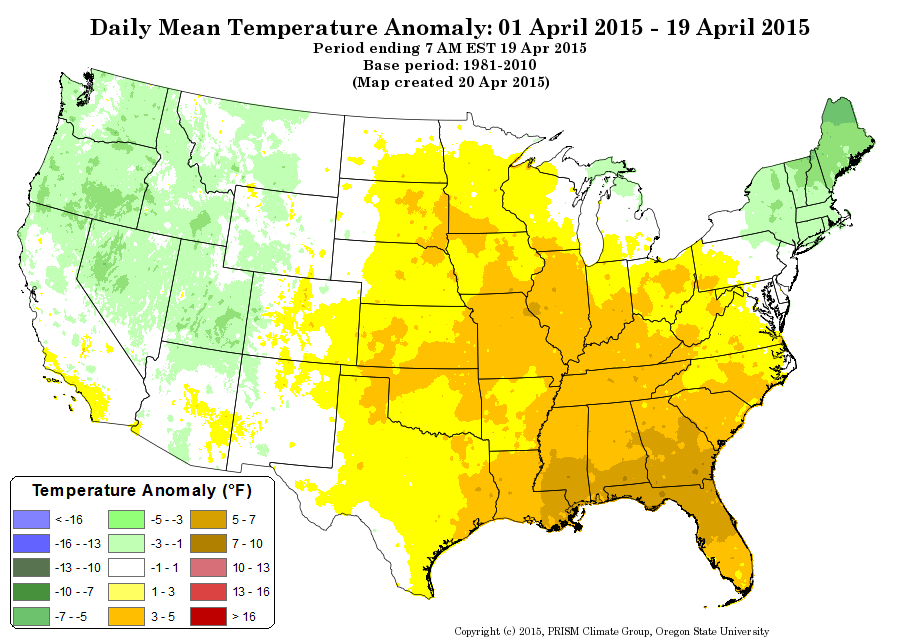
April hasn’t been super warm, but it has been very dry:

April precipitation anomalies, courtesy PRISM

April precipitation anomalies, courtesy PRISM

April temperature anomalies

April temperature anomalies

Data courtesy PRISM Climate Group.

What does this mean for Colorado River water users? It decreases the possibility that there will be water available in Lake Powell to release extra supplies for downstream states, which increases the near term odds of a formal shortage declaration sooner (potentially as soon as 2016) rather than later. More here on who will be impacted by shortage.

In California, you can’t charge water hogs more than the rest of us

Crazy California’s proclivity for “governance by voter initiative” seems to have just undercut one of the major tools in the municipal water conservation kit.

Tiered water rates, in which residents are charged a low rate for basic needs and increasingly higher rates for high usage, violate California law, according to a court ruling handed down today. Matt Stevens in the L.A. Times:

[T]he 4th District Court of Appeal  struck down San Juan Capistrano’s fee plan, saying it violated voter-approved Proposition 218, which prohibits government agencies from charging more for a service than it costs to provide it.

“We do hold that above-cost-of-service pricing for tiers of water service is not allowed by Proposition 218 and in this case, [the city] did not carry its burden of proving its higher tiers reflected its costs of service,” the court said in its ruling.

Precipitation-runoff relationships in sustained drought

This paper is measuring stuff in Australia, but seems to mimic the dropoff in runoff we’re seeing on the Rio Grande and other western U.S. rivers compared to the precipitation deficits we’re experiencing:

Annual rainfall and runoff records from south-eastern Australia are used to examine whether interdecadal climate variability induces changes in hydrological behavior. We test statistically whether annual rainfall-runoff relationships are significantly different during extended dry periods, compared with the historical norm. The results demonstrate that protracted drought led to a significant shift in the rainfall-runoff relationship in ~44% of the catchment-dry periods studied. The shift led to less annual runoff for a given annual rainfall, compared with the historical relationship.

From “The influence of multiyear drought on the annual rainfall-runoff relationship: An Australian perspective”, Saft et al., Water Resources Research, 10.1002/2014WR015348

h/t Kevin Anchukaitis at Woods Hole


In California drought, when the water’s not fer fightin’ over

What to make of this California drought story from Alex  Breitler?

Farmers within the Delta and farmers south of the Delta aren’t exactly bosom buddies.

Not when it comes to water.

But this spring, as their lawyers geared up for another year of fighting over limited supplies, farmers on both sides quietly started talking.

They hammered out a rough plan to compensate Delta farmers for voluntarily fallowing their fields, thus freeing up water that could be pumped south to their parched brethren.

The tentative arrangement was more complex than that — too complex, according to state officials, who rejected the plan late Wednesday.

But parties on both sides say the progress they’ve made could be helpful if, heaven forbid, the drought lingers for years to come.

The danger for me here is that the entire premise of my upcoming book is that collaborative arrangements to share water, rather than fighting, are the only way out of the mess we’ve made for ourselves. So obviously, in the midst of all the California hollerin’ right now, I love this story because it feeds my preconceived narrative. Most of my research right now is focused on deals like this, and how they come about – the formal legalistic (institutional) structures, but also the informal stuff. Great job Alex for this detail:

Farmers from both regions met recently on McDonald Island, toured the farms there and broke bread together (actually, they ate burritos).

Burritos! Yes! (For my book, beer seems to be the thing, though there’s an epic tale I may include involving mole at a Mexican restaurant in Salt Lake City.)

But there are two problems with the story that give me pause. The first is the obvious point that the deal didn’t go through. The state nixed it. I don’t see that as a huge problem. Part of what all these burritos, beer and mole are about is learning how to have the conversation. Alex’s story gets that:

While the plan appears to be dead this year, he didn’t rule out the possibility of another effort.

“We were trying to change the way we do this in California with more of a direct farmer-helping-farmer approach, rather than lawyer-talking lawyers,” he said.

The second problem is more fundamental. Like some of the deals I’m looking at in the Colorado River Basin, this is a small deal. Are problems are huge. Does this approach scale up?

Deconstructing media coverage of the California drought

Brian Devine has written one of those special pieces that made me smack my forehead repeatedly and say, “Yeah, that!”:

To conflate the myriad problems of water in California into a single problem is the hallmark of a generalist reporter on deadline, as if I wrote that the Detroit auto industry’s collapse was because they made lousy cars. Did they? Probably. Certainly I could find some evidence for that. Have we planted too many almonds? Are we growing too much of China’s forage crops? Do we have too many lawns? Do we still drink bottled water unnecessarily? Yes. No doubt. But to write about one of those things and omit the others- not out of malice or ignorance, mind you, but to find an interesting story that appeals to busy readers from all walks of life- has real consequences for how the general public- the ultimate arbiter in the market and the voting booth- think about our very, very complicated problems.

I recommend clicking through to read the entire piece. It is very good.

The Upper Basin: the Colorado River shortage that has already happened

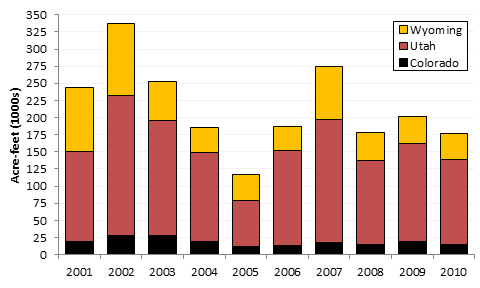
Mike Cohen of the Pacific Institute, in some conversations last week sparked by my post about the risk of what we often call the “first ever” shortage in the Colorado River Basin, points out that shortages in fact are routine in the river’s Upper Basin.

This is a result of hydrology. The Lower Basin – Nevada, Arizona, California, and Mexico – has two big storage reservoirs upstream of its water users that fill in wet years and therefore allow continued water use downstream in dry years. But if you’re in Utah or Colorado, without a big reservoir above you, you’re dependent on the snowpack in the mountains above you and the water flowing down your river. If it’s a dry year, you don’t have water to irrigate.

The U.S. Bureau of Reclamation attempts to calculate the shortages that result – the amount of water that would have been used but is not available simply because it’s a dry year. Here’s Mike’s graph of the results:

Courtesy Michael Cohen, Pacific Institute; data from USBR

Courtesy Michael Cohen, Pacific Institute; data from USBR

2002 is particularly interesting, and was apparently particularly galling for folks in the Upper Basin. It was a horribly dry year, with big shortages to Upper Basin water users. But the big downstream reservoirs were relatively flush, and the Bureau declared a “surplus” on the Lower Colorado, giving California a big slug of extra water.

Typically in a big river system, the people upstream have the advantage, and those downstream are left behind because of upstream use. But on the Colorado, it’s the reverse.

You should read Cynthia Barnett’s new book, “Rain”

Rain, a Natural and Cultural History, by Cynthia Barnett

Rain, a Natural and Cultural History, by Cynthia Barnett

I presume that the audience for this blog is, in significant measure, made of people who think a lot about water. Many of your are probably already familiar with Florida write Cynthia Barnett’s books, Mirage, and Blue Revolution. For you, the news that Cynthia has a new book is self-recommending.

There’s so much good to say about Cynthia’s new book, Rain: A Natural and Cultural History, that it’s hard to know where to begin. Her history of the raincoat alone, or the people who measured rain, or forecast it, is delightful and makes the book worth the price of admission. Water nerds will love this book.

But let me write from my particular point of view, the tradecraft of someone who cannot read a book like this and not be at least a little distracted by the “how did she do that” part. (Cynthia’s Mirage, the story of Florida water, has been a model for me in my own work, explaining a place and its water, and she has been a kind and generous mentor as I negotiate the process of book-writing myself.)

Her seventh chapter, “Rain Follows the Plow”, tells the story of those who resolutely moved west across the Great Plains of North American in the 19th century, confident that rain would follow them into this arid landscape as they busted the sod:

Once the dutiful settlers broke up land with their plows…, rainfall could seep down, then return to the atmosphere overhead. The more soil cultivated, the ore moisture captured. More moisture, more evaporation. More evaporation, more rain.

“Rain follows the plow.”

The theory stuck like wet grass.

It was, of course, wrong.

It’s a story water nerds will find familiar, but Cynthia brings it a remarkable new life drawing on the letters of pioneer Uriah Oblinger, his wife Mattie, and family. For a time, their 160 acres of Nebraska soil did them well, but Mattie died in the birth of their fourth child. Until her death, it was a happy time, and a wet one, but it did not last:

In reality, dry was normal. But Mattie would never know it in the seven years she worked to build a life on the plains with Uriah and their three little girls. She died in childbirth in February 1880, along with their infant son. Uriah was left with nine-year old Ella, Stella, five, and Maggie, two.

That spring was dry; day-and-night different from the year Mattie had arrived on the plains. Uriah’s crops failed. He blamed himself as much as the lack of rain. “I hard know how to manage,” he wrote to Mattie’s parents in the fall, asking that they take one of the children. “I feel that it is not possible or right for me to go through another season as I have this one, for I cannot do justice to myself or family this way.”

The tradecraft is in a) finding a story as compelling as Uriah and Mattie’s, told through their old letters, and b) weaving the story so gracefully through the broader narrative of rain and drought on the plains. It’s full of narrative like this, stitching together a wonderful picture of the water falling from the sky that water nerds will love, but also the rest of us, people for whom water is just that unquestioningly beloved part of our lives.

I highly recommend this book.
Decades of dry on the Rio Grande

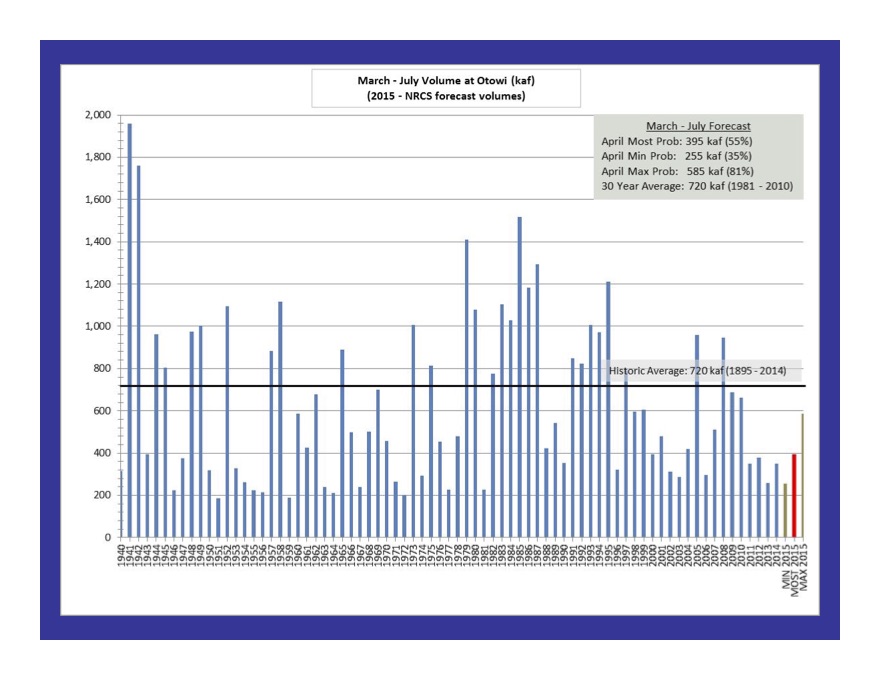
Seventeen of the last 20 years have had below-average runoff at Otowi (north-central New Mexico) on the Rio Grande:

Courtesy USBR

Courtesy USBR

That’s from the U.S. Bureau of Reclamation’s 2015 Annual Operating Plan presentation, done in Albuquerque last week. “Average” is the 1895-2014 mean.

Southwest monsoon!

Sorry, that was a clickbait headline. Let me walk it back: Odds shifted slightly toward a wetter Southwest monsoon this summer!

Summer seasonal outlook

Summer seasonal outlook

 
The usual forecast explainer: this shifts the odds from the climatological one-in-three-years-is-wet statistical binning to a 33-40 percent chance of wet in the light green area, upwards of 40 percent in the dark green area.

That translates to a seasonal forecast of continued drought, but some improvement, across the Colorado River Basin:

Seasonal drought outlook

Seasonal drought outlook