
Downtown alley, Albuquerque, Boxing Day 2014
Downtown alley, Albuquerque, Boxing Day 2014
Annie Snider left an excellent summary in our Christmas stocking of the state of play on the Colorado River. Lake Mead approaches the end of the Calendar year at elevation 1,087 feet above sea level, which is nearly 20 feet below last year at this time, as basin water managers scramble to build new institutional widgets aimed at propping up the lake’s level against looming shortage declarations. A deal signed this month takes the next step:
All sides agree that the deal, signed during the users’ conference here, won’t begin to solve the basin’s overarching problems. For one thing, users have only mapped out the path to 750,000 acre-feet of those reductions and are back-weighting the targets.
But it does suggest states are prepared to share the pain rather than battle over the remaining water in court.
It also follows an earlier agreement among water users in the Lower Basin this summer to conduct an $11 million conservation pilot program (Greenwire, Aug. 1).
“I think the significance of the system conservation agreement isn’t the volume of water; it isn’t the amount of money; it’s not even the parties who are there,” said John Entsminger, general manager of the Southern Nevada Water Authority.
“It’s the fact that for the first time on the river, we see major water users acting with the basin as a whole in mind and getting to that equilibrium and treating the system as the beneficiary rather than acting in their own local best interest and trying to put water in their bank accounts.”
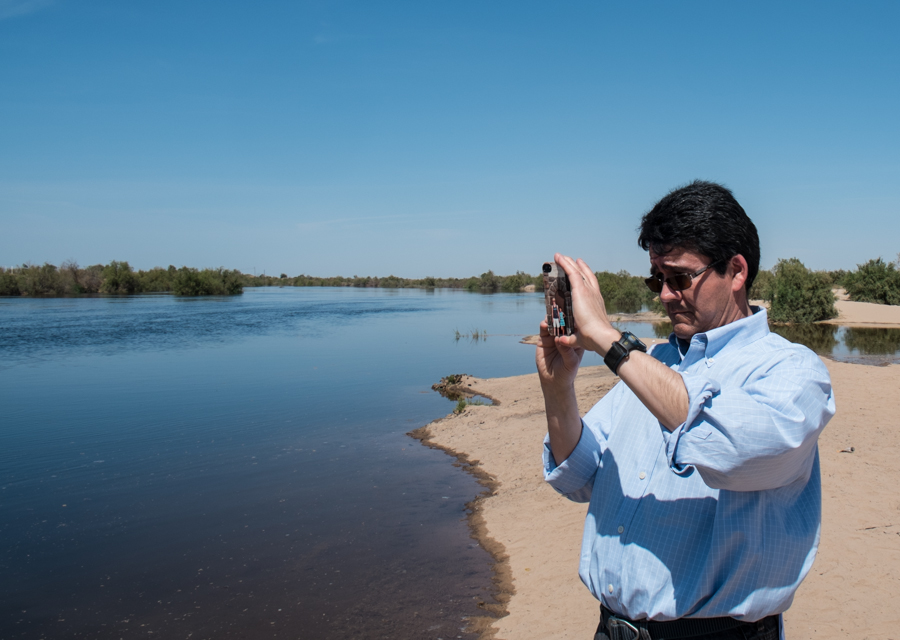
Deputy Interior Secretary Mike Connor at the San Luis Bridge, March 28, 2014, watching the delta pulse flow
Michael Connor, the Interior Department’s second in command, who helmed Reclamation for more than four years, had tough words for his former colleagues in the basin.
If conditions worsen without consensus from the states on what to do, the federal government will have to step in, he told them at the conference.
“We need more urgency, more definitive commitments and more collaborative agreements,” he said. “Without proactive agreements, I fear the Colorado River Basin will return to its past and replicate what still goes on in many basins, which is conflict, litigation and gridlock.”
The entire piece, which seems to be out from behind the E&E paywall, is worth reading.
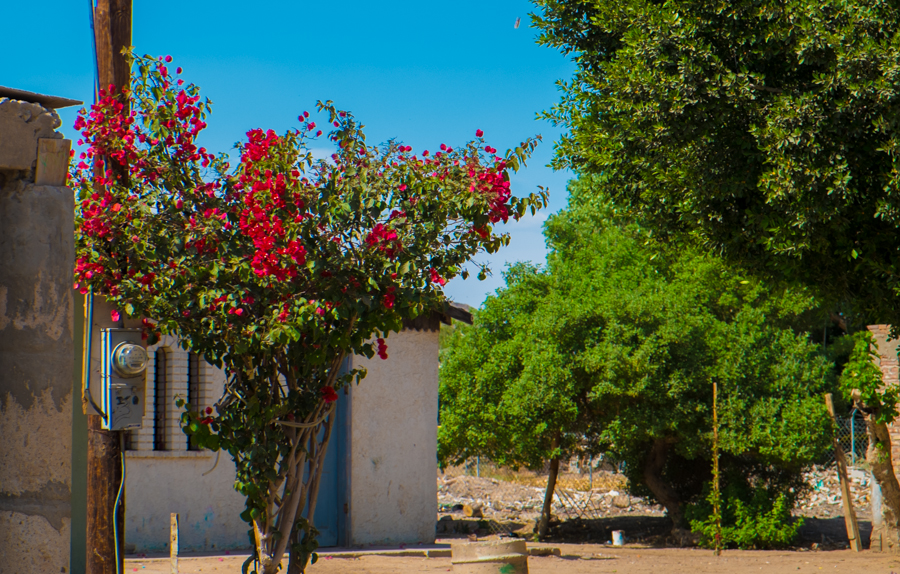
Bougainvillea, Algodones, Baja, MX, March 23, 2014
In March, President Obama nominated New Mexican Estevan López, who at the time was head of the New Mexico Interstate Stream Commission, to head the U.S. Bureau of Reclamation. It was a big deal in a number of ways, not least of which was that, in replacing Mike Connor, López would be the second New Mexican in a row to head this incredibly important water agency. But then, as happens with things that require Congressional action these days, the nomination languished, leaving the Bureau and New Mexico water management in limbo.
Finally in October, López went back to Washington to serve as “principal deputy” at Reclamation, a position that didn’t require any congressional action. He was for all purposes running the agency, in all but title. But with Congressional action such a dicey game these days, it seemed entirely possible that he would serve out his term, running the agency and doing all the work, without ever actually getting the formal title or, as a friend put it, “getting his picture on the wall.”
So I was happy to see the tweets out of Reclamation today after his name was included earlier in the week on a list of what were described as “non-controversial nominations” to which the Senate gave its assent. If you know Estevan, you’ll recognize the grin in the second picture:

Estevan López being sworn in as Commissioner of Reclamation
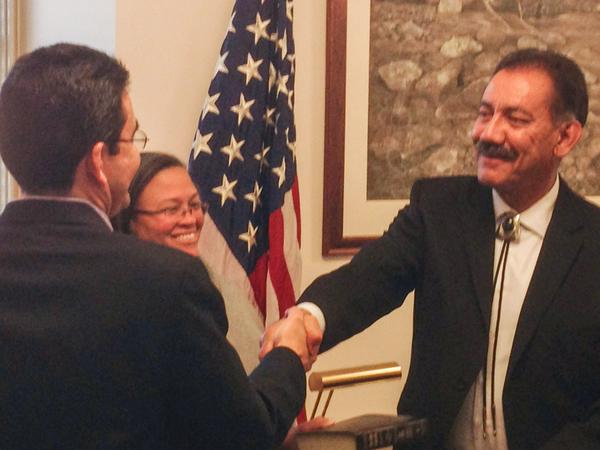
Estevan López, smiling after being sworn in as Comissioner of Reclamation
“The average daily water consumption across the south east in November 2014 was 190 litres per person per day. This is a stark contrast to consumption levels before the millennium drought, when the region’s residents were using an average of 330 litres per person per day.”
That’s Queensland, Australia. To translate to U.S. measures, that’s down from 87 gallons per person per day to about 50. By comparison, Albuquerque (which I frequently cite as a success story) is currently at about 135 gallons per person per day, down from some 250 in the mid-1990s.
We can do this.

Rain
 , is now available for pre-order, which means we don’t have to wait too much longer. (If you have time to kill between now and then, may I recommend Blue Revolution: Unmaking America’s Water Crisis
 ?)
?)
Even with the release of extra water from upstream reservoirs, Lake Mead outside Las Vegas is forecast to continue dropping in 2015 and into 2016, according to the U.S. Bureau of Reclamation’s latest monthly “24-Month Study” (pdf). At this point, as Lake Mead drifts deeper into record emptiness, it goes without saying that the big reservoir, the key to supply water for urban-suburban Nevada, Arizona and Southern California, along with the vast agricultural empires of the southwestern deserts, is heading into record territories.
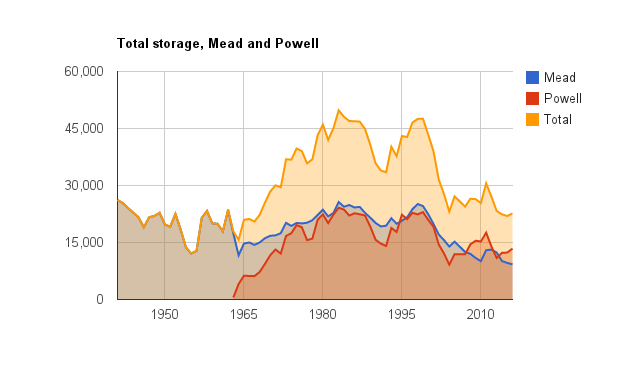
Storage in Lakes Mead and Powell. Data source: USBR, graph by John Fleck
But for the record, the current forecast end-of-water-year level for Sept. 30, 2015, is 1,075.32 feet above sea level, which would be a record low for the end of a water year. Forecasting into 2016 should be taken as little more than median flow arm-waving, but for the record, 2016’s 1,070.64 would be, yup, another record. The forecasted drops would happen even with an anticipated release of surplus water from upstream, according to the Bureau’s analysis.
Faced with serious risks if dropping reservoir levels continue, the board of the Southern Nevada Water Authority last week voted in favor of spending another $650 million to build a new pumping plant capable of sucking water out of the reservoir at very low levels. Brett Walton reported the details:
The water authority’s two existing intakes will be exposed to desert air if the lake’s elevation drops below 1,000 feet above sea level. A third intake is currently under construction, but it would require a separate pumping station — like the one that the committee recommended — to operate at the lowest water levels, those below the 1,000-foot mark.
This is not Las Vegas expecting Lake Mead to drop that far, but rather buying some extremely expensive insurance against an enormous downside risk. To senior managers at SNWA, that risk has to appear in the realm of possibility. Since 1998, Mead’s elevation has dropped 133 feet. The 1,000-foot mark – the point at which a major U.S. city’s water supply is gone – is just another 81 feet away.
The best part of doing this story was standing by the Rio Grande at dusk with Chris Witt, watching the sandhill cranes fly in to roost. The birds were great, but the really extraordinary part was watching Chris watch them – eyes flitting, counting, listening and hearing.
As they flew by, they announced their presence with the characteristic honking that has become the serenade of winter on New Mexico’s middle Rio Grande, and Witt offered a play-by-play of his rising count. That one was a lesser sandhill crane, smaller than the others with a peg-like beak. Those others the larger greaters, and listen to that high-pitched whistle heard amid the deep honking coming from the Y-shaped formation, the distinctive cry of a juvenile keeping up with mom and dad.
There’s also some stuff about birds being deceptive to get mates, which is maybe a sex angle so you should click?
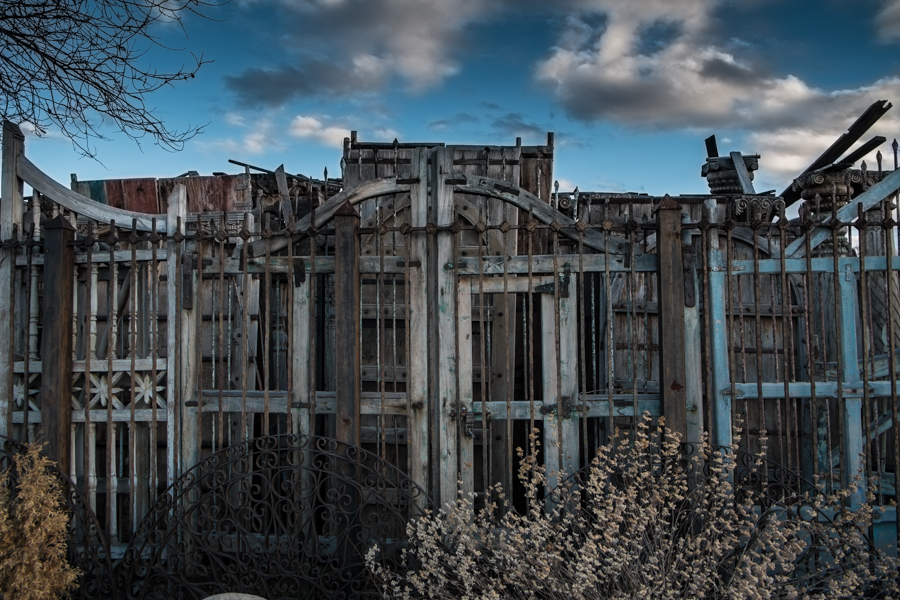
back lot at a Santa Fe, NM, antiques bazaar

Lissa, advancing on the Plaza, Santa Fe, December 2014