“We have a cool, pleasant ride today…”

Powell Expedition

Powell Expedition

My new favorite Twitter feed is @jwesleypowell, who is tweeting his trip down the Colorado River into the great unknown:

Soon after dinner, we discover the mouth of the San Juan, where we camp.

The tweets are drawn from the publicly published version of John Wesley Powell’s journals, which is a ripping good read. But it’s also a bit of a fiction, assembled after the trip, with some stitching up here and there.

It is in that regard helpful that a historian by the name of John Cooley has collected in one place all of the contemporaneous journals of the participants in the epic journey. “The Great Unknown” provides a useful adjunct to Powell’s gloss, as in this July 31 entry from George Braldey upon the group’s arrival at the mouth of the San Juan:

[T]place is most desolate and uninviting…. Fear Major will conclude to remain here and observe the eclipse on the 7th but sincerely hope not for to find shelter we have to crawl into the rocks and let the evelike projection of the cliff shelter us, and the rocks are almost hissing hot.

It wasn’t all biscuits and gravy.

(And in the manner of stitching, the above picture is actually from the second Powell expedition.)

Earth, air, fire and water

Ashy water in Rio Grande ditches, July 31, 2011

Ashy water in Rio Grande ditches, July 31, 2011

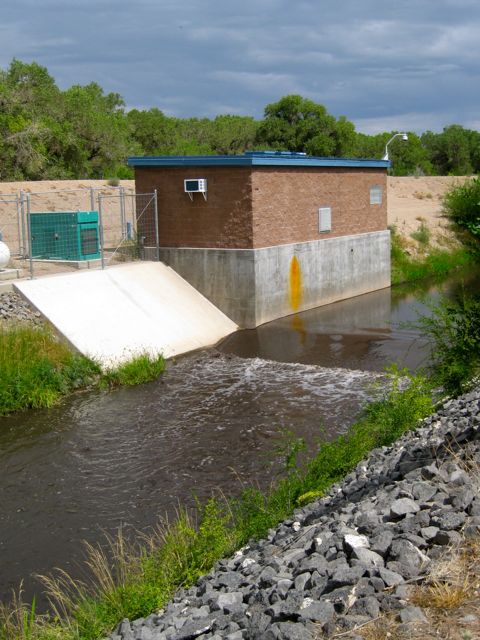
I tried my best while I was out riding this morning to get a picture that shows the strange discomfort flowing past in the Rio Grande and the irrigation ditches that flank the river as it passes through town. Need words to help – the water at this spot, on one of the ditches in Albuquerque’s south valley, is usually clear. It’s a spot where I often see a black-crown night heron fishing. Today, it was gunk.

The Las Conchas fire, which goes down as the “largest fire in New Mexico history” (more on the scare quotes later) was reported 99 percent contained this morning, meaning we’re almost done with it as fire. But it is monsoon season here, when fire’s aftermath turns to ash and mud and debris flows. As I wrote in Saturday’s paper (sub/ad req):

The runoff marks the latest wave of problems from one of the worst fire seasons in New Mexico history. While the fires and the damage they directly cause have drawn the most attention, experts say watershed damage is one of the biggest threats they pose in the long term.

Santa Fe and Albuquerque both shut down their drinking water river diversions. Albuquerque shifted to groundwater. Santa Fe has been forced to draw down reservoirs that were already perilously low because of the pitiful winter snowpack.

I wrote a piece a couple of weeks ago about the “new normal” as increasingly unhealthy forests and a changing climate create conditions that are ripe for this sort of fire year:

We are living in what some scientists have taken to calling the “Anthropocene,” a geologic era during which human influence dominates the landscape around us in ways that will be easily detectable long after we are gone. In the woods above Los Alamos, a big part of that influence dates to the arrival of the Chile Line trains in the late 1800s and the expansion of grazing animals that accompanied it.

“They ate all the grass,” McDowell said.

That grass provided the fuel for frequent, low-intensity surface fires that cleared out undergrowth while leaving the forest’s great Ponderosa pines intact.

Well-intentioned and effective but ultimately counter-productive efforts to snuff out every fire before it could spread added to the problems that finally blew up in the mountains bordering Los Alamos and Santa Clara Pueblo in the last two-plus weeks.

But I feel like I’m only scratching the surface. I didn’t touch the issue of water and watersheds in the “new normal” piece, and I’m only beginning to understand the forest health issues that are driving all of this.

Albuquerque’s Rio Grande drinking water system is back up as of Friday, and Santa Fe hopes to get going next week, two more steps toward an uncomfortable normalcy.

Drought – An Update

For grins, I just checked the latest climate data for Baton Rouge, which is in the grip of a fierce drought. July’s been a decent month for them. Still below normal, but better than it has been. From July 12-14, they got 2.84 inches of rain.

rain gauge

rain gauge

It’s the last day of the month, so I can total up my July rainfall. (I measure at 7 a.m., so anything that falls this afternoon or this evening goes on the Aug. 1 report.)  I got six days with measurable precip in July, a total of 0.62. That brings me to 2.82 inches for the water year that started last Oct. 1. with records at my house going back to the 19990-2000 water year, that’s 41 percent of average, the lowest by a good chunk since I’ve been keeping track.

2.84 inches over three days at Baton Rouge and they’re still in drought. 2.82 inches over 10 months and we’re still in drought. Drought, you see, is a relative phenomenon, involving less precipitation than you’ve come to depend on.

This past winter’s La Niña-driven drought was epic in New Mexico, and the monsoon season has been lackluster. And what might we have in store for the coming winter? I don’t mean to alarm, but…

Combined with the recent weakening of the positive subsurface ocean anomalies and the lingering La Niña state of the atmosphere, the possibility of a return to La Niña during the Northern Hemisphere fall 2011 has increased over the past month.

The Ag Irrigation Conservation Paradox

Reining in the Rio Grande

Reining in the Rio Grande

Ever surprising.

Although increased irrigation efficiency is one of the most widely promoted solutions to increased water demand, its actual effects on the water balance are complex and even paradoxical. The cost to farmers of delivered irrigation water is minimal, meaning that there is little benefit from installing expensive water-conservation technology in terms of reducing costs. The only real incentive to farmers for increasing efficiency is to use what water is saved to irrigate additional land and thus increase income.

From the newly published Reining in the Rio Grande: People, Land, and Water, by Fred Phillips, Em Hall and Mary Black, which I highly recommend.
You Can’t Make Up Shit This Good

Trinity Test

Trinity Test

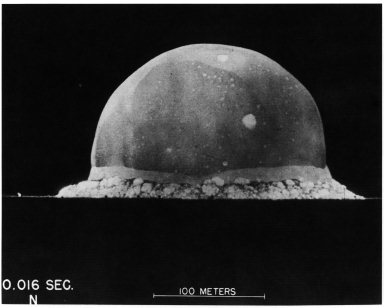
Nora, over at Escape Pod, captures something remarkable about the Manhattan Project:

[T]he more I learn about the Manhattan Project the more it feels like a fabricated story. Oppenheimer is said to be the father of the atomic bomb, but really he’s just the only person in the world that rolled high enough Intelligence, Wisdom and Charisma scores to manage the top secret, international community of scientists that the US Government hid away on a hill in the New Mexican desert. Read a bit about the stories of the creation of the bomb and they all feel like fiction– the Soviet spies meeting surreptitiously in Albuquerque, confirming their identities with matched halves of a Jell-O box, Richard Feynman learning to open locked cabinets containing nuclear secrets, even Oppenheimer’s iconic “I am become death” quote, and you’ll feel like you’re reading the notes and ephermera of a rather eclectic world of science fiction.

I commend the entire piece – The Bomb, The Fire and the Caves: New Mexico and Science Fiction – to your attention.

Sierras and the Colorado Basin: We’re All In This Together

A reminder that Northern California’s water problems and the Colorado Basin’s are linked, in this new paper by Paul Miller and Thomas Piechota on snowpack around the West. Miller and Piechota focus primarily on Colorado Basin snowpack (which as we know is declining) but note the relevance of the Sierra Nevada as well:

Decreasing snowpack is prevalent over the Sierra Nevada Mountain Range, which suggests additional strain on California’s water resources. Although the Sierra Nevada Mountains are located outside of the Colorado River Basin, changes to California’s water supply system from any source will impact Colorado River usage in the southern portion of the state. For instance, as the availability of water resources for the state decreases, it is less likely that California will have the flexibility to participate in Reclamation sponsored conservation programs which allow for states to store water resources in Lake Mead, to the benefit of the Colorado River System.

This echoes a theme I’ve touched on a couple of times of late:

Rainwater Harvesting in New Mexico

Is it legal in New Mexico to catch the rain that falls on my roof and put it in a barrel for later use? Kinda. Sorta. Maybe?

I love this question, which I’ve written about in the newspaper (sub/ad req) in the past, and which came up last week when I was talking to the local chapter of the AIA.

It’s crazy to think that it wouldn’t be. I mean, it’s water on my property, right? The dilemma is that if the water would have run off my property and ended up in a a river had I not stopped it, it would be someone else’s water under the doctrine of prior appropriation. They could sue me. Crazy-sounding, I know, but it’s the law.

So for benefit of those who are curious, below is the actual written policy, as promulgated by the New Mexico Office of State Engineer. How might I determine if the barrel out by the drain spout is “reduc[ing] the amount of runoff that would have occurred from the site in its natural, pre-development state”? I dunno. Sue me?
Ose Rainwater Policy

Elephant Diaries: The Revenue Problem

Heartbreaking words by Josh Brodesky inside the Arizona Daily Star newsroom last week as another round of layoffs came:

The cuts filled the newsroom with an eerie stillness accented only by tears and typing. The next day’s paper still had to be put out.

I think most staffers knew a day like Thursday would come, but that doesn’t make it any easier. The combined readership of newspapers in print and online is at an all-time high. But partly because of the rotten economy, advertising sales are down.

What management has said is this: We don’t have a readership problem, we have a revenue problem.


No Living With Me Now


Nerd Merit Badge

Nerd Merit Badge

Maggie Koerth-Baker in BoingBoing yesterday:

In reality, global cooling was never a broadly accepted Theory. It’s reasonable to assume that a good chunk of Americans never heard about it at all. And global cooling never had the support of most climate scientists, let alone scientists in other disciplines, like biology and public health, which are linked to climate change in many important ways today.

We know all of this thanks to the work of two scientists, Thomas Peterson and William Connolly, and a journalist, John Fleck. In 2008, they published a detailed history of this myth in the Bulletin of the American Meteorological Society. So that’s another thing that makes the myth of global cooling stand out from the pack. Unlike a lot of myths, the path from fact to fiction is very well-documented.

I’ve earned my Nerd Merit Badge.

Worst since the Dust Bowl?

In this epic dry year, we’ve heard a lot of “worst since the Dust Bowl” comparisons. I’ve been arguing that it’s a bogus comparison – one horribly dry year against a decadal scale phenomenon. But there’s a second reason, nicely captured by Kevin Welch today in the Amarillo Globe-News:

Farming practices imported from the Midwest contributed to the woes of the ’30s. Plows turned sod over, breaking it into fine particles. Mechanization turned small operations into farms covering square miles, Baumhardt said.

When it got dry and windy, the dust flew.

Some approaches developed by scientists involve not plowing under all crop residue after harvest, avoiding making the soil smooth or not plowing at all.

“Clods don’t blow,” Baumhardt said. “Wheat residue does essentially what tree rows do. It prevents the wind from getting the energy to move soil.”

The impact is less dust. Further, moisture is conserved because the soil isn’t disturbed as much so evaporation slows.

The Dust Bowl was part climate, part the result of farming practice. Farming practice was fixed.