
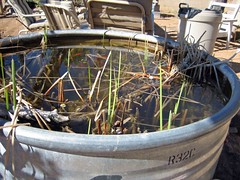
By request, a picture of the cattails coming up in the backyard “pond”. If you look close, you can orange fish. And apparently cattails – Typha – are edible. Who knew?
What We Do With Water In The Desert

I’m stretching the point a bit, but standing at the edge of an alfalfa field in Albuquerque’s South Valley this afternoon, I was reminded of Bruce Smith’s description in last Friday’s Science of the co-evolution of humans, dogs and the bottle gourd:
In Asia, for example, the domestication of two utilitarian species–the dog (for hunting) and the bottle gourd (for containers)–by ~12,000 years before the present (yr B.P.), did not so much involve deliberate human intervention as it did allow dogs and bottle gourds to colonize the human niche.
I’m abusing Smith’s point here, but I can’t help but marvel at the evolutionary success of the alfalfa plant. It started in Iran in the bronze age, and here it is, spread out over more than 4,000 acres of desert in the Middle Rio Grande Valley, making a good life for itself in this desert environment by exploiting our taste for milk and beef.
First, the alfalfa’s got to tame the river. The annual runoff can flood the whole valley floor, so the alfalfa got us to build levees and a big dam upstream to hold back the flood waters. Next, it needs a lot more water than nature provides. Up north of town, at a place called Angostura, the alfalfa got us to build a low dam to divert water out of the Rio Grande and into a spiderweb of irrigation ditches that envelopes the floor of Albuquerque’s central valley with the sort of beautiful ditch you see in the photo above.
The ditches are great for walking the dog, but we kid ourselves. The real reason the alfalfa had us build them is this. We have served our master well. 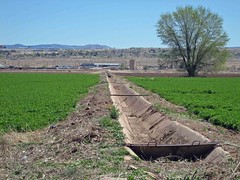
Japanese Garden
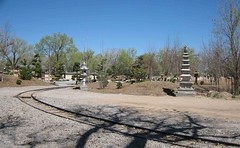
On the bike ride today, I spied the new Japanese Garden, under construction at the botanical gardens. I’m not sure about the opening date, but if you can’t wait, walk (ride?) up the bike trail north of Central a little less than half a mile and peek through the fence. It’s free.
Adaptation
Andrew Revkin on the First World-Third World adaptation dichotomy: our robust First World economic engines are both causing climate change and providing us the resources to adapt to the damage it causes. The Third World? Not so much:
Michael H. Glantz, an expert on climate hazards at the National Center for Atmospheric Research who has spent two decades pressing for more work on adaptation to warming, has called for wealthy countries to help establish a center for climate and water monitoring in Africa, run by Africans. But for now, he says he is doubtful that much will be done.
“The third world has been on its own,” he said, “and I think it pretty much will remain on its own.”
Global Not-So-Warming

The NASA GISTEMP March numbers are out. You can pretty clearly see the drop in temperatures as a result of the collapse of El Niño. They’ve also changed the way they’re calculating the adjustments for time-of-day bias and station history. (The change is explained here.) As you can see in the graph I linked above, the new adjustments have the interesting effect of substantially reducing the rate of temperature increase, primarily over the second half of the twentieth century. It’s more noticeable in the data set based solely on meteorological stations, less so in the land-ocean temperature index.
update: Looks like the graph I linked to and the page explaining the change in the bias adjustment has been taken down.
Daybook
- reading: Preparing for a talk at UNM in a couple of weeks, I’m rereading a couple of old sciency favorites: Thomas Kuhn’s Structure of Scientific Revolutions and The Golem, by Harry Collins and Trevor Pinch.
- paper of the day: Abrupt changes in rainfall during the twentieth century, by some UW-Madison folks, offering a new and potentially useful statistical approach to defining drought (hat tip Daniel Collins)
- stuff I wrote elsewhere: A quick look at the proposed spent fuel reprocessing plant (very quick – as I suggested over on the work blog, this project doesn’t look like it has much in the way of legs)
- word of the day: pilgarlic – a bald man
The Perfect Drought
Bettina Boxall writes in the LA Times about “the perfect drought”:
Nature is pulling a triple whammy on Southern California this year. Whether it’s the Sierra, the Southland or the Colorado River Basin, every place that provides water to the region is dry.
It’s a rare and troubling pattern, and if it persists it could thrust the region into what researchers have dubbed the perfect Southern California drought: when nature shortchanges every major branch of the far-flung water network that sustains 18 million people.
Usually, it’s reasonably wet in at least one of those places. But not this year.
The mountain snowpack vital to water imports from Northern California is at the lowest level in nearly two decades. The Los Angeles area has received record low rainfall this winter, contributing to an early wildfire season that included Friday’s blaze in the Hollywood Hills. And the Colorado River system remains in the grip of one of the worst basin droughts in centuries.
(Hat tip Belshaw)
Worsening Western Drought
 Drought conditions continue to worsen across the Western U.S., according to the latest edition of the drought monitor, out this morning:
Temperatures fell from the previous week’s lofty levels but remained above normal for the 7-day (March 20-26) period. Late in the period, favorably cooler, wetter weather arrived in the West in conjunction with a developing storm. Nevertheless, the overall Western depiction exhibited a worsening trend due to a disappointing winter wet season, prematurely melting snow, and worsening prospects for spring and summer runoff potential. In particular, drought areas of the Southwest and Intermountain West were connected, resulting in a net expansion of moderate drought (D1) across Nevada, Utah, and adjacent areas.
Irrigated Agriculture
Apropos of nothing except that I’m fascinated by the interplay between agriculture and urbanization in the West, I ran across this data this evening in the Census of Agriculture (and if I blog it here, I can Google it and find it later):
Irrigated agricultural acreage in Bernalillo County (that’s the county in which Albuquerque sits):
- 1987: 7.445
- 1992: 10,042
- 1997: 11,021
- 2002: 7,952
Global Warming to Speed Earth’s Rotation
Felix W. Landerer and colleagues at the Max Planck Institute for Meteorology in Hamburg say global warming will slow down speed up Earth’s rotation by changing ocean bottom pressure, in the process shifting mass around:
We find a net transfer of mass from the Southern to the Northern Hemisphere, and a net movement of mass closer towards Earth’s axis of rotation. Thus, ocean warming and the ensuing mass redistribution change the length-of-day by ?0.12 ms within 200 years.
update, with an obvious correction.