
Warming and Drought

My story on warming and drought is up:

Four hundred years of “epic drought,” from A.D. 900 to A.D. 1300, may offer clues to what western North America faces in a warming world, according to new research.

That ancient drought coincided with a time in which the planet was warm, leading scientists to suggest that something similar may be in store as our planet warms again.

Our current drought, the worst by some measures since record-keeping began, coincides with a period of rising temperatures and increasing drought in the West. But it “pales in comparison” with the megadrought that settled over the West a thousand years ago, according to Ed Cook, a climate researcher at Lamont-Doherty Earth Observatory in Palisades, N.Y.

“This is not intended to minimize the impact of the current drought,” Cook said in a telephone interview, but to point out that “things could be much worse.”

The work is not a prediction that human-caused global warming will definitely cause drought, Cook said. But given our growing understanding of the relationship between warmer temperatures and Western drought, the possibility that greenhouse warming could lead to a drier West must be considered, Cook said.

“The point is that it would not be a good thing,” Cook said.
von Storch

Roger Pielke Jr. has offered an interesting framework for watching the fallout from Hans von Storch’s paper in Science last week challenging Michael Mann’s “hockey stick” climate graph:

In this highly politicized atmosphere, given how many scientists spoke out in support of or against Mann et al.’s “hockey stick” it will be very interesting to see reactions among scientists to Von Storch’s new paper. (It won’t be so interesting to see how advocacy groups react, as it will be completely predictable.) Specifically, given the close connection of support or refutation of the earlier paper with explicit political agendas, scientists who were critical of Soon and Baliunas may be very hesitant to comment on Von Storch et al., except in a negative way. Conversely, we can expect howls of support from those scientists who supported Soon/Baliunas.

Continue reading ‘von Storch’ »

Balloons

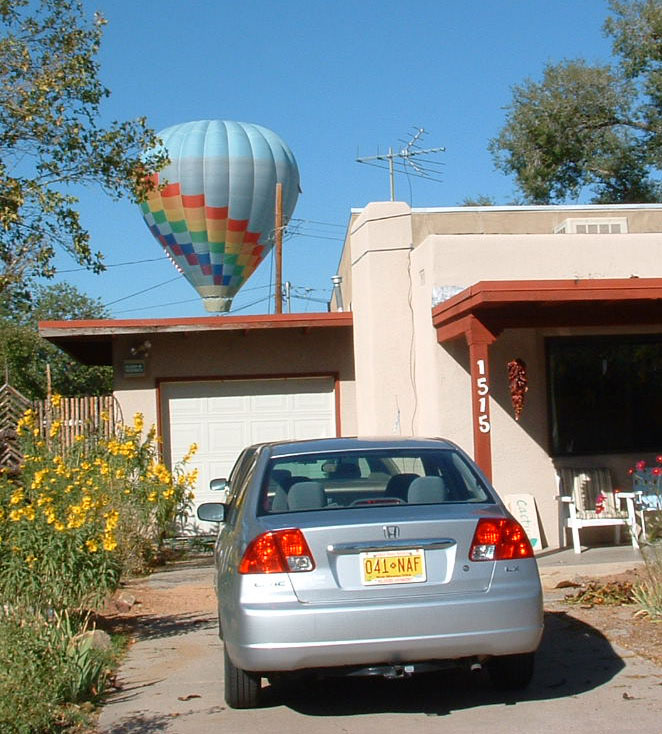
It’s that time of year in Albuquerque. Lissa snapped this flying over our house this morning while I was in the shower:


Balloon flying over my house.

It landed at the apartments around the corner.

It’s our 15th year, and I’m not jaded. It’s still fun to see hundreds of hot air balloons flying over my city.

Why Cell Phones are so Annoying

A news story in Nature explains why cell phone conversations on the subway (or wherever) are so annoying.

Apparently we have a harder time ignoring someone talking when we only hear one person’s side of the conversation. A group of British psychologists tested the idea on the train with both cell phone conversations and face-to-face conversations in which only one side of the conversation was audible. Then they quizzed other passengers about how annoying it had been. The result – it’s more annoying when you can only hear one side of the conversation.

Extinction

One of the classic scientific debates, on a par with “nature vs. nurture,” albeit far more obscure, is the question of what caused the great megafaunal extinction at the end of the Pleistocene.

Pretty much everywhere you look, you find evidence of big critters roaming the earth – mastodons, mammoths, big camels, and my favorite, beavers the size of black bears. And then they “blink out,” to borrow a lovely phrase I heard a biologist use recently. In a very short period of time in geologic terms, they’re gone.

Two dominant explanations are offered. The extinction coincides with the end of the Pleistocene, the emergence from the last ice age 10,000 years ago. That’s big-time climate change. Could that have killed them off? But there’s a second earth-changing event that happens around that same time – the explosion of us. Could we have killed them?

There’s a new review paper(sub. req.) in Friday’s Science by Barnosky et al. that offers a classically equivocal answer – it’s both! And more research is needed!
Continue reading ‘Extinction’ »