It is hard to know where to begin. The Department of the Interior’s Post-2026 Colorado River draft environmental impact statement, and the deep questions it raises, is an “everything including the kitchen sink” sort of process.
But at its root, the question it raises is simple: Tell us what you’re going to do.
It is easiest to quote the Draft EIS itself on the central question: “In critically dry periods, all alternatives have unacceptable performance.” Roger that. Tell us what you’re going to do.
In the short run, with a meager snowpack and no clear explanation of how federal and state managers are going to operate the reservoir system, the basin’s dams and diversions now, we have no clear picture of what will happen in 2026. Tell us what you’re going to do.
Some specifics
The ad-hoc collective that Allen Best dubbed “the Traveling Wilburys of the Colorado River” – Anne Castle, Eric Kuhn, Jack Schmidt, Kathryn Sorensen, Rin Tara, and me – took yet another stab at offering our suggestions in comments we submitted yesterday to Interior’s P26 EIS process.
I’ve been mentally largely elsewhere lately, finishing up the book and managing my health (I’m doing great! Thanks for asking!), so I mostly show up at the last minute on these things to dub my vocals, but my friends are very kind and inclusive, and they do good work. In particular, stuff like this full of both useful NEPA-speak and also substance:
The analyzed alternatives do not meet the purpose and need of the proposed federal action. “In critically dry periods, all alternatives have unacceptable performance.” Therefore, the alternatives analyzed do not meet the purpose and need for the federal action as described in the DEIS. It is incumbent on Reclamation and Interior to provide at least one alternative that meets the purpose and need.
As I said: Tell us what you’re going to do.
The Final EIS and Record of Decision must specify how short-term operations will address the current vulnerability of the system and its critical infrastructure. The new operating regime for the Colorado River will be implemented at a time of unusually low storage volumes and unprecedented low flows. The vulnerability of the system in providing an adequate water supply is unprecedented. Regardless of the duration of the next set of guidelines, it is imperative that Reclamation provide a clear picture of what actions will be implemented in the near term (i.e., next year, next 3 years, next 5 years) to protect critical infrastructure, and to protect public health and safety.
As I said: Tell us what you’re going to do.
The preferred alternative should be based on the broadest possible interpretation of federal authority to ensure a sustainable water supply provided by the river. The DEIS states that, “The Basic Coordination Alternative is designed to be implementable without agreements among Basin water users regarding distributions of lower Colorado River mainstream shortages, storage and delivery of conserved water from system reservoirs, or other voluntary agreements….” Because the Basic Coordination alternative does not meet key performance objectives for a large percentage of the Dry and Critically Dry futures, it is incumbent on the Agency to explore and propose using the outer limits of their authority to achieve a system that provides a sustainable water supply. Reclamation and Interior should not default to a “safe” legal approach when those operations are insufficient to balance supply and demand and provide a prudent operating regime. Lawsuits over the operating guidelines adopted by the Department of the Interior are inevitable, regardless of which alternative is adopted, even a theoretically “safe” one. Therefore, the preferred alternative should utilize the broadest possible interpretation of Reclamation’s and Interior’s authority to provide a predictable and resilient Colorado River so that the system can continue to operate in a reasonable manner while the lawsuits proceed.
This one’s on you, Secretary Burgum. We do offer suggestions, but if you don’t like ours, then tell us your alternative: Tell us what you’re going to do.
This one has seemed for a long time like a no-brainer to me:
The Upper Basin demand scenarios utilized in the modeling are unrealistically high.… [T]he Upper Basin demand scenario utilized in modeling the impacts of the various alternatives is much higher than historical use and does not reflect likely future actual use. The 2016 UCRC demand scenario embedded in the DEIS modeling is approximately 40% to 50% higher than recent average demand. Public statements by representatives of the Upper Division states emphasize the limitations imposed on Upper Basin water users by annual hydrology, but the UCRC demand scenario fails to take those hydrologic limits into account.
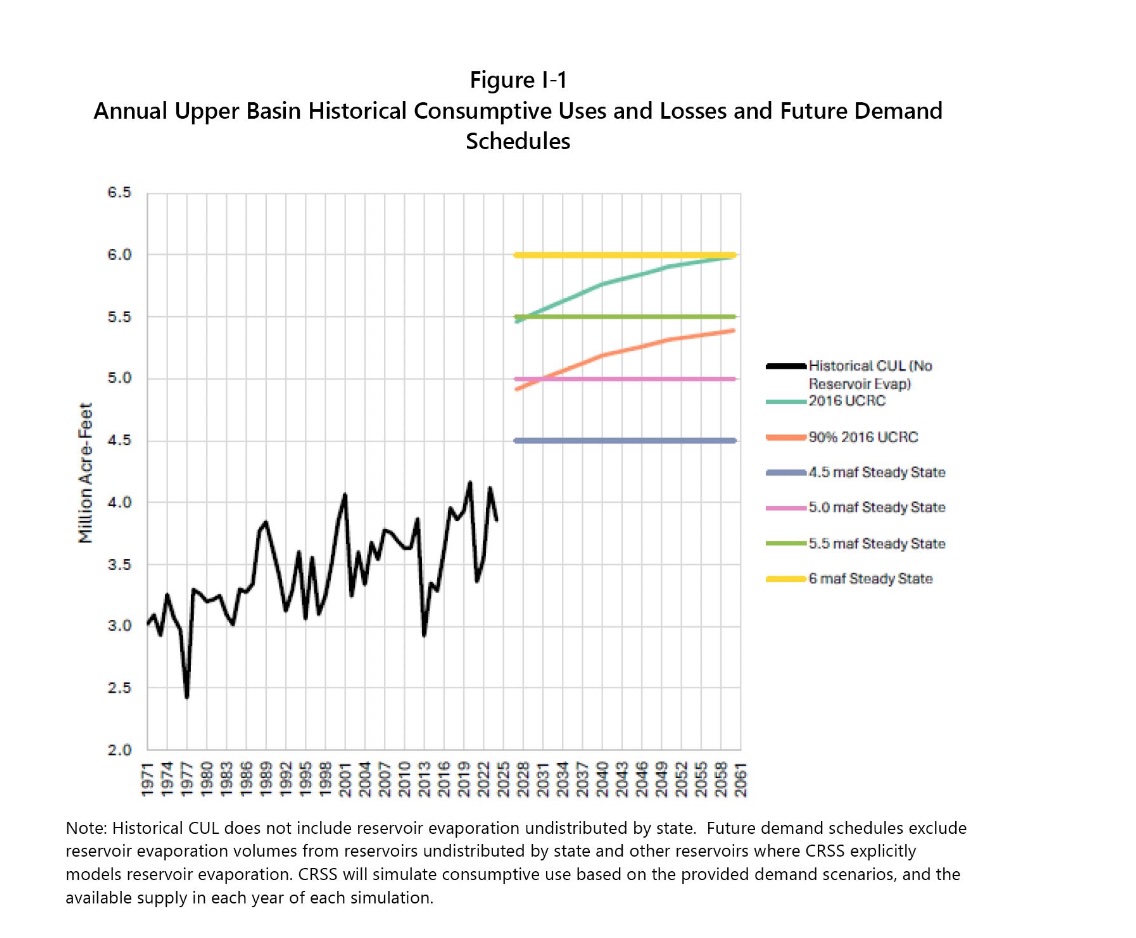
Really?
This one’s on my Upper Basin leaders: Really?
Reclamation should specifically identify what additional authority is needed to implement an operating regime that meets the purpose and need for the EIS over the long term. There are no alternatives identified in the DEIS that meet the purpose and need and that Reclamation can implement without additional legal authority. This creates significant uncertainty around river management, despite the intended purpose of providing water users a greater degree of predictability about water availability in the future. Reclamation should describe specifically what additional legal authorities it believes would be required to implement desired operating provisions. Furthermore, Reclamation has indicated the intention to “seek additional authorities” to protect critical reservoir infrastructure. These additional authorities should be explained.
Again, Secretary Burgum: Tell us what you’re going to do.
The colossal failure of the Colorado River Basin leadership is on display in this simple sentence from the draft EIS: “In critically dry periods, all alternatives have unacceptable performance.”
You’ve spent the last few years telling us what you can’t do. It’s on you now: Tell us what you’re going to do.
(Lots more in the full comments, it’s a useful primer on the current state of play.)
We once had an engineer that would default to why an idea of management/supervision couldn’t work, shouldn’t be tried, or would otherwise fail for a multitude of reasons. We did it anyway, somehow things worked out.
It would seem that the basin states suffer from the same trip wire our engineer employed.
The law is that the Upper Basin States deliver 75 maf/10 years. It’s my understanding that in some tier of shortage to Lee Ferry, the Secretary of the Interior decides how the water is divided.
I’ve asked this before: What is the accuracy of measurements of withdrawals in the Upper Basin? If they are taking 20% more than is reported, that’s nearly 1 maf. Do we really know the total discharge of the Colorado River in the Upper Basin? Acoustic Doppler has been around for about 40 years.
Nobody else will ask this: Is anybody in DJT’s administration who he has appointed even fractionally competent? Will distribution of Colorado River water be decided by bribes and extortion? Did you miss the action taken against universities and law firms for billions of dollars early in the administration?
Nobody asked me, but here is a take on “In critically dry periods, all alternatives have unacceptable performance.”
“Anticipating critically dry periods, bureaucrats are demonstrating unacceptable performance.”
It’s time to step up and perform.
Thank you for sharing comments by you and others. So insightful. I’ve shared the comments and key portions, in my opinion, particularly pertaining to Utah where I reside. We are water wasters generally and should be held to conserving more before BOR approves a management plan that actually affords Utah more water to waste! Again, thank you!
Hey, I tried to buy you some coffee but it wouldn’t let me. Sorry!
I’ve read several uninformed opinions, including in The NY Times, that the Upper Division states are not contributing their share. Consider this view, from this side of the state line. New Mexido’s San Juan-Chama Project water imports were only 39% of what once was considered and delivered as “firm-yield.” Our losses due to aridification already exceed sixty percent. The 400,000 acre-feet Heron Reservoir, almost full for many consecutive years in the 1980s and 90s, is now virtually empty, and therefore cannot now maintain higher releases thought bad years. A quantitative analysis is online at the NM Water Advocates website.
“Who Killed the Colorado River?” PBS Terra (2024) https://www.youtube.com/watch?v=d3Lt58tTYFk (scroll down for transcript)