
I’d be delighted if you could join us June 2 at Bookworks

In which I hold our book in my hands. Photo by L. Heineman
I was sitting on the front porch early this afternoon with my eyes on the street when the postman come up the front walk holding a book-shaped package. I walked up to him, reached out, and held it in my hands.
The kind folks at Bookworks and the Leopold Writing Program, with some help from UNM Press, have arranged a book launch event June 2.
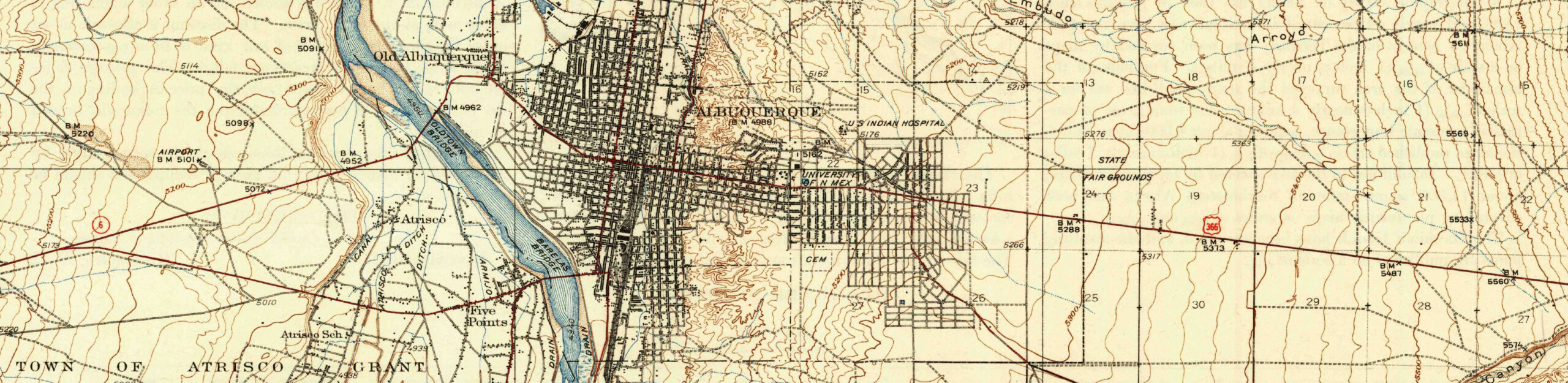
I could not have dreamed of a better place than Bookworks to launch Ribbons of Green into the world, for two reasons. First, Bookworks remains a canonical bookstore. Second and more important for our book, it sits at the heart of one of the most important neighborhoods in Albuquerque for the narrative of our book. It was here, just around the corner on the Griegos lateral, that we imagine a young Max Gutierrez standing on the ditchbank watching flood waters finally claim the old village of Los Ranchos.
Just down the road is Max’s old farm, now home to Valley High School. His parents and brothers and in-laws had property scattered all through Los Griegos and Los Candelarias, and the evolution of these neighborhoods, from acequia villages to modern peri-urban suburbs of a growing.
Just up the road is Melquiades Montaño’s old farm, once a swamp, now a treasured community open space (Los Poblanos Open Space) farmed in alfalfa. Tracing a line from there down through Max’s neighborhood, just 550 feet east of Bookworks, is the Griegos Drain, built in the early 1930s to drain the valley’s swamps, changing the flood plain on which we built our city forever. We’re pretty sure Max’s father-in-law’s house is one of the properties condemned by the Middle Rio Grande Conservancy District because it was in the path of the drain.
One of the challenges in book like Bob and I have tried to write with Ribbons of Green is the movement back and forth from the general – the broad conceptual superstructure of the project – to the specific – the lives of people like Max and the places they called home. The boundaries between what Bob wrote and what I wrote in this book are opaque even to me, but I feel like the chapter about Max and, by inclusion, this neighborhood, may be the best thing I’ve ever written. (I’ll let Bob speak for himself.)