There’s a letter to the editor in the latest High Country News (it’s in the paper edition, can’t link yet) that repeats a California water myth that’s just flat wrong – the California Supergiant Alfalfa Water Use Export Myth.
Alfalfa alone is using more water than all the other water uses combined, and most of it is being shipped overseas for use as feed for dairy cows.
No. Just no. In all sorts of ways.
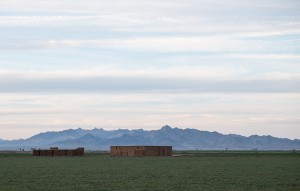
Palo Verde Irrigation District alfalfa, Blythe Calif., February 2015, photo copyright Joh Fleck
Let’s start with the water use. Alfalfa is a major crop in California, with 780,000 acres under irrigation in the 2012 Census of Agriculture. It does, in fact, use a lot of water, but that is just 10 percent of all irrigated acreage in California. That’s nowhere near enough irrigation to take up “more water than all the other water uses combined.” (Source: Census of Agriculture, tables 9 and 36) That’s not to say that California’s alfalfa crop isn’t big. It is very big. But California’s irrigated agricultural economy is huge, with lots of other crops also being irrigated. There is more California acreage planted in almonds than there is in alfalfa. There is more California acreage planted in grapes than there is in alfalfa. (Source: USDA NASS) The notion that alfalfa is using a majority of California’s water is absurd.
But what of the exports? I tried to do my own calculations recently and came up with about 3 percent of U.S. alfalfa. That was not bad.
“Dr. Alfalfa”, Daniel Putnam at UC Davis, ran the numbers last summer on U.S. exports of alfalfa and other hay crops:
Hay exports historically had never been a large component of US hay markets, and still aren’t. There was a dramatic change in 2007 with increased foreign demand with the largest growth from the UAE and China.
But even with this rapid expansion, exports are still a tiny fraction of the US of hay market – we calculate that total exports of hay at about 3% of US production, and alfalfa hay at 3.5% of US production in 2014.
A lot of the exported alfalfa comes from the western United States, but still a far cry from the myth’s “most of it” – maybe 11.5 percent of all the alfalfa grown in the west, according to Putnam:
The primary recipients of US-grown alfalfa hay are still domestic dairy producers.