Bad water on the Texas-Mexico border

The Texas Tribune (which I will never forgive for hiring my pal Jolie McCullough away from Albuquerque) is crowdfunding what sounds like a very interest bit of water journalism:

Despite decades and billions of dollars spent trying to provide Texans living along the Mexican border with reliable access to clean drinking water, hundreds of thousands of residents there — the vast majority of them low-income Latinos — still don’t have this certainty. We need your support to find out why.


NM Drought: it depends on where the rain is falling

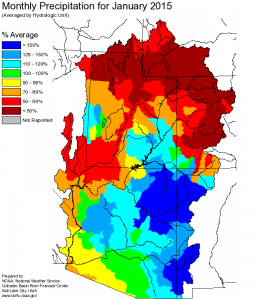
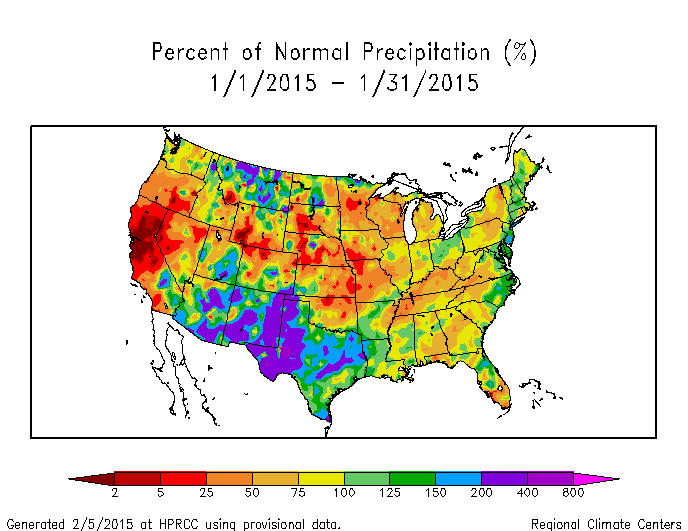
January was wet in southern New Mexico:

Courtesy High Plains Regional Climate Center

Courtesy High Plains Regional Climate Center

But the farmers of the southern part of the state are among those with the highest drought risk this year. How could that be? Diane Alba Soular does a nice job of explaining that it’s snow in the mountains, which creates Rio Grande runoff, that matters. Rain at the farm itself only helps at the margin:

King said precipitation in Las Cruces isn’t the solution to a large-scale drought.

“Any precipitation is good, but we’re talking a much more long-term and profound drought we’re in,” he said. “One little dusting is not going to cure it.”

Faubion said while recent localized storms in Doña Ana County help in a way because they add moisture to the soil. So, when river water is released from reservoirs later this year, less of it will soak into the ground. Also, the soil moisture can help dormant crops, such as alfalfa and pecans, and some crops that are grown during the winter, he said.

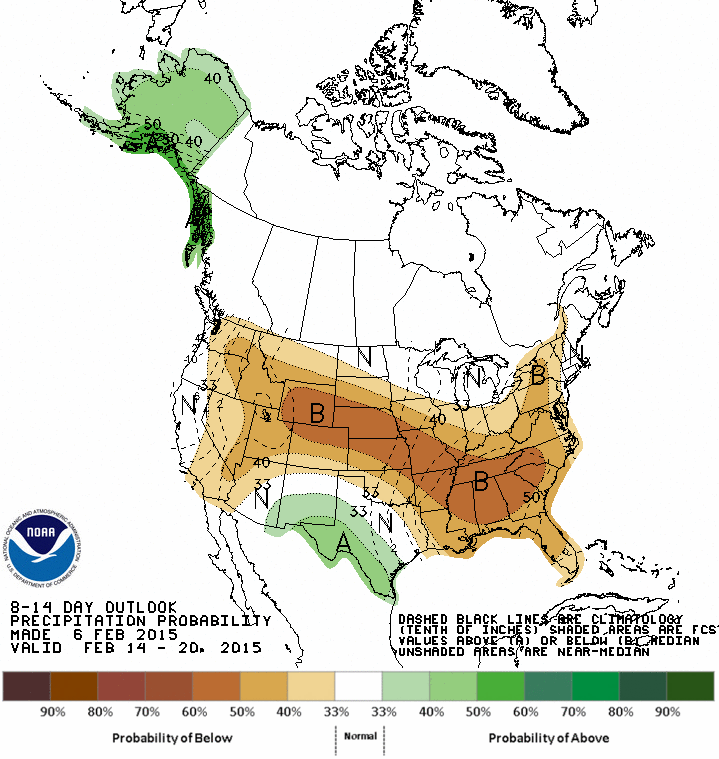
That’s why the mid-range forecasts for the rest of February aren’t super helpful:

8-14 day outlook

8-14 day outlook


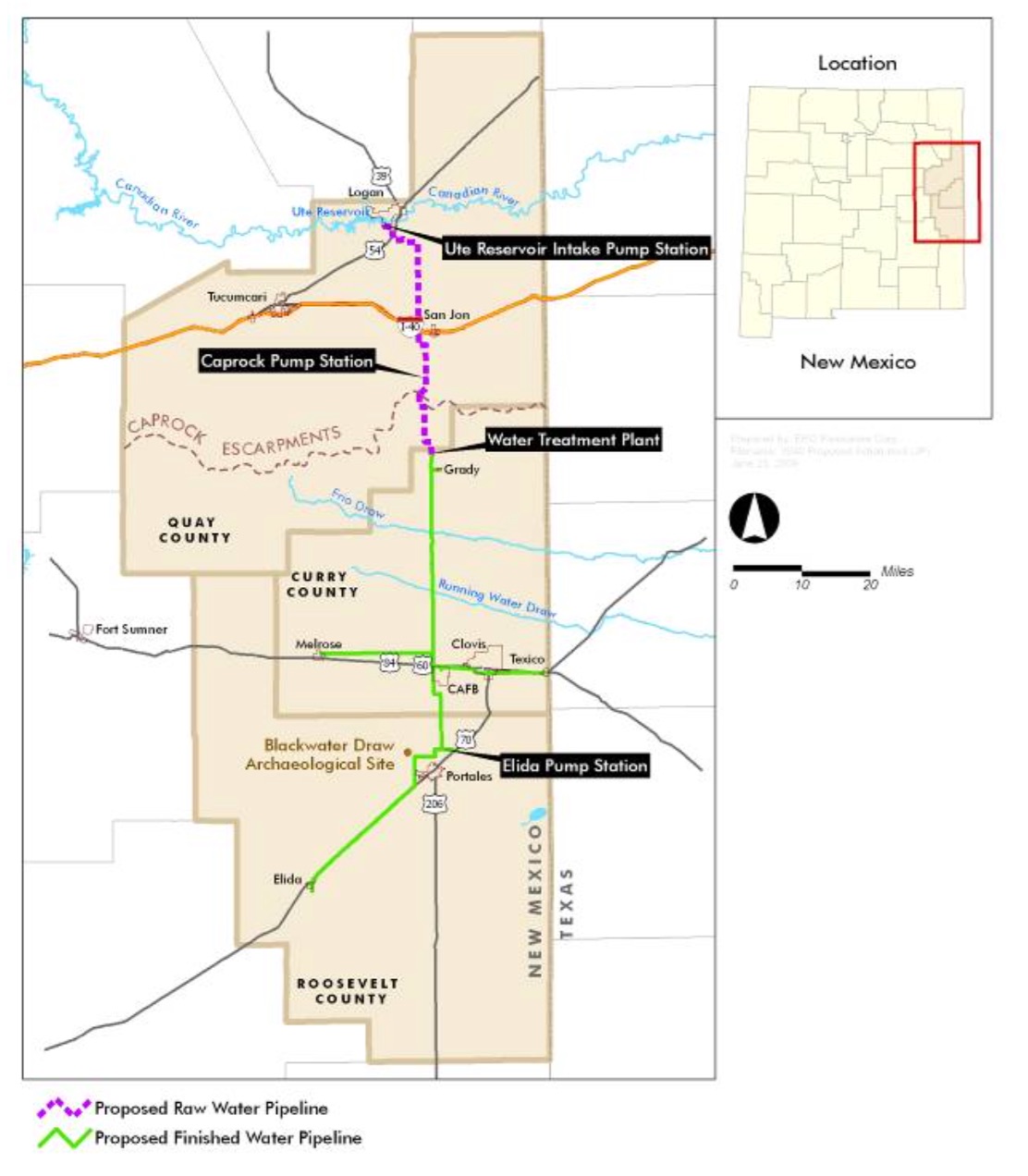
New life for one of the West’s zombie water projects?

Ute Pipeline, map courtesy USBR

Ute Pipeline, map courtesy USBR

I have long assumed that the Eastern New Mexico Water Supply Project, also known as the Ute Pipeline, was one of those zombie water projects that never quite dies but will never be built, either. The idea is to build a pipeline from the New Mexico Interstate Stream Commission’s Ute Lake on the Canadian River to bring water to eight eastern New Mexico communities, the largest of which is Clovis. The ISC built the reservoir for just such a purpose, but the water users lack a pipeline to get water from reservoir to lake.

Like much in western water, the idea has been that the federal taxpayers will foot the bill. Of the current estimated $523 million cost for the pipeline, $393 million is supposed to come from the feds. Until today, I thought this year’s federal spending on the project was going to be $47,000, which is a rounding error in a $500 million project, and a sign that the feds are not really serious about building this, but are unwilling for political reasons to zero it out.

But today Reclamation threw another $700,000 into the pot for work on the pipeline in the current fiscal year. It’s part of $96.9 million in bonus money Congress gave Reclamation for western drought and rural water infrastructure. Here’s Estevan López’s statement that accompanied the spending plan Reclamation released today for the new money: “Reclamation and its partners are confronting a growing gap between supply and demand in river basins throughout the West,” López said. “The funding released today will help us meet immediate needs and support long-term infrastructure and environmental needs of key water projects.”

So I guess the Ute Pipeline is a key water project, though it’s worth noting the size of the Obama administration’s Fiscal Year 2016 request for the work: $47,000. At this rate, it’s gonna take a while.

More info:

addendum: Credit for the “zombie water project” name to Peter Gleick, I think. Denise Fort and Barry Nelson several years ago wrote a useful overview (pdf) a few years back that included a lot of projects of this sort.

A lousy January in the Colorado River Basin

January Colorado Basin precip, courtesy CBRFC

January Colorado Basin precip, courtesy CBRFC

January was dry in the water-producing parts of the Colorado River Basin.

The official Feb. 1 forecast for the Colorado River above Lake Powell (the part of the Basin where all the water comes from) calls for just 80 percent of median April-July inflow. That’s a big drop from the Jan. 1 forecast, which called for inflow of normal (and by “normal” I mean at the median).

That’s about 1.2 million acre feet less inflow forecast. That’s a lot of water to lose in a month. I realize it’s just water on paper. There still are big error bars on the forecast, inherent uncertainties because we don’t know how much it’ll snow from here on out. Seasonal forecast odds are tipped slightly toward wet, so we could get some of that back.

But yowza, 1.2 million acre feet is a lot of water.

Feb. 1 Rio Grande forecast numbers – still bad

update Feb. 4:

The official numbers are out, largely unchanged from the preliminary numbers:

Otowi

  • max: 107 percent
  • mid: 63 percent
  • min: 33 percent

San Marcial

  • max: 108 percent
  • mid: 49 percent
  • min: sorta zero (the models have a hard time with the bottom end of the range at San Marcial)

previously: The NRCS preliminary Feb. 1 forecast numbers are out, and despite last week’s storm, they continue to point to the fourth consecutive low flow year on the Rio Grande in New Mexico.

At Otowi, the key spot for measuring flow into the river’s mid-New Mexico valleys, the mid point of the forecast range is 450,000 acre feet of runoff from March through July, which would be 63 percent of the 1981-2010 average. The forecast offers max, mid and low numbers, which correspond to a one in ten chance on the wet side, the mid point, and a one in ten on the dry side. Here are the percentages:

  • max: 101 percent
  • mid: 63 percent
  • min: 33 percent

What that’s telling us is that the snowpack is low now, and it would take great snow from here on out just to get us up to normal. And that if things stay dry, it could get a whole lot worse.

San Marcial, the last measurement point above Elephant Butte reservoir, looks crummier at the midpoint, but with a bigger spread:

  • max: 109 percent
  • mid: 50 percent
  • min: sorta zero (the models have a hard time with the bottom end of the range at San Marcial)

These are preliminary numbers. NRCS will firm them up later in the week, and I’ll provide an update.

Who does this matter to? Middle Rio Grande Conservancy District farmers have essentially no water in storage, and will have a hard time storing any for the peak of summer at those midpoints. Lower Rio Grande farmers are in a similar situation. And the coalition of agencies trying to keep the river wet for the endangered Rio Grande silvery minnow will have some scrambling to do.

On the plus side, despite last week’s storm, the roof above my new UNM office didn’t leak, so there’s that.
“I’ve been born and raised, still hauling water.”

In the Navajo Times, a piece about Darlene Arviso, the water lady. She drives a big truck around to homes on the eastern side of the reservation without running water, of which there are many:

Armed with her cellphone and massive truck, Arviso heads out into the community to deliver water to families in need.

“I go to different areas every day. I do 10 to 14 houses a day,” Arviso said of her route, adding that if some of the elders are home alone she’ll help them fill their buckets and take them inside.

In that regard, it is worth noting that the administration’s Fiscal Year 2016 budget request asks Congress to appropriate $91.2 million dollars for continued work on the Navajo-Gallup Water Supply Project, which will bring a more reliable supply of water into the eastern reaches of the Navajo Nation, where hauling water is the norm.

the problem with “drought”

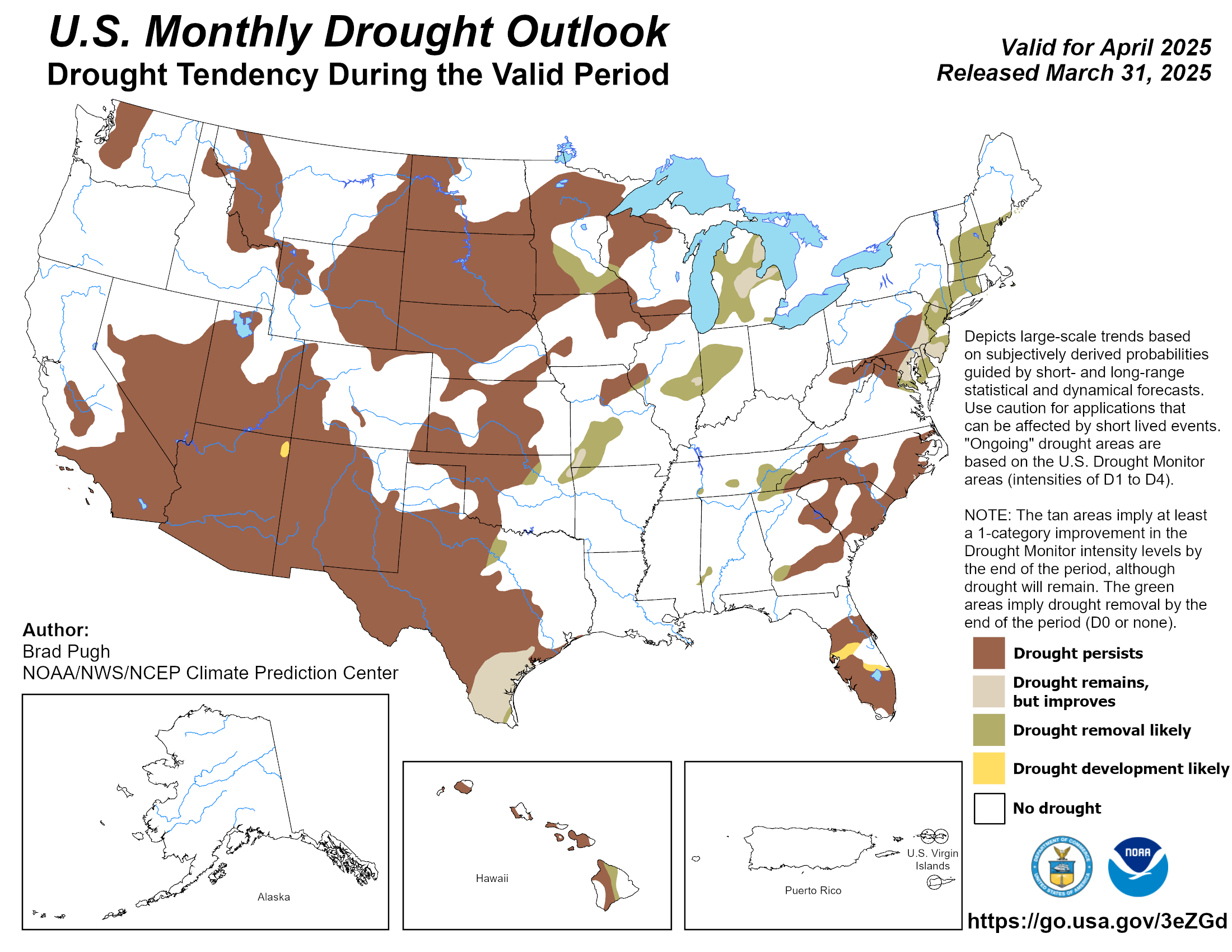
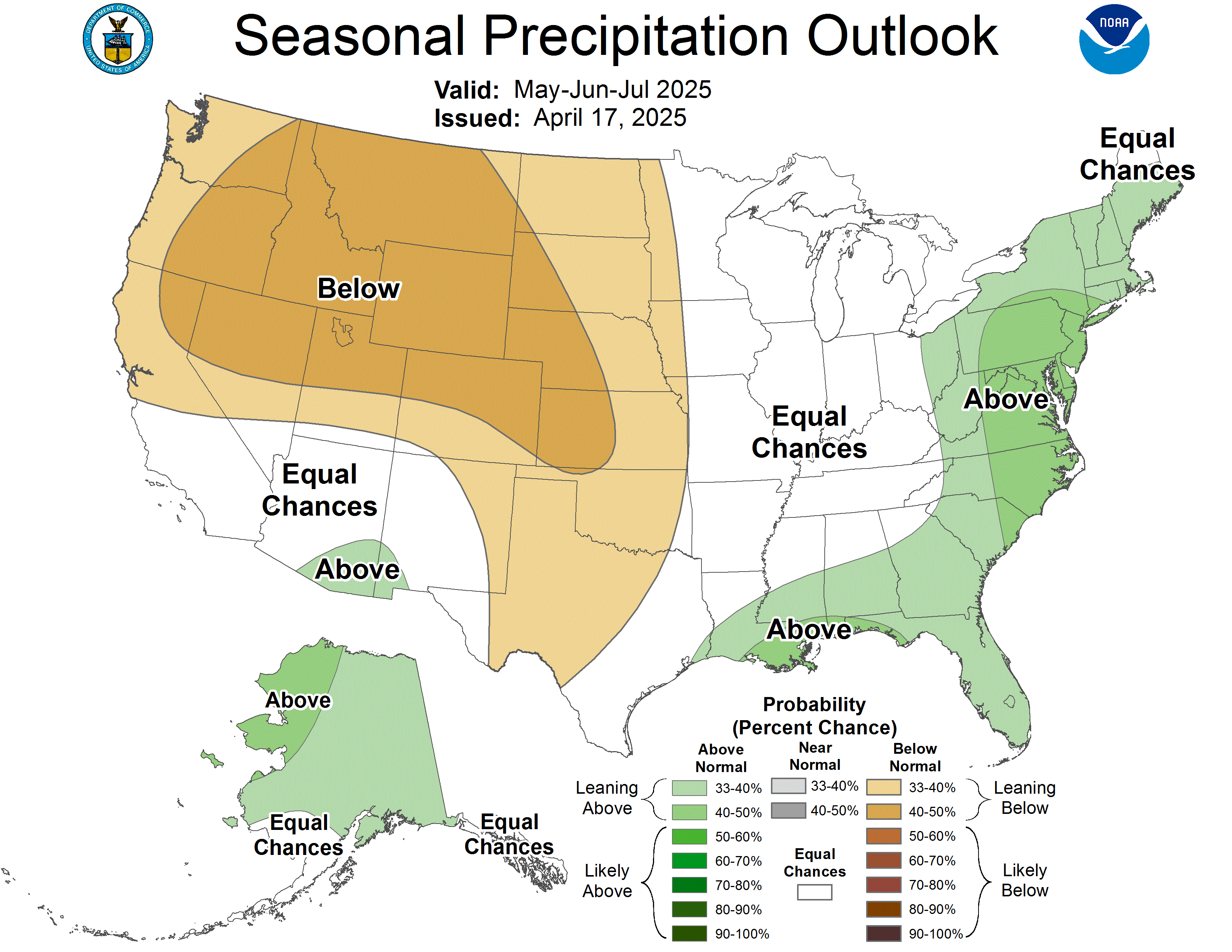
The new monthly U.S. drought outlook, out this morning, has good news for New Mexico:

February 2015 drought outlook

February 2015 drought outlook

But wait, I thought that idiot Fleck told us in Sunday’s paper that water managers were bracing for another dry year in New Mexico. What gives?

This:

The question of who might be hurt and who will avoid the pain illustrates the complex nature of New Mexico water, where drought is no one big thing, but rather a series of little things, depending on the needs of each group of water users.

If you’re irrigating from a ditch off of Embudo Creek, collecting Sangre de Cristo snowmelt, you’ve got a decent shot at a reasonable runoff this year. If you depend on river runoff from Colorado, like my friend Steve Harris, who runs a river rafting operation in northern New Mexico? See that brown blob extending north of the border atop the headwaters of the Rio Grande? Yeah, not so good, sorry Steve. Steve lives in essentially the same place as the Embudo Creek irrigators, but his water needs are completely different.

If you’re the city of Albuquerque, you’ve got plenty in storage and groundwater to fall back on. You’ll be fine, regardless of the map color on top of you. If you’re growing onions in the Hatch Valley of southern New Mexico, the color of the map where you live also doesn’t matter, but in the other direction. No matter how green it gets, an empty Elephant Butte Reservoir and lousy snowpack to the north means another lousy irrigation season unless we get some monster snows between now and spring. Local rains in Albuquerque and Hatch can help at the margins, but are not determinative of local “drought” conditions.


In New Mexico, precip where it matters not

tl;dr Despite good rain in the cities of New Mexico’s Rio Grande Valley this year (especially at my house!), it’s the snowpack that matters for state water supply. And the snowpack is not good.

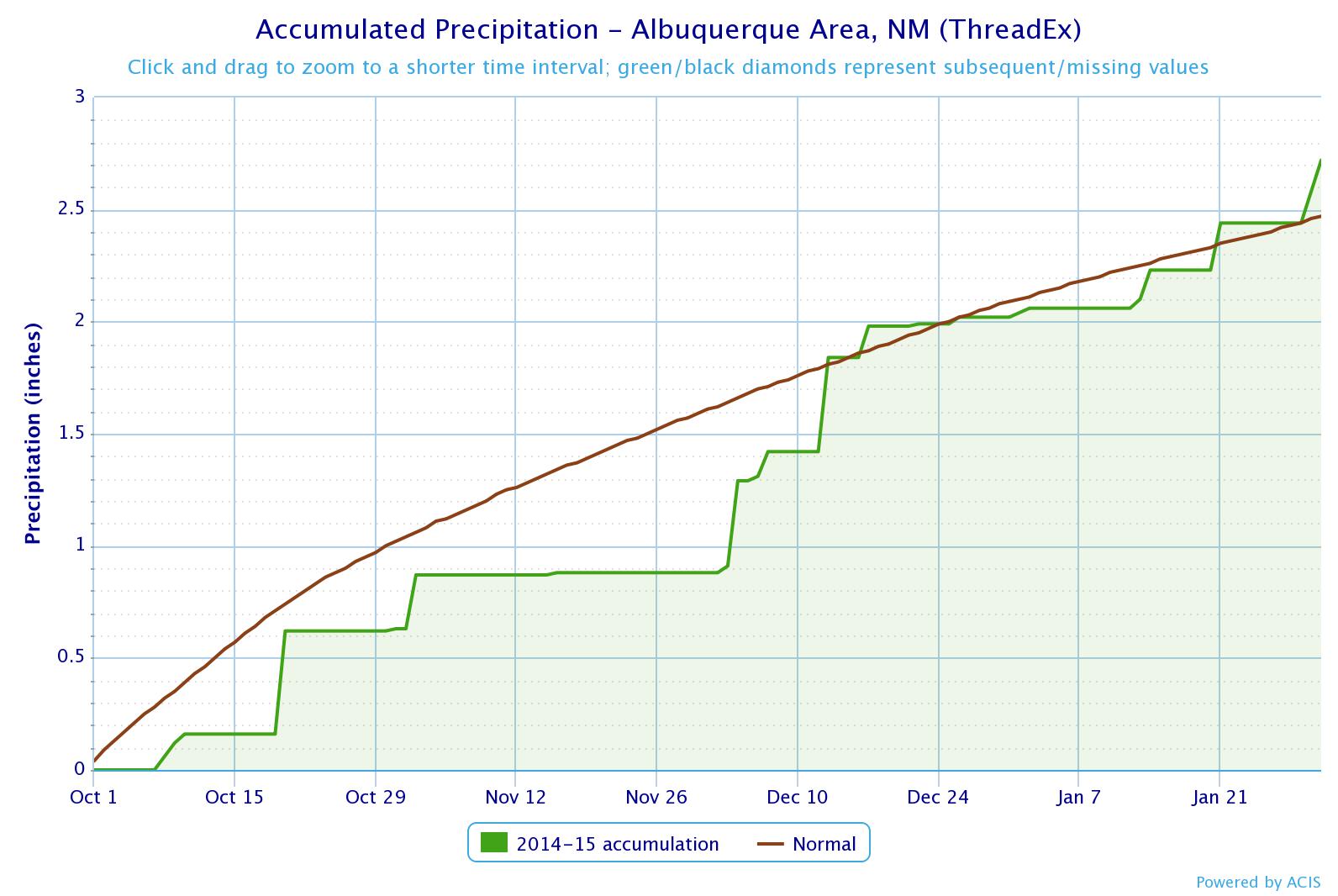
Albuquerque precip through 1/31/2015

Albuquerque precip through 1/31/2015

Longer: My backyard rain barrels are full, and the latest storm has brought Albuquerque’s water year precipitation (since Oct. 1) to 2.72 inches (6.9 cm), 10 percent above the mean. Unfortunately for the state’s water users, the amount that falls in the river valleys of central New Mexico means little. It is mountain snowpack that matters.

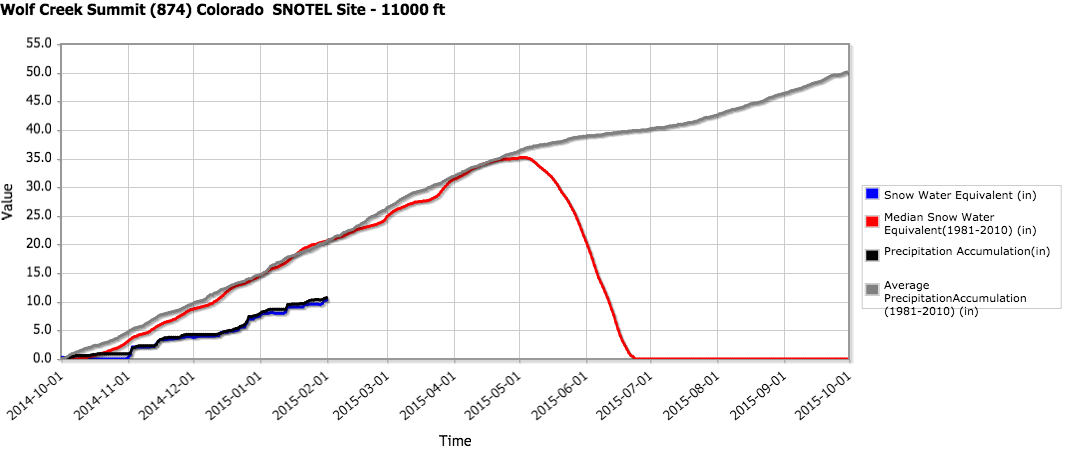
When I was out last fall with a group of university colleagues who were doing field work for a drought vulnerability study, one of the farmers we met with told us his quick rule of thumb for keeping tabs on how much water he thinks he’ll get in the spring: he watches the Wolf Creek SNOTEL site. It’s located in the mountains above Pagosa Springs in southern Colorado, and it’s snow up in that region that will fill (or not) the rivers and reservoirs he needs to irrigate his onions. There are a lot fancier forecast tools available that many of us stare at obsessively, but if you want a quick feel for how things are shaping, Wolf Creek’s a nice proxy. The red and grey lines are the median for this time of year, the black and blue lines are the actual – roughly half.

Wolf Creek SNOTEL, courtesy NRCS

Wolf Creek SNOTEL, courtesy NRCS

That’s why, despite a big storm just done (arguably the wettest of the year in New Mexico), I wrote this for Albuquerque’s Sunday morning driveway read:

For the fourth consecutive year, New Mexico water users are watching a skimpy snowpack in the state’s northern mountains and worrying about how much water they will have this spring and summer.

On the state’s largest rivers – the Pecos, the Rio Grande and the San Juan – the thin covering of mountain snow means less water in early forecasts.

“The runoff looks pathetic again,” said Greg Lewis, Pecos River basin manager for the New Mexico Interstate Stream Commission.

Key messages:

  • San Juan-Chama supplies, the Colorado River trans-basin diversion that brings water to the middle Rio Grande, is at risk for its second shortfall
  • Santa Fe and Albuquerque, with reserves and diversified supply, will be OK despite San Juan-Chama risk
  • Pecos farmers will be fine, thanks to full reservoirs from two consecutive years with huge late summer rains
  • The Lower Rio Grande, from Elephant Butte Reservoir down, is in a heap of hurt. Agriculture there, especially in the Hatch Valley, is vulnerable.

We’ll have runoff forecast numbers in the coming week, so I’ll come back with something more rigorous then. In the meantime, I guess bookmark Wolf Creek?