My semi-charmed life: Episode II

Isabel Sanchez, my editor for many years at the Albuquerque Journal, gave me this hourglass as a going away present. The joke has been that I really need a new watch, and that I was just nine months away from my 25th anniversary at the Journal, which is traditionally marked by the gift of a nice watch. I would point to my crappy old watch with rubber bands to catch the loose strap, and wonder whether it was worth hanging on another nine months.
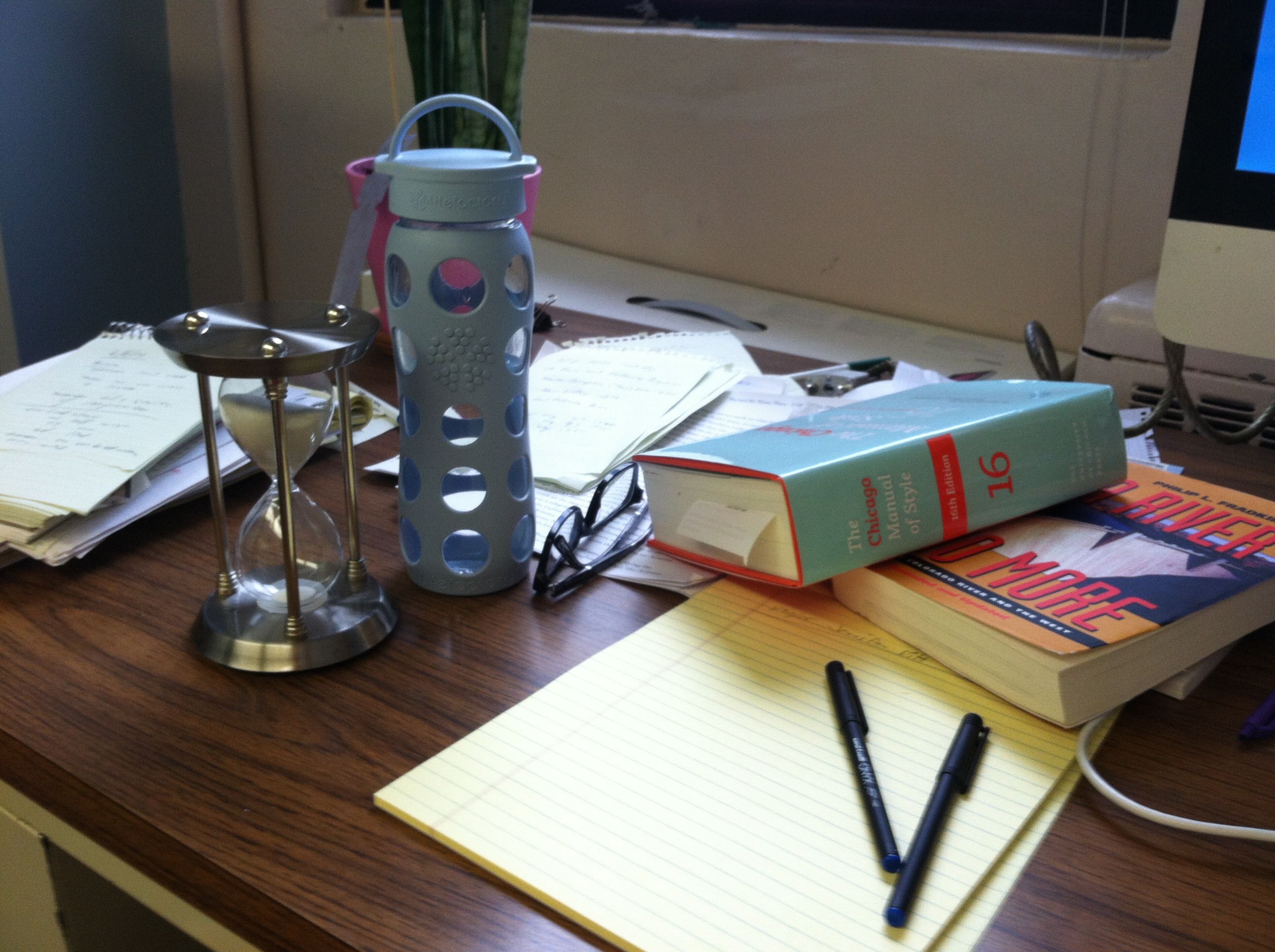
my desk, with Isabel's hourglass

my desk, with Isabel’s hourglass

If you are a writer who has worked long and deeply with a good editor, you will understand why my relationship with Isabel was the hardest thing to walk away from. She could see, through the mush of copy turned in on a newspaper’s unforgiving deadlines, what I was trying to say, and helped me say it.

Six years ago, as the newspaper business was reeling from the double whammy of a general economic shitstorm and the simultaneous implosion of our business model, I spent serious time taking an inventory of my skills and options. (Was it too late to learn welding?)

Watching the slide, Michael Hirschorn speculated on what the decline of newspapers meant for people like me:

It will … mean the end of a certain kind of quasi-bohemian urban existence for the thousands of smart middle-class writers, journalists, and public intellectuals who have, until now, lived semi-charmed kinds of lives of the mind.

I am happy that Hirschorn was at least partly wrong, because six years ago I concluded that nothing could be better for me than that semi-charmed life. But there were constraints to the newspaper form – a self-contained 600 or 800 words for a naive audience for whom I had to explain everything from scratch – that increasingly chafed.
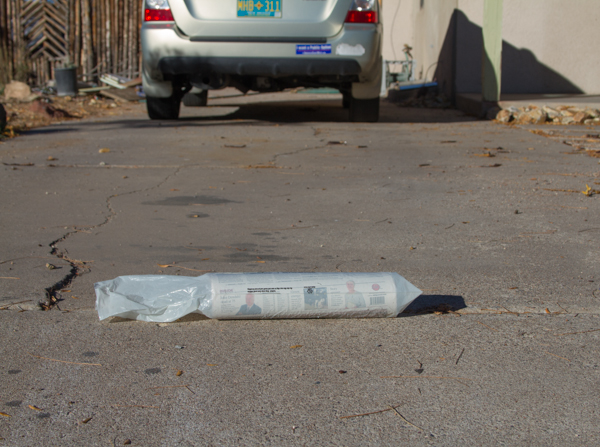
newspaper on driveway

newspaper on driveway

It’s a powerful medium. To have editors and designers and printers staying up all night, and a delivery team in the dawn hours to throw my words on 70,000 driveways is a remarkable privilege. I care deeply about water. Welding jokes aside, I looked hard six years ago at options working in government water policy jobs before deciding that there was no better way to help New Mexico sort out the problems posed by aridity and climate change than the seat I had and the 70,000 driveways to which it gave me access.

But there is a more complicated story I need to tell, that cannot fit in 600 or 800 words. I’ve been looking for a way to tell that story off and on for years. When I got serious about using a book to do it, I thought I could still do newspapering on the side. But it eventually became painfully clear that I didn’t have enough brain to do both.

A year and a half ago, University of New Mexico Water Resources Program Director Bob Berrens was kind enough to invite me into the program as an adjunct. As my life began shifting from newspaper to book, Bob offered me a university office and a title (Writer in Residence). There are not one but two libraries within a two minute walk of my office, and while campus parking is exorbitant (something I wholeheartedly support), the 35 minute walk from my home to my new office is delightful, and the bus ride is quicker than my old car commute.

So here’s the plan.

This blog will stay put. It’s evolved from a toy to a sketchbook for the ideas that are going into the book, and as the book work gets more serious this year, the sketchbook is critical. I think best when I write in public, and you all have been an invaluable sounding board over many years. I’ll also be working more with the Water Resources Program students, who are so smart and engaged in figuring out how to contribute to the work of better managing our scarce water.

I’ll be traveling a lot around the Colorado River Basin this spring working on the book – Las Vegas, Phoenix, Los Angeles, the Imperial Valley, west slope Colorado. I’ll give a shout out when I need help – I’m counting on y’all to tell me where I need to go and who I need to talk to.

And I’ve left my watch at home and put Isabel’s hourglass on my desk as a reminder that I still have deadlines, but they’re more fluid now – of my own making and under my own control.
ACLU steps into Gila Case

As near as I can tell, the American Civil Liberties Union has no particular stake in water policy. But the venerable champion of free speech is wading into the rancorous New Mexico debate over the possible diversion of water from the Gila River. Lauren Villagran writes (behind surveywall):

The American Civil Liberties Union said Wednesday it will defend former Interstate Stream Commissioner Norm Gaume in the countersuit launched against him by the agency he once led.

Gaume sued the Interstate Stream Commission in October, alleging the commission violated the Open Meetings Act in its deliberations regarding the future of the Gila River. The commission later countersued, claiming Gaume intended to hold up a decision that had to be made by the end of last month.

“The ACLU feels this is a very dangerous precedent that if allowed to stand could silence New Mexicans and render transparency laws meaningless,” said Daniel Yohalem, a Santa Fe civil rights attorney working with the ACLU to defend Gaume.

More background here on the issue from former Albuquerque Journal reporter John Fleck.

a “literary startup”

I like how Mary Z. Fuka described yesterday’s John Fleck 2.0 launch party – I’m a “literary startup“. I need a clever name with some sort of capital letter in the middle or something. And a logo. I need a logo, right?

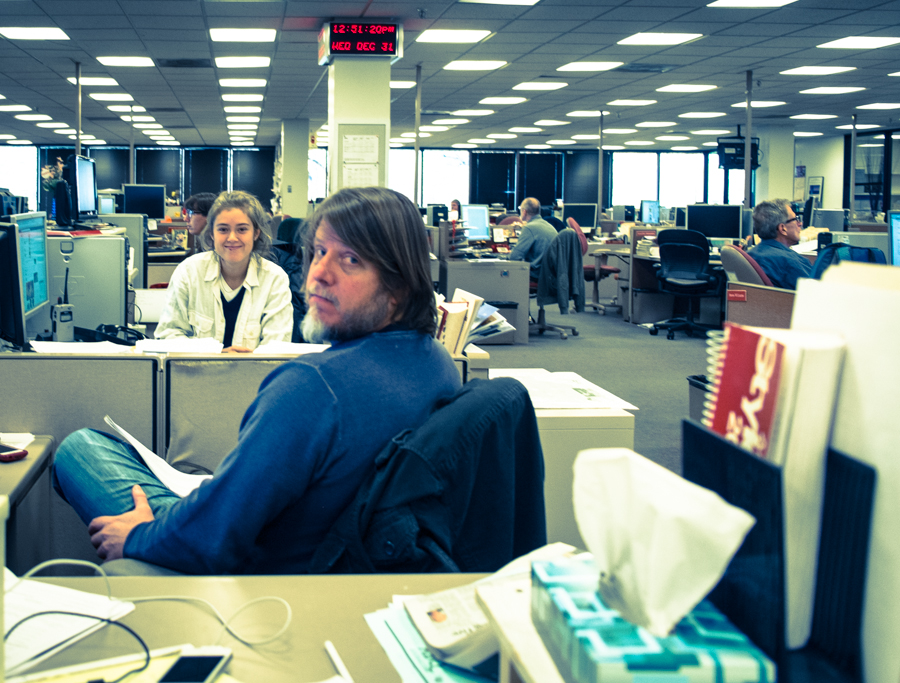
Nicole Perez, Robert Browman, the desks next to mine, Dec. 31, 2014

Nicole Perez, Robert Browman, the desks next to mine, Dec. 31, 2014

This morning, the day after I finished up the last stories of a 30-plus year career in daily journalism, feels oddly normal – checking the drought monitor, reservoir levels at Elephant Butte, the latest storm forecast. But I will so very much miss this thing you see to the right.

I had an old can of Spam on my desk at the Albuquerque Journal, which arrived some years ago in some sort of ridiculous press kit trying to get our attention regarding something ridiculous. I’ve no memory of the thing we never covered, but I saved the Spam.

It was, the joke went, my emergency supply. If the shit ever really went down – nuclear war, societal collapse – the Spam would buy me one more day of journalism. It is well past its 2007 “best used by” date, but when we’re talking Armageddon and certain death anyway, so what if the Spam’s a little old?

That the pull of what I’m doing now – writing a book, devoting my whole brain to learning and thinking about the Colorado River – was strong enough to pull me away from those people and that endeavor should tell you a great deal about how excited I am about my new project. Because I love these people – the two in this picture and so many more, the shared adventure of making a newspaper every day. Every day! So hard to leave that.

I left the Spam with Nicole with the confidence that, when the balloon goes up, she’ll be there for you.

Hoover Dam, sinking

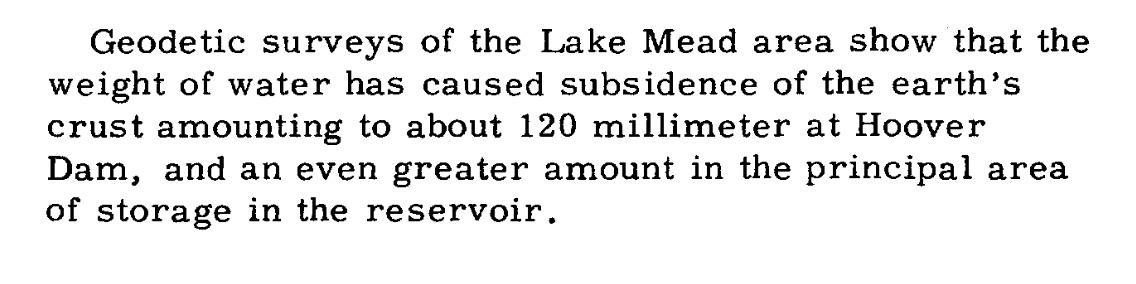
Fourteen years after Hoover Dam’s gates were closed, U.S. Geological Survey scientists found earth’s crust beneath the dam had sunk 4 inches because of the weight of its impounded water:

Courtesy USGS

Courtesy USGS


That’s from Geological Survey Circular 346, First Fourteen Years of Lake Mead, 1954 (pdf), ht Kyle House

“This is not a wet place.”

The University of Arizona’s Mike Crimmins:

But the real answer might be for Arizonans and other people of the southwest to adapt to living under drought conditions.

“We expect it to be a lot wetter than it is and it should be,” Crimmins said. “Just look around, the landscape tells the story. This is not a wet place. When it is wet we should just be thankful that it is and expect that most of the time it will be drier than our expectations.”

Importing California water

almonds, for sale in Costco, Albuquerque

almonds, for sale in Costco, Albuquerque

At Costco over the weekend in Albuquerque, New Mexico, I snapped this iPhone picture of California almonds, lots of them. I was planning the joke even before I took it about imported California water, on sale here in the desert. Which is true. Takes a lot of California water to make these almonds.

But upon reflection, I realized that pretty much everything sold in Costco comes from somewhere else, and water was used in its production process. So it’s really a store full of imported water. The almond schtick is just an obvious case.

The Hard Path: moving water costs a lot

Brett Walton reports this morning on the initial cost estimates for a pipeline/canal thingie to move Missouri River water to western Kansas:

By all measures, it would be a mammoth undertaking. A 360-mile canal to move Missouri River water uphill across Kansas would cost $US 18 billion to build and $US 1 billion per year to operate, according to a U.S. Army Corps of Engineers technical report. That figure includes power stations and pumping stations, but does not include the cost of a canal network to deliver water to individual farms. Design, administration, and interest on the loans would add another $US 10 billion.


We don’t get to decide nature’s boundaries

My Albuquerque Journal colleague Win Quigley, intrigued by the coyotes in his Albuquerque Country Club neighborhood, near downtown, visited with the Bosque Environmental Monitoring Program’s Dan Shaw and wrote this:

[C]onsider the country club neighborhood, Shaw said. Kit Carson Park and the country club golf course abut the irrigation ditch, which abuts Tingley Beach, which abuts the river ecosystem. The park and the golf course are lush and regularly watered. Just across a little bit of concrete, old lawns are still watered, trees are planted, gardens are tended.

“This is prime real estate for wildlife,” Shaw said. To a porcupine or a coyote, this urban neighborhood is merely part of the range, an extension of the bosque itself. “You guys are putting welcome mats out to critters who don’t honor boundaries.”

Dan’s Eco-tracking: On the Trail of Habitat Change (Barbara Guth Worlds of Wonder Science Series for Young Readers) is great.

New Mexico water policy and the problems of a part-time legislature

A few years back, I put on my “water beat reporter” hat and went to Santa Fe for the spring legislative session to track some bills that I found interesting. The newspaper has a team of skilled legislative specialists who I’ve always been able to lean on, but it was fun to bring my water beat background into that world and see how the two fit together.

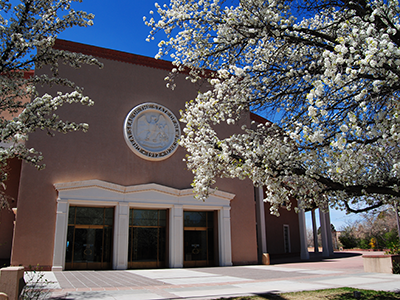
New Mexico state capital building, courtesy New Mexico legislature

New Mexico state capital building, courtesy New Mexico legislature

I spent a lot of time in hearings, and hanging out in the hallways and lobbies (“lobbyists”!) and came away with the realization that we simply lack the institutional capacity for the huge range of questions that we ask our system of legislative governance to deal with.

This really hit home when I tried to arrange an interview near the end of the session with Peter Wirth, a smart Democratic senator from Santa Fe who was working on some of the water legislation that interested me. I met him in the hallway behind the Senate floor during an afternoon voting session for what may count as one of the strangest interviews of my life. We’d talk for a few minutes, and then be interrupted when the Senate clerks would stick their heads into the hallway and shout “Voting!”. And all the legislators in the hall would run back in to vote, then return to finish their conversations.

Over a half hour or 45 minutes of conversation, we must have been interrupted six or seven times while Wirth had to yank his attention away from our topic to some other bit of governance. Finally, Peter had to leave for good, because they were beginning to debate a complex state pension issue that required his full attention.

I wandered back upstairs to the press gallery, and looked on as Peter delivered a crisp, passionate, extremely thoughtful floor speech on the pension issue. He had pivoted without time to catch his breath from a deep and thoughtful discussion of water policy to a deep and thoughtful discussion of an entirely different question, which in turn was only one of many that we’ve asked Peter and his colleagues to cope with.

We don’t pay him for this. We don’t pay for staff to help him with this. Once I watched the ebb and flow of this for a two month session, I came away unsurprised that the institution is incapable of trying to rewrite 19th and 20th century water laws to meet 21st century problems. They have to wrestle with a budget, and difficult education questions, and energy policy, and environmental regulations, and (substitute here the thing that you really care about that they haven’t quite gotten their arms around). By my count there are already 31 pre-filed bills for the coming session that deal in some way with water. I’m a professional water nerd, paid (sorta) full time to work on this stuff, and I can’t keep all that straight. How can they?

People who agree with me about the problem suggest two overlapping solutions.

One is to pay legislators, so it is not solely the province of people with the privilege of taking a few months off now and then to do the public’s business. The second, which I think could be even more important, is to create paid legislative staff, so guys like Peter could, for example, have a water policy expert at their disposal. There is some existing paid staff structure, but it’s not enough, and it forces legislators to rely instead on lobbyists as a sort of informal technical support system. That is less than ideal.

Heath Haussamen has a great piece in New Mexico In Depth’s big new legislative package that gets at this problem:

Alan Webber, who made a career in the business world, noted the speed that society moves today. The conversation about reform must start with the premise that the world has changed, said Webber, who ran unsuccessfully for governor in 2014.

“The speed of change is faster. The world of technology is faster,” he said. “Lots of things that seemed self-evident (when New Mexico became a state in 1912) are much more complicated. We really ought to equip ourselves with the legislative structure to deal with these problems, to get ahead of them.”

(And, as an aside, the whole NMID package is worth a look.)

Transparency and the Colorado River Compact

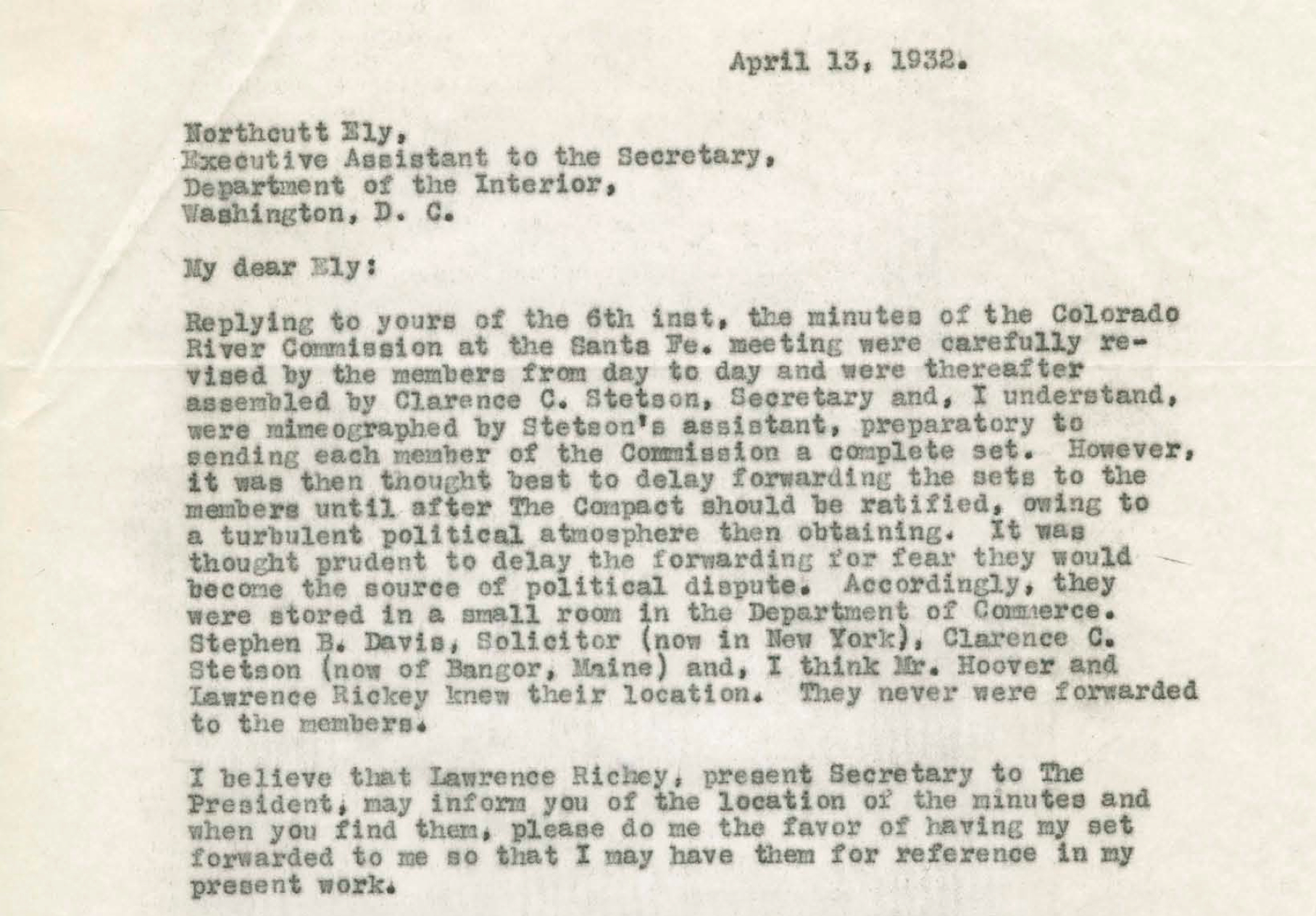
The negotiation of the 1922 Colorado River Compact governing the allocation of water from the West’s great river, and the ratification process that followed, was a politically delicate process.

Precisely how delicate is made clear in a fascinating exchange of letters 10 years after between Colorado attorney Delph Carpenter (the compact’s primary architect) and Norcutt Ely, who at the time was executive assistant to Interior Secretary Ray Lyman Wilbur.

The Compact Commission’s 27 sessions were largely closed affairs, though detailed minutes were kept. Ely wrote Carpenter in 1932 inquiring about their whereabouts:

Would you be good enough to tell me where I might find minutes of the meetings of the Colorado River Commission which led up to the execution of the Colorado River Compact.

Carpenter’s reply is fascinating. The minutes had been “carefully revised by the members from day to day”, Carpenter wrote, and then mimeographed with the idea of sending a set to each member of the Commission. But that never happened:

It was then thought best to delay forwarding the sets to the members until after The Compact should be ratified, owing to a turbulent political atmosphere then obtaining. It was thought prudent to delay the forwarding for fear they would become the source of political dispute.

Instead, they were stashed in a “small room” at the Commerce Department. Carpenter suggests several people who might know where they were, and that they be forwarded to the state representatives “before they become lost”.

Delph Carpenter to Northcutt Ely, April 13, 1932, courtesy Colorado State University Library

Delph Carpenter to Northcutt Ely, April 13, 1932, courtesy Colorado State University Library

 Thankfully, they were not lost. The University of Colorado has published them in full.

I found the Carpenter-Ely letters in the Colorado State University digital collection.