The cheapest source of new water is being less wasteful with old water.
“Sir: You have made me unhappy”
From a letter to Franz Kafka:
Sir,
You have made me unhappy. I bought your ‘Metamorphosis’ as a present for my cousin, but she doesn’t know what to make of the story.
As quoted in the Economist’s review of Kafka: The Years of Insight
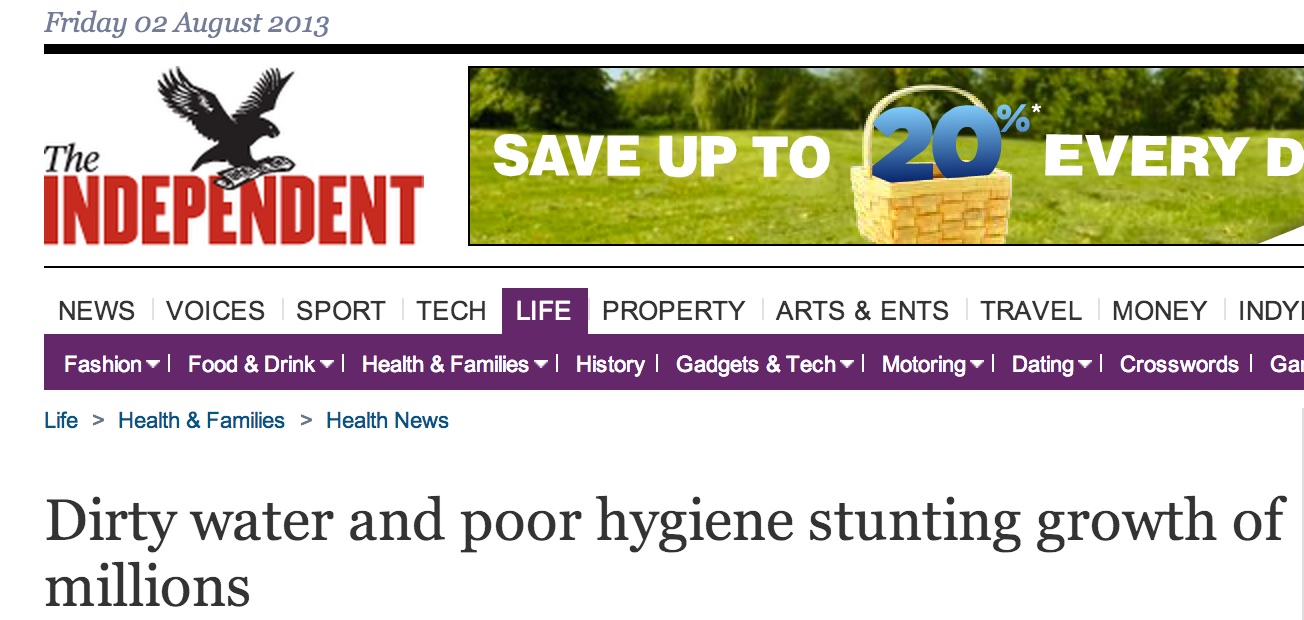
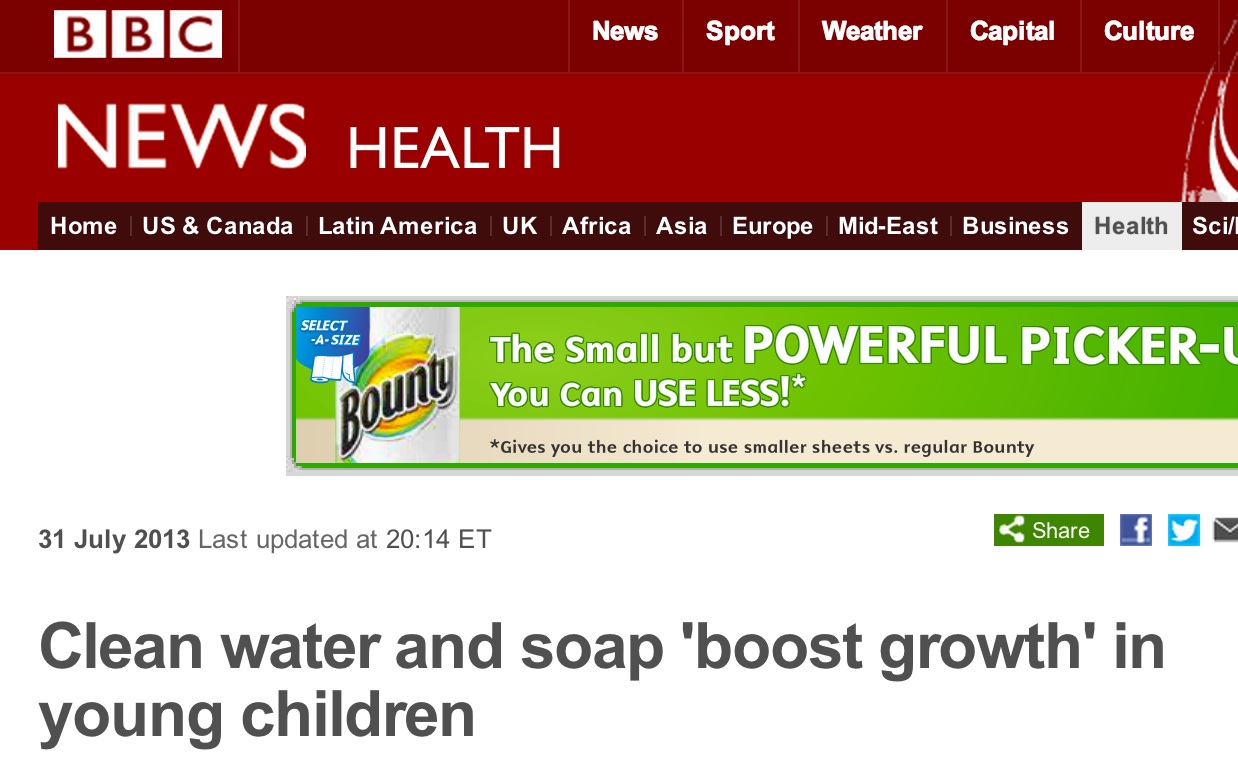
Framing clean water and kids – is the glass half dirty or half clean?
The Independent – Dirty water and poor hygiene stunting growth of millions:
Independent
The BBC – Clean water and soap ‘boost growth’ in young children:
BBC
Fourteen years of Colorado River Basin drought
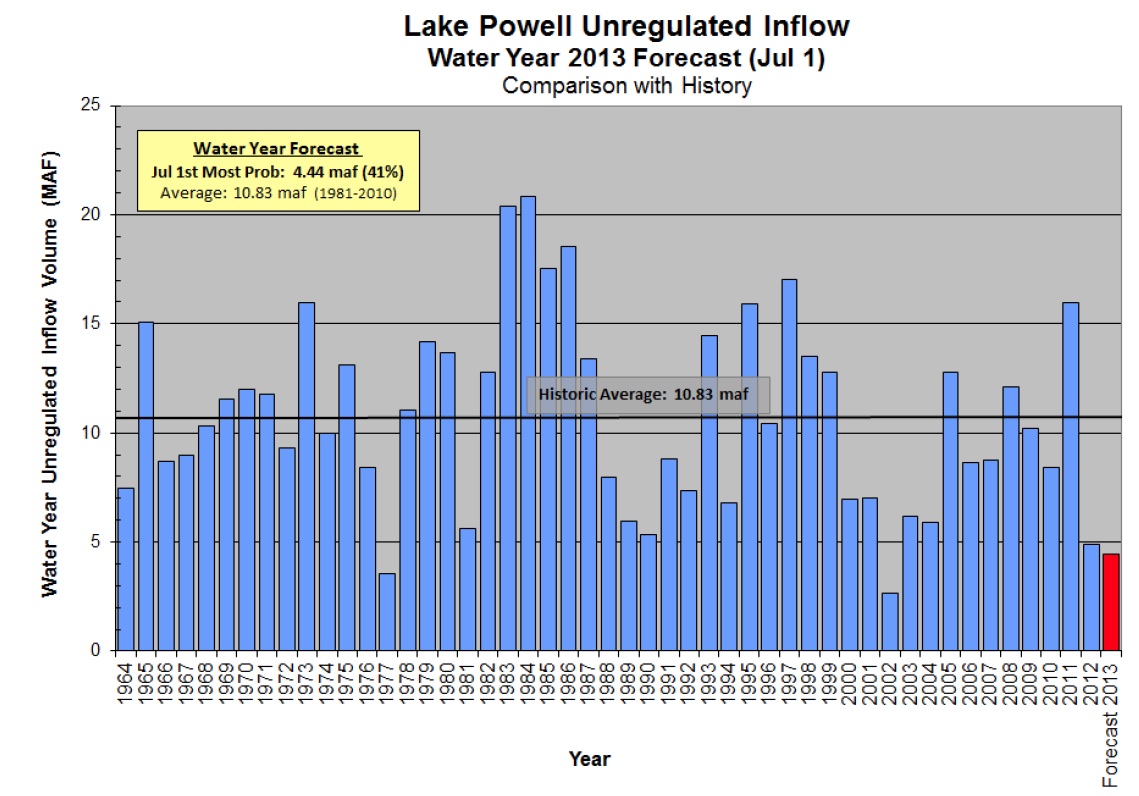
Here’s a striking graph distributed this week at the U.S. Bureau of Reclamation’s 2014 Colorado River Annual Operating Plan consultation meeting in Las Vegas:
Lake Powell Unregulated Inflow, courtesy USBR
That’s annual unregulated* inflow into Lake Powell on the Colorado River. A couple of things worth noting:
- 2012 and 2013 are two of only four years since Glen Canyon Dam was completed with inflows less than 5 million acre feet
- Only three of the 14 years from 2000 to the present have had above average inflows into Lake Powell
- Three of the four lowest years on record have occurred during the current drought
This data isn’t new, it was just striking to me to see this graphical representation.
* “unregulated inflow” involves an estimate of what the natural inflow into Lake Powell would have been absent upstream dams and diversions
Mike Taugher, a journalist’s journalist
Amid some tears today over the tragic death of my former colleague Mike Taugher, I found a couple of stories he wrote about California water worth sharing. Mike was the Albuquerque Journal’s environment beat reporter back in the 1990s, and a nicer colleague you couldn’t have found, a talent, a joy to work with, a mensch.
He’d moved on to California, where from his perch at the Contra Costa Times he’d become one of the most useful and productive reporters covering California water before he left the business last year to go to work for state government.
Here’s a great example of his work, bird-dogging the connections between billionaire “farm baron” Stewart Resnick and Sen. Dianne Feinstein:
Acting at the request of Beverly Hills billionaire and Kern County water baron Stewart Resnick, U.S. Sen. Dianne Feinstein is seeking a high-level scientific review of new endangered-species permits that farmers and others blame for water shortages.
It’s juicy stuff, an admirable example of a dogged journalist trying to hold power accountable on behalf of the people. It’s easy to understand why that sort of journalism matters, and it’s the kind of work upon which we often heap praise.
Here’s an entirely different sort of piece, this about the endangered Delta smelt:
[W]hy should anyone care if a nondescript little fish goes the way of the dodo?
After all, Delta smelt do not make the A-Team of endangered species, the so-called charismatic megafauna — bald eagles, grizzly bears, otters, whooping cranes and the like — that people tend to want to protect, if only because they look magnificent in magazines and nice on neckties.
This is not the sort of flashy investigative work that wins plaudits (of which Mike had won many). This was explanatory journalism at the top of its craft, a deft piece of work helping us make sense of our world.
That Mike could do both things so well (and with a cheerful modesty that was a delight to be around) is why he was a journalist’s journalist.
the irrigation efficiency dilemma
In the arid west, increased irrigation efficiency is one of the most commonly suggested solutions to our water problems. But Jay Lund and Thomas Harter point out the dilemma:
In many areas, drought-year groundwater supplies depend substantially on irrigation inefficiency in wetter years, when surface water is available and used by farmers. Ironically, local inefficiency often improves regional water use efficiency and sustainability. However, excessive groundwater pumping causes long-term continual decline in groundwater levels (“overdraft”) and irrigation inefficiency increases salt and nitrate loads to groundwater. There are few perfect solutions in water.
Mixed bag.
ditch, farm, mountains, sky

Valle de Oro National Wildlife Refuge (formerly Price’s Dairy), south of Albuquerque NM, July 28, 2013, by John Fleck
beavers
There’s a little concrete check dam in Albuquerque’s riverside woods at the bottom of a pond built by humans as wildlife habitat. Among the wildlife that has taken up residence is a family of beavers, who have built a palatial home on the island in the middle of the pond. But they seem dissatisfied with the workmanship of the dam, and have been making their own helpful additions (the stick in the center has characteristic beaver chew marks on the upper end):
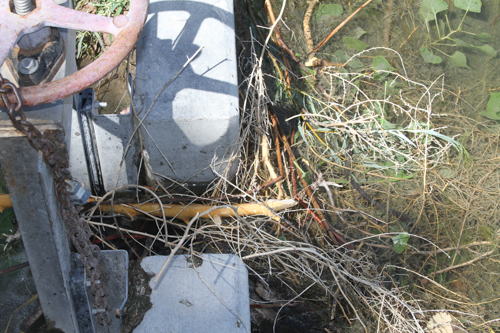
Bosque beavers, dissatisfied with human dam construction, making their own slight modifications:
Praise be to the gods of storytelling
update: A helpful reader had a correction: Hub Moeur was Gov. Moeur’s, nephew, not his son. Rats.
previously: This evening, I snapped to the fact that J.H. “Hub” Moeur, the Arizona attorney who as chief counsel for the Arizona Interstate Stream Commission filed the 1952 brief in the seminal Colorado River case Arizona V. California (because Arizona was afraid California would take too much Colorado River water) was the son of B.B. Moeur, the Arizona governor who in the 1930s dispatched National Guard Troops to block construction of Parker Dam (because Arizona was afraid California would take too much Colorado River water).
As an old newspaper colleague used to say, you can’t make up shit that good.
the first rule of journalism
always get the name of the beer:
On my way home from work, I picked up a six-pack of Saison 88, a beer produced by Santa Fe Brewing Co. The advertised alcohol content is 5.5 percent.