Two hundredths of an inch of rain this evening was enough to put the first water in our new rain barrels!
Two hundredths of an inch of rain this evening was enough to put the first water in our new rain barrels!
To be clear: I think the Bureau of Reclamation’s announcement today that it is curtailing releases from Lake Powell in 2014 is a big deal. But one of the members of my brain trust (journalism is a mashup – I just repackage the ideas of people much smarter than myself) points out that there’s an interesting argument to be made that the shortfall that has us all doing the hair-on-fire thing is not really all that large.
Under the Law of the River (the hairball of rules governing Colorado River operations), the states of the Upper Basin are required to release 8.23 million acre feet per year* from Lake Powell. But because of year-to-year variability, it’s calculated as a ten year rolling average. That allows for excess water during wet times and reduced deliveries during dry times.
Here’s the actual deliveries over the last decade, including the estimated 2014 curtailment to 7.48 maf:
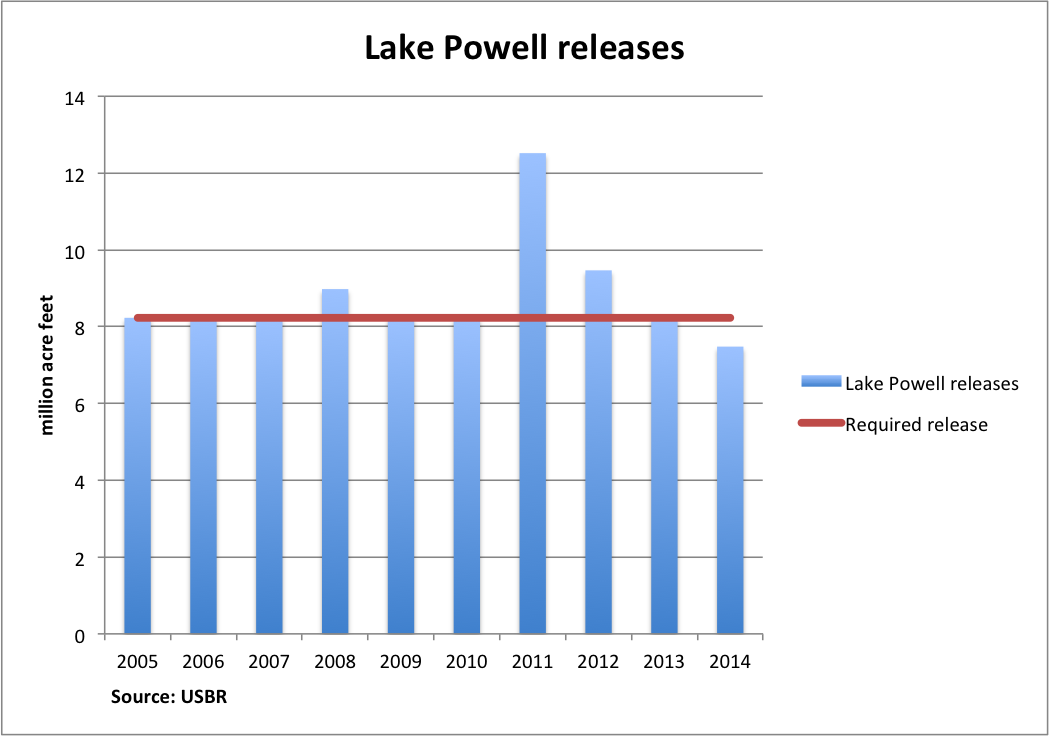
Powell releases
You can see that for nine of the ten years, deliveries have been at or above 8.23 maf. In 2011 and 2012, they were over by quite a bit. I like to call it “bonus water“. Here’s another way of looking at the numbers, a bar chart showing simply the over- or under-delivery relative to the 8.23 maf standard:
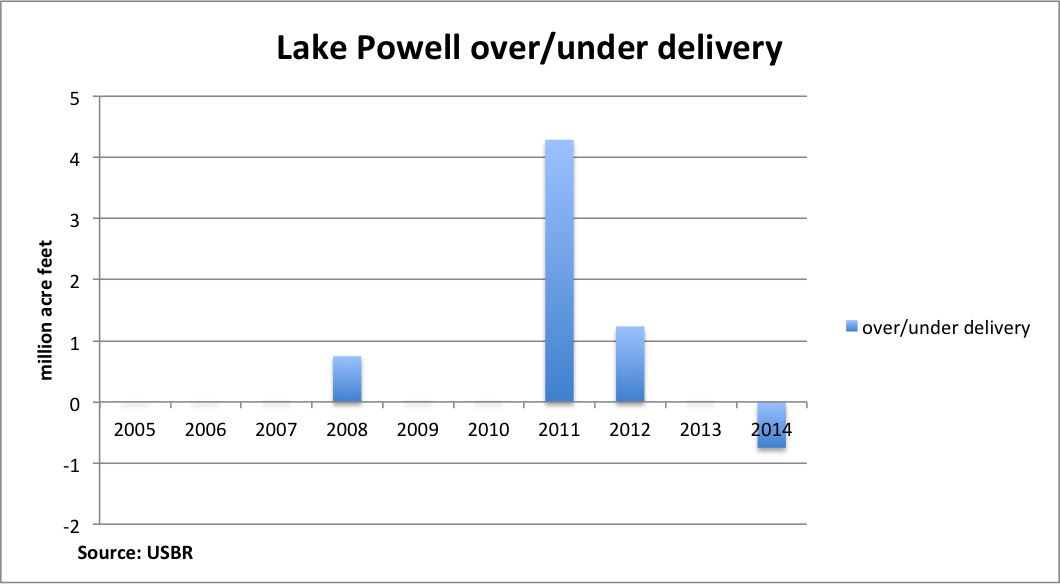
Powell over/under-delivery
You can see that the sticky-up bits in 2011 and 2012 are a lot bigger than the sticky-down bit in 2014. So really, my brain truster has a point. The shortfall out of Lake Powell in 2014 is not all that large compared to the recent over-deliveries. Or maybe this really makes the case that the Lower Basin is not living within its means, where “its means” are defined as 8.23 maf per year. (Related snark here.)
* Stipulated that not everyone agrees the Upper Basin is required to deliver 8.23 maf. It might really only be 7.5 maf. Who knows? (pdf)
BOULDER – With the Colorado River Basin gripped by extreme drought, federal water managers Friday announced historic water conservation measures.
Supplies in New Mexico, one of seven states that depend on the river’s water, will be untouched by the moves. But experts said the move is a warning that demand is outstripping supply throughout the basin.
“What we’re facing here is a truly historic drought,” said Assistant Secretary of the Interior Anne Castle, speaking at a meeting of Colorado River managers at which the shortage declaration was a major topic of discussion.
Castle said natural drought, made worse by climate change, requires “new thinking” to deal with the region’s water problems.
The Bureau of Reclamation is going to tell us Friday that there’s not very much water in Lake Powell, and that as a result releases from Powell will be curtailed in the coming year, which sets off a cascading set of effects downstream. I took a crack at explaining this here, but Brett Walton has really done the journalistic heavy lifting to explain what it all means. I don’t have much to add to Brett’s analysis, which is rich and detailed, except for this simple takeaway message: You’ll hear from and see a lot of people in coming days running around like their hair is on fire about this. Chill. As Brett’s piece explains, this is an orderly process.
From the Telegraph:
Water companies across a third of the country will be required to consider fitting all properties in their areas with a water meter and billing customers for every drop they use.
Under the order, approved this week by Owen Paterson, the Environment Secretary, some family water bills could double.
It follows warnings from the Government’s environment specialists that climate change and England’s growing population will put the future supply of water in reservoirs and rivers under “serious stress”.
This innovation is apparently based on some clever new work by a British academic named Adam Smith who has just recently discovered that consumption of a scarce good is influenced by the price charged. The striking implication is that if you charge people a flat rate for a commodity like water, regardless of how much they use, some people will install “power showers”.
From Juliet McKenna, another example of the lengths to which southwestern municipalities will go to adapt to shrinking water supply:
LA’s plan calls for building one of the country’s largest groundwater treatment systems at one of its largest Superfund sites. Groundwater in the San Fernando basin has elevated levels of chromium, perchlorate, nitrates, and trichloroethylene — the result of decades of industrial operations. Ultimately, the two required treatment plants are expected to be operational by 2022. By 2035, the utility expects that this treated groundwater can be used to reduce the amount of water it imports by a factor of one-half.
Building treatment plants is a costly proposition, but the alternative — relying on imported supplies — is no bargain either. MWD’s water wholesale delivery rates, which have nearly doubled since 2006, will approach $900/AF in 2014. The project will be funded by ratepayers through low-interest bonds.

I’ll be on the radio Saturday at 9 a.m. with Katie Stone on KUNM’s Children’s Hour (one of the great Albuquerque media institutions) explaining Albuquerque’s aquifer. Streaming live on line or on your mobile device.
From Jay Lund, a comment on my post last week about low flows into that is worth elevating:
Perhaps a bigger issue is that average unimpaired flow appears to be < 11 maf, but total allocations are more than 16 maf/year (1.5 maf/yr for Mexico and 7.5 maf each for the upper-basin and lower-basin states). Mexico and the lower basin states already use their full allocations. As upper basin state use grows, water storage in the amazingly large Colorado R. reservoirs will diminish over time. We will blame droughts and climate change, but overallocation is a more than equal contributor to the problem. Improving allocations will have large economic benefits.
I got what may be my all time favorite reader comment a couple of weeks back when I tried to explain that the summer rains New Mexico has been getting do not mean our drought is over:
This article is miserablism at its absolute worst. How about looking at important progress in reservoirs like Conchas where water levels are up 6 feet – during the summer months? It’s pretty obvious you don’t reverse a ten year drought in a month, but looking at Elephant Butte and concluding nothing beneficial has occurred, when the rainwater hasn’t even made it that far yet, is just Fleck being his usual dismal self. If you don’t like living in a desert, why don’t you move??
I must admit I was a little worried when it started raining the first week in July. But once I realized I could write about storms ruining alfalfa and flooding neighborhoods and twist the knife with the “but the drought’s not over!” taunt, I knew I was golden. This is a once-in-a lifetime journalistic opportunity. Fleck the Miserablist, at your service.*
I loved the comment so much, I wrote the same story a week later, but my trolling failed.**
We got 3.09 inches (7.8 cm) of rain at our Albuquerque house in July. That’s our wettest month since August 2008. Still just 63 percent of average for the water year, but much better than it was.
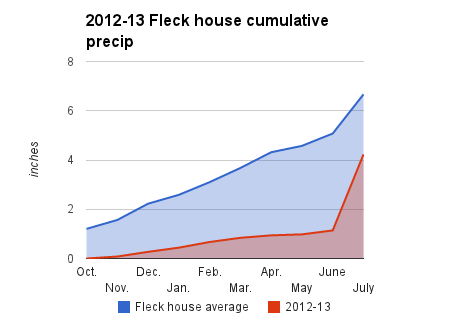
2012-13 water year, Heineman-Fleck house
* This paragraph is a joke. Its purpose is to poke fun at me and my profession, incentivized, as Danah Boyd argues, by fear and the attention economy.
** This paragraph also is a joke. I wrote the second story because the drought really is serious, and all available evidence suggests the rains have helped little, and public understanding seems an important thing. Plus fear economy.