Stuff I wrote elsewhere: oil and water

From the morning paper, the fruits of a trip to Farmington, in northwest New Mexico, for a legislative hearing on water. Among the items on the agenda, water use in oil and gas production:

The problem, according to Egolf and others, is that the state lacks comprehensive data on how much water is being used now in hydraulic fracturing operations, how it has increased in recent years, and how it might rise as operations expand. That question is especially pertinent in the San Juan Basin, which oil and gas experts say could be on the verge of a major increase in hydraulic fracturing operations.


Global groundwater trends – not encouraging

Cynthia Barnett has an article in the fascinating new environmental publication Ensia about the problems we face globally because we’re pumping water out of the ground faster than nature puts it back in. One of the things I like about Cythia’s writing on water is her optimistic, solutions-oriented approach:

The solutions to overdrawn aquifers are similar to those for overdrawn bank accounts. Foremost is reining in overconsumption. Cities and farmers alike have shown that we can live with less water. Facing severe groundwater depletion in the 1980s, residents of Tucson, Ariz., have managed to reduce their daily Big Gulp from 200 gallons per person in 1985 to 130 gallons today. At the same time, the city has transitioned away from mining the aquifer as its primary source. Three-fourths of Tucson’s water supply in 2003, groundwater now accounts for less than half — with the remainder drawn from the Colorado River and reclaimed sewer and industrial sources.

And this:

The real test is whether people already in conflict can come to share and restore aquifers. Contrary to conventional wisdom, the Pacific Institute, which has tracked water conflict throughout human history, found that water has more often been a source of international cooperation than of war.


Fallowing – the path of least resistance?

Antoine Abou-Diwan had an interesting story over the weekend in the Imperial Valley Press suggesting fallowing, rather than more sophisticated agricultural water conservation approaches, has become the default standard for water savings in the Imperial Valley needed to meet the Imperial Irrigation District’s obligations under California’s Quantification Settlement Agreement.

Under the QSA, water saved in Imperial is transferred to coastal Southern California for urban use. This is all part of California’s Byzantine efforts to live within its 4.4 million acre foot Colorado River allocation:

Under the terms of the QSA, the IID will eventually transfer to the San Diego County Water Authority 200,000 acre-feet of water annually, and more than 100,000 acre-feet to the Coachella Valley Water District and Metropolitan Water District.

The transfer should be sustained by water that is conserved through improvements to the IID’s system and on-farm water-efficient irrigation practices, like sprinklers and tailwater recovery systems, all funded with millions of dollars from the recipients of the IID’s water.

Yet, 10 years into the transfer, most of the water being conserved comes from fallowing, whereby a field is taken out of production to conserve the water that would ordinarily irrigate it.

If you’re interested in the complexities of making conservation work in a water-stressed West, the full article is worth a read.

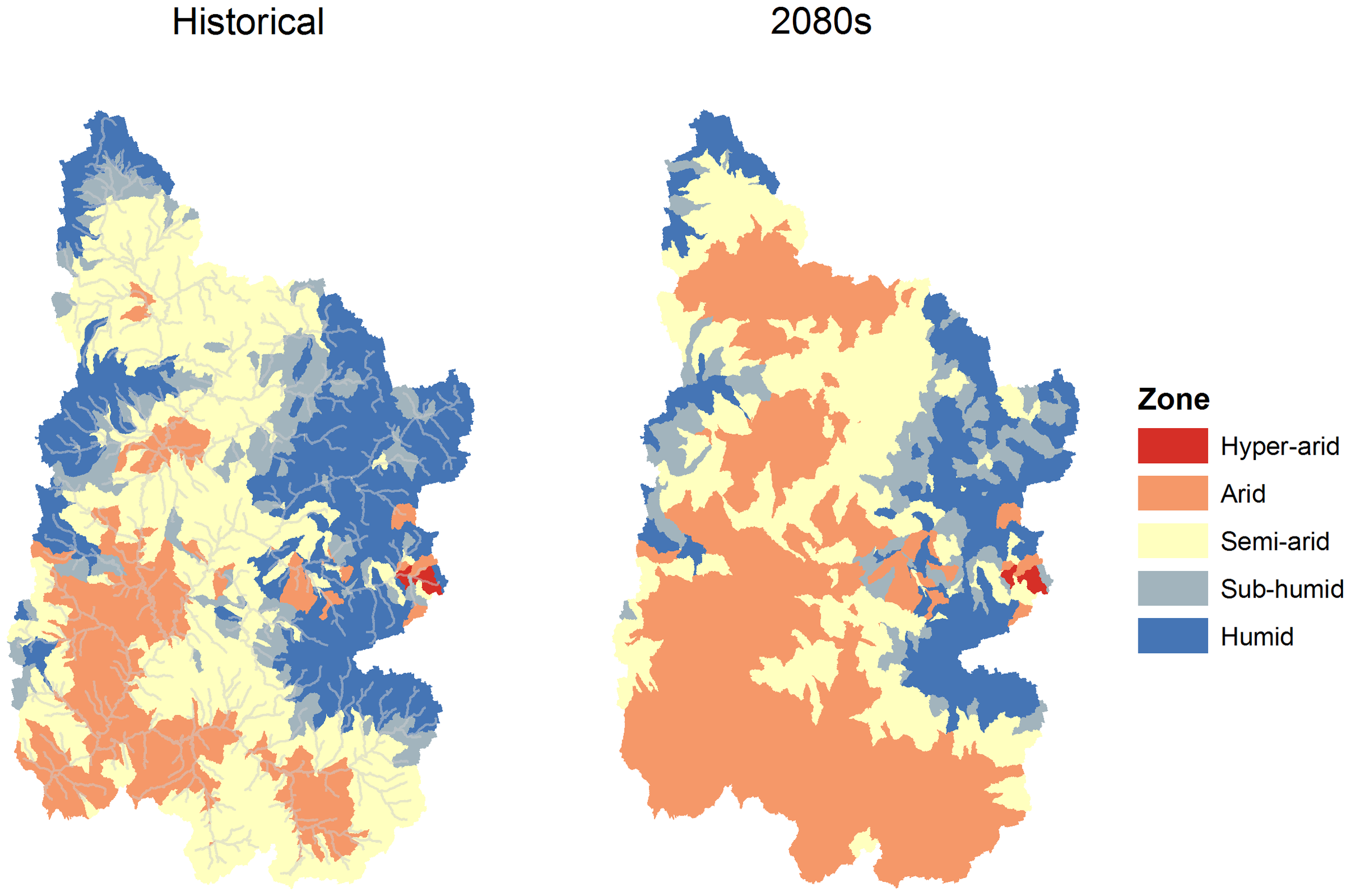
Increasing aridity in the Colorado River Basin

A new paper by Darrin Ficklin and colleagues anticipates drying in the Upper Colorado River Basin, especially in its southern region:

The shift from semi-arid to arid conditions is likely to be especially prominent for the southern and central subbasins of the UCRB.

increasing aridity in the Upper Colorado River Basin, Ficklin et al.

increasing aridity in the Upper Colorado River Basin, Ficklin et al.

Climate Change Impacts on Streamflow and Subbasin-Scale Hydrology in the Upper Colorado River Basin, Ficklin et al, PLOS One

The ag irrigation efficiency paradox

A visit to Santo Domingo Pueblo yesterday morning to look at irrigation efficiency work funded by the U.S. Bureau of Reclamation and others offered a nice demonstration of the paradox of ag water conservation. From my story (behind a Google survey wall, sorry):

By using the pueblo’s irrigation supplies more efficiently, the project, funded by the U.S. Bureau of Reclamation, has allowed a resurgence in the traditionally agricultural community. “There’s more people farming again,” former pueblo Gov. Everett F. Chavez told Bureau Commissioner Mike Connor during a morning tour.

In other words, the water conserved is supporting an expansion of farming rather than, as is often assumed in public discussions of ag water savings, to reduce consumption. C.-Y. Cynthia Lin at UC Davis recently posted an interesting discussion of research into water conservation efforts in western Kansas:

In response to rapid depletion of the High Plains Aquifer, the state subsidized a widespread conversion to more efficient irrigation technology in the late 1990s through mid-2000s. Programs paid up to 75 percent of the cost of upgrading or installing new irrigation technology – primarily “dropped nozzles,” which attach to center-pivot irrigators and reduce the amount of water lost to evaporation and drift.

But after making the shift to dropped nozzles, farmers ended up applying more groundwater to fields – completely negating the conservation intent.

Rather than reducing consumption, many farmers used their efficiency “savings” to expand irrigation into poorer soils or grow thirstier higher-value crops such as corn, alfalfa and soybeans. Greater irrigation efficiency increased overall water use.

To be clear, I’m not arguing that this is a bad thing. More crop per drop makes sense. But it’s not what one might expect.

Brad Udall on the Colorado River and “the reality of the public”

My name’s John, and I’m a water law junkie. I can’t get enough of Article III(d) of the Colorado River Compact. I love picking fights over the Upper Basin’s share of Mexico’s 1.5 million acre feet delivery obligation. I don’t care. I’ll argue either side.  Just give me my fix.

So I’ll happily stipulate that under the Law of the River, Arizona’s junior water rights mean that as climate change saps the Colorado’s flows, the Grand Canyon State will see its allotment cut to zero before California loses a drop. That’s what the water law says, right? Mainline.
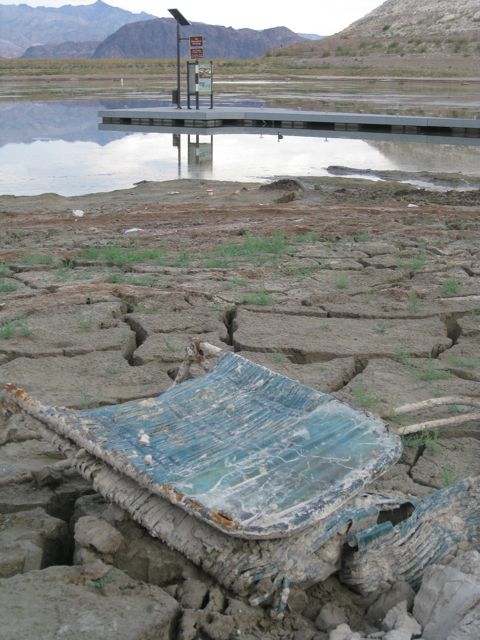
Boulder Harbor, Lake Mead, Oct. 18, 2010

Boulder Harbor, Lake Mead, Oct. 18, 2010

This is why Friday’s talk by Brad Udall, head of the University of Colorado law school’s Getches-Wilkinson Center for Natural Resources, Energy, and the Environment, was the most interesting thing I heard in two very interesting days of talks on the occasion of the 50th anniversary of the U.S. Supreme Court’s most significant water law ruling, period, in the case of Arizona v. California.

Udall stood up before a room full of lawyers, law school professors and water managers and said, in essence, that water law doesn’t matter. OK, that’s a rhetorical overstatement of a nuanced point. What Udall was really saying is that there’s a world inhabited by water law junkies like me that accepts the reality that, for example, Arizona’s junior rights mean its Central Arizona project, which represents half of its Colorado River entitlement and delivers water to Phoenix and Tucson, gets cut off completely before California loses a drop. And then there’s “the reality of the public” where people, faced with such a situation, are going to say, in essence, “WTF?” (my initialism, not Brad’s)

Udall’s “reality of the public,” as distinguished from the “reality of the water community”, is a world in which regular folk have no clue about all this Article III(d) and Colorado River Basin Storage Project Act and “doctrine of prior appropriation” stuff that we water nerds so venerate. They just want to turn on the tap and have the water come out. But they have some basic notions of fairness and good sense, imagining that the policies underlying our attempt to supply that water will consider questions of equity, sound economics and the environment. Water management actions that violate those notions will, to quote Udall, “violate the public’s sense of ‘rightness'”.

This means several things in terms of practical Colorado River Basin management.

It means that, whatever the Law of the River says, as a practical matter we’re not going to let the level of Lake Mead drop below 1,000 feet above sea level, the elevation at which Las Vegas can no longer get water from the reservoir. Udall had a slide in his talk quoting Mike King, head of the Colorado Department of Natural Resources: “I don’t care what you think about the Law of the River, we are not going to dry up a city of 2m people.” And even if/when Las Vegas gets its “third straw” built to protect its diversions at low lake levels, “the reality of the public” is not likely to tolerate drying up a lake that 8 million people enjoy every year.

It means, as I suggested above, that Udall thinks folks won’t tolerate a situation in which Arizona loses all its CAP water while California continues to take a full allotment.

And it means, Udall argued, that the states of the Upper Basin will not be left to take the full brunt of the river’s shrinkage because of climate change while the Lower Basin gets its full Compact share.

Udall offered some suggestions for what might happen in the alternative – creative new ways of sharing shortages; Californians, especially their big ag users, are going to have to do some of the sharing, and the three “E’s” – equity, economics and environment – will have to be on the table, even if they don’t have a specific “Law of the River” claim.

But here’s the key point: the solutions involve people who have no idea about all the “Law of the River’s” legal niceties: they’re going to want the water distributed in a way that make sense to them.

updated: To correct misstatement about Arizona’s priorities. Only CAP water is junior to California, not all Arizona’s river water.
the Colorado River doomsday clock

Chatting on the sidelines of last week’s Clyde Martz Summer Water Conference in Boulder, Doug Kenney had a great suggestion. We need something along the lines of the Bulletin of the Atomic Scientists’ famous nuclear doomsday clock for Colorado River water management. Doug’s comment came when I was grabbing some quotes for my newspaper story on the Bureau of Reclamation’s announcement that releases from Lake Powell will be curtailed beginning Oct. 1.

“This is kind of like the Colorado River doomsday clock,” Kenney said. We didn’t really settle on the specifics of how many minutes closer to midnight we should set the clock after Friday’s Bureau announcement, and I’m no graphic artist. But I’ll leave you with an update of my sort-of-monthly graph of storage in Lake Powell and Lake Mead, with estimated 2013 and 2014 water year-end numbers added:

Colorado River storage

Colorado River storage