Tree rings suggest strong ENSO response to greenhouse forcing

A new paper in Nature by Jinbao Li and colleagues, using tree rings to create an El Niño/La Niña (the El Niño-Southern Oscillation, or ENSO) reconstruction of unprecedented fidelity, suggests an increase in ENSO in the second half of the 20th century:

Our data indicate that ENSO activity in the late twentieth century was anomalously high over the past seven centuries, suggestive of a response to continuing global warming. Climate models disagree on the ENSO response to global warming, suggesting that many models underestimate the sensitivity to radiative perturbations.

(For more on the insanely cool usefulness of tree rings, you should buy my book.)

Rio Grande as plumbing

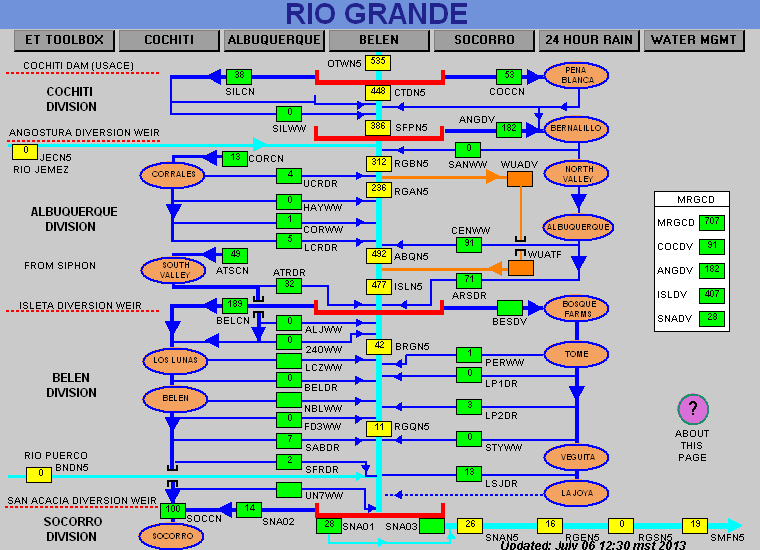
Doing daily journalism on the declining Rio Grande, I have frequent occasion to use this handy tool from the Middle Rio Grande Conservancy District and the Bureau of Reclamation. It gives close-to-real time readings on all the main river and irrigation system gauges:

Rio Grande plumbing

Rio Grande plumbing

It occurs to me that its crisp reductionism rather supports my recent argument that the Rio Grande is plumbing.

Is Phoenix’s fondness for lawns and pools really a water management strength?

Wigman Resort, Phoenix, photo by Dan Dickinson, licensed under Creative Commons

Wigman Resort, Phoenix, photo by Dan Dickinson, licensed under Creative Commons

An AP story that made the rounds yesterday pointed out that Phoenix set an all-time water consumption record during last weekend’s heat wave:

Water Services Department spokesman David Cerull tells radio station KJZZ that homeowners used most of the water.

He says demand generally goes up when it gets hot and that people water their yards more for fear of plants dying. He adds that residents with pools use more water because of increased evaporation.

When Phoenix residents face the inevitable alternative – give up their lawns and pools, or abandon their homes – this current consumptive reality means they’ve got a lot of savings left to squeeze out of their water budget. Is their profligate lawn-and-pool lifestyle thus an advantage?

The Ogallala – another example of what people do when the water starts to run out

Kate Galbraith in the New York Times last week had a piece with another example of how farmers respond when the water begins to run out:

Mr. Grall’s cornfield is part of a closely watched demonstration project aimed at showing farmers how to use less irrigation water on their crops. It was put together by a groundwater authority in the Panhandle that strictly limits the amount of Ogallala water each farmer can pump. The project reflects the harsh reality that has taken hold across the drought-stricken state: farmers, who account for more than half of the water used in Texas, must learn to do more with less, just like cities and industrial plants.

The story is a reminder that simply extrapolating current supply and demand trends into the future and then projecting our doom is not the right way to think about or water future in the increasingly arid West. You have to look at both the alternative approaches that use less water (which are many, as Galbraith’s story points out) and also the ability of our institutions to provide the underlying structures needed to support adaptation:

The North Plains district first imposed pumping limits in 2005 and tightened them in 2009. In 2005, it also began phasing in requirements for some wells to have meters. Both moves were controversial at the time. A larger groundwater district just south of North Plains, the 16-county High Plains Underground Water Conservation District, has struggled in its attempts to impose metering requirements and pumping limits.

Stuff I wrote elsewhere: irrigating the Rio Grande

From the morning paper, Day 1 (Day N?) of my Rio Grande death watch:

JARALES – There’s a great line about New Mexico’s central river, often attributed to Will Rogers: “The Rio Grande is the only river I ever saw that needed irrigation.”

Whether Rogers said it or not (and there is some question), it is no longer a joke.

“We’re irrigating the Rio Grande,” water manager David Gensler said as he watched a small flow off the Sabinal canal in southern Valencia County, where workers have cleared an old ditch and diverted a bit of the precious liquid into the otherwise largely dry bed of the Rio Grande.


Lund on a call for a new environmentalism

Smart Jay Lund piece on the shortcomings of old-school environmentalism in the new world:

Classical environmentalism is mostly about stopping new harmful human influences, not reversing the harmful effects of past changes or shaping a more environmentally friendly future. Environmentalism has not substantially reversed the widespread urban and agricultural destruction of wetlands or freed rivers from the concrete and rock that straightened their course.

A new environmentalism is needed that can redirect and reconcile human activities to better support and even expand habitat for native species. Rather than insist on blocking human use to protect nature – a largely quixotic quest now – environmental reconciliation works in and with unavoidably human habitats.


Cutting the Gordian knot of the Upper Colorado River Basin’s delivery obligations

The folks at the University of Colorado’s Colorado River Governance Initiative have a clever idea to keep the Upper Basin states from getting screwed by climate change. Their new Upper Basin Voluntary Demand Cap white paper (pdf) offers a solution path for one of the stickiest problems in future Colorado Basin water management under climate change.
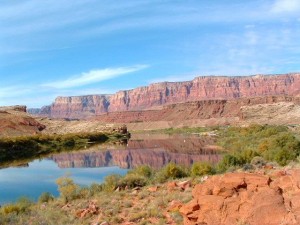
Lee's Ferry

Lee’s Ferry

In short, it’s a bargain under which the two basins would share a huge risk at the intersection of climate change and legal uncertainty over interpreting the Law of the River.

The sticky problem is Article III(d) of the 1922 Colorado River Compact (pdf):

The States of the Upper Division will not cause the flow of the river at Lee Ferry to be depleted below an aggregate of 75,000,000 acre-feet for any period of ten consecutive years reckoned in continuing progressive series beginning with the first day of October next succeeding the ratification of this compact.

Translated, that means the Upper Basin states might have to deliver 7.5 million acre feet of water each year at Lee’s Ferry. With a river twice that size, the compact’s authors presumed, there would be plenty of water for the upper basin states (New Mexico, Colorado, Utah and Wyoming) to use their half and just pass the rest of the water on down for California, Nevada and Arizona. But there’s a central unresolved legal question, as the CRGI folks wrote in a white paper last year (pdf):

[T]he prevailing interpretation has been that the Upper Basin has the obligation to deliver 75 million-acre feet every ten years (an average of 7.5 million acre-feet/year) downstream to the Lower Basin, and if this leaves insufficient water for the Upper Basin to consume the 7.5 million acre-feet promised in Article III(a), then the Upper Basin must bear that shortage in its entirety. However, a counter interpretation more favorable to the Upper Basin is that they do not have a delivery obligation, but rather an “obligation not to deplete” the flow of the river below an average of 7.5 million acre-feet/year based on the language used in Article III(d) of the Compact.

Not surprisingly, you can pretty much guess the legal interpretation a lawyer will offer based on which basin they’re from. Lower Basin attorneys say, “Yup, gotta deliver 7.5, no matter what.” Upper Basin attorneys say, “No, if the river’s low because of a changing climate, rather than our depletions, we’re off the hook.”

This disagreement is a huge deal because under the former interpretation, if as expected climate change reduces the flow in the river, the Upper Basin takes the entire squeeze.

The thing is, water managers hate uncertainty. And no one’s lawyers, Upper or Lower Basin, can guarantee which way a judge would rule if they threw the dice and went to court. The downside risk is enormous.

The CRGI folks call their idea the “Upper Basin Voluntary Demand Cap.” The idea is that Upper Basin states agree to cap their total depletions at some level below the 7.5 million acre feet allotted to them under the compact (which they’re not using right now anyway). In return for holding their consumption line there, the Lower Basin agrees not to make a “compact call” if deliveries at Lee’s Ferry drop below 7.5 maf:

Establishing the value of the “cap” and the release objective are points to be negotiated; but the principle is to establish these numbers in advance of a crisis and without a need to litigate the omissions and ambiguities that exist in the Compact and related elements of the Law of the River.

There’s precedent for this sort of approach in the 2007 shortage sharing agreement, which doesn’t supplant the Law of the River but is rather, in the words of the CRGI folks, “an operational regime placed on top of this foundation.”

It’s the kind of solution space I was thinking of in my “What Seven States Can Agree To Do” piece last year, though I’m not smart enough to come up with the specifics. The Law of the River is malleable if all the parties can come to agreement on the bends it needs.