Science isn’t enough

Smart Mark Lubell on why a better scientific understanding of our groundwater foibles – even “perfect science” – isn’t enough:

But there are many policy-makers and citizens who will take that perfect science (even when presented in a very simple manner) and flick it away like a bothersome mosquito because they don’t trust the scientists, or because the science reflects negatively on their current behavior(for example, groundwater extraction), or does not agree with their basic ideology. Second, even if the policy-makers believe the science, they usually have to figure out a way to cooperate with other water users, and why should Water District X stop withdrawing groundwater if Water Distrct Y will not? Such cooperation problems are barriers to sustainable water management from the local to global scale. Third, let’s say a bunch of policy makers believe the science and come up with some new policies to govern urban and agricultural water use, or non-point source pollution. These policies might be asking or requiring farmers, citizens, factories, and cities to change their behaviors. So we need to know exactly how these targeted decision-makers will respond to different types of policy tools.
On “regulatory assurance” in the Sacramento Delta

Jeff Michael did a pithy job Thursday of untangling the snag of old fishing line that is “regulatory assurance”, the Endangered Species Act and the proposal to build giant tunnels beneath the Sacramento-San Joaquin Delta to get water from California’s wet north to its thirsty south with, it is hoped, minimal disruption to the delta through which the water would otherwise travel.

The core of Michael’s argument is that the real value (in dollar terms) for water users is “regulatory assurance” – the knowledge that they’ll get the water they expect without unexpected supply interruptions because of endangered species problems. But why, Michael asks, must that regulatory assurance come from the tunnels, rather than the habitat work that is also part of the project. If they could get that regulatory assurance at lower cost by fixing the delta rather than tunneling beneath it, Michael asks, would that not be a win for all?

I’ve been arguing that water policy planning driven by the ESA is what led the delta to the political and policy mess we’re in. But if Jeff’s line of argument is right, then my argument about the ESA may not be.

It may simply be that the BDCP process got headed down the big conveyance path not because it was constrained by the requirements of the ESA policy process, but rather because that’s the path they wanted to be on. There is some evidence to support that in the November 2007 “Bay Delta Conservation Plan: Points of Agreement” (pdf):

Under a Planning Agreement dated October 6, 2006, the Steering Committee worked over the course of this year on developing an overall approach to the BDCP. We have chosen to concentrate initially on different approaches to conveyance and how they would likely contribute to achieving the planning goals and conservation objectives of the Planning Agreement and affect habitat restoration opportunities across the Delta.

A conveyance is what they seem to have been looking for, and a conveyance is therefore what they found?

Stuff I wrote elsewhere: Las Conchas and a search for optimism about wildfire

Lissa and I took a drive Sunday up State Route 4 through the Jemez to look at the big Las Conchas burn one year later.

A couple of points worth noting:

  • Miles of forest that has not burned
  • Lots of forest that burned healthy (sprouting aspen on the forest floor)
  • Elk grazing in the Valle Grande

From the morning paper:

But recall I promised to be optimistic. The drive up State Route 4 into the heart of the Jemez passes through mile after mile of unburned forest. In some areas, Marlon’s deficit is obvious — woods thickly overgrown with fuel just waiting for another downed power line or dry lightning strike.

But there are miles where crews have begun to try to fix things — clearing the thickets, carefully reintroducing fire through prescribed burning. And then there are patches like the woods I drove through down Forest Road 289, where wildfire just did what it is supposed to do, clearing out the undergrowth and leaving a healthy forest behind.


Checking the conventional wisdom on the Clean Water Act

The conventional wisdom about the US Clean Water Act (which I’ve always believed) is that it’s been a great success. Maybe not?

On the fortieth anniversary of the Clean Water Act this paper reports the first quantitative assessment of the aggregate trends in water quality in the U.S. using a single standard over the years 1975 to 2011. The analysis suggests that fresh water lakes for the nation as a whole are about at the same quality levels as they were in 1975. In short, viewed in the aggregate, nothing has changed.

Who needs water in the Colorado basin

In the past, I’ve used the Bureau of Reclamation’s Yuma Desalting Plant as a sort of benchmark for measuring who’s the most desperate for water in the Lower Colorado River Basin, and the level of that desperation.

Tony Davis had an excellent look at the project this past week in the Arizona Daily Star, and the provisional answer it suggests is “no one”.

The U.S. Bureau of Reclamation had expected the desal plant’s test run to cost $23 million. The final tab was $15.9 million. The test was to last up to 365 days but treatment was finished in 328 days.

Nonetheless, the plant’s most immediate obstacle to long-run operations is lack of money. But a significant amount of fact-gathering and discussions must also occur, water officials and environmentalists said.

The current tight federal budget has no money to run the plant at full scale, said Jennifer McCloskey, Yuma-area manager for the Bureau of Reclamation, which runs the plant.

The plant also needs $25 million to $50 million in upgrades, she said.

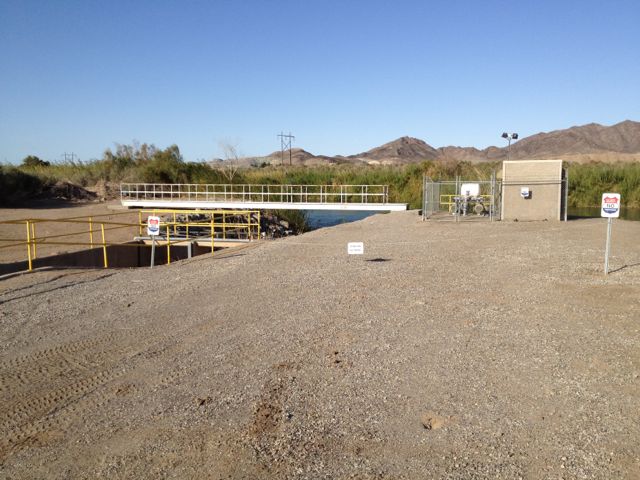
Yuma Desalting Plant outfall, Colorado River, February 2012

Yuma Desalting Plant outfall, Colorado River, February 2012

I haven’t dug into the numbers in detail myself, so it’s not clear to me how much it per acre foot of water it would cost, for example, the Metropolitan Water District of Southern California to operate the plant. But since they’re not stepping forward, I infer that they’re not desperate enough, at least yet, to pick up the tab.

But in classic western water tradition, Tony’s story does suggest an alternative path that might yet put the YDP to use – get federal taxpayers to pick up the tab!

The Central Arizona Project and other regional water agencies want the plant open for additional water during droughts – particularly with the Colorado River heading this year toward one of its lowest flows on record. CAP’s view is that running the plant is a federal responsibility, and the bureau should figure out the most effective and efficient method of running it, said Chuck Cullom, CAP’s Colorado River programs manager.

“The fact that Reclamation doesn’t request funding for the plant … doesn’t change what we believe is a pretty clear obligation,” Cullom said.


Two very different responses to climate change

Two very different responses to climate change:

In London, England, local borough councils are utilizing land use regulations to stop Londoners from removing their front gardens. Nearly 6,000 miles away in Las Vegas, Nevada, in the United States, municipal authorities such as the Southern Nevada Water Authority are doing the exact opposite—offering monetary incentives for landowners to tear out their front lawns.

Fascinating look at urban landscape scale community responses when the risk is flooding or aridity: Christian D. Petrangelo in the Vermont Law Review (pdf)

the 2012 deluge

It’s all relative, I guess.

I just finished my June backyard rain sheet for the National Weather Service, and realize I’ve had 8 times as much precipitation in the first six months of 2012 as I did over the same period last year – 2.21 inches (5.61 cm) compared to 0.27 inch (0.69 cm) last year.

This year’s January-June total is 74 percent of my long term average.

736 gallons per person per day

Some months ago, I complained in the newspaper about water consumption in Palm Springs:

Today … customers of the Desert Water Agency, which serves Palm Springs, consume an average of 540 gallons of water per person per day.

Having just visited Palm Springs on a desert vacation, I had that number in mind last week when the Albuquerque Bernalillo County Water Utility Authority released its latest per capita calculations. They show that water usage in the Albuquerque area in 2011 dropped below 150 gallons per person per day, down from 252 gallons when water conservation efforts began in the mid-1990s.

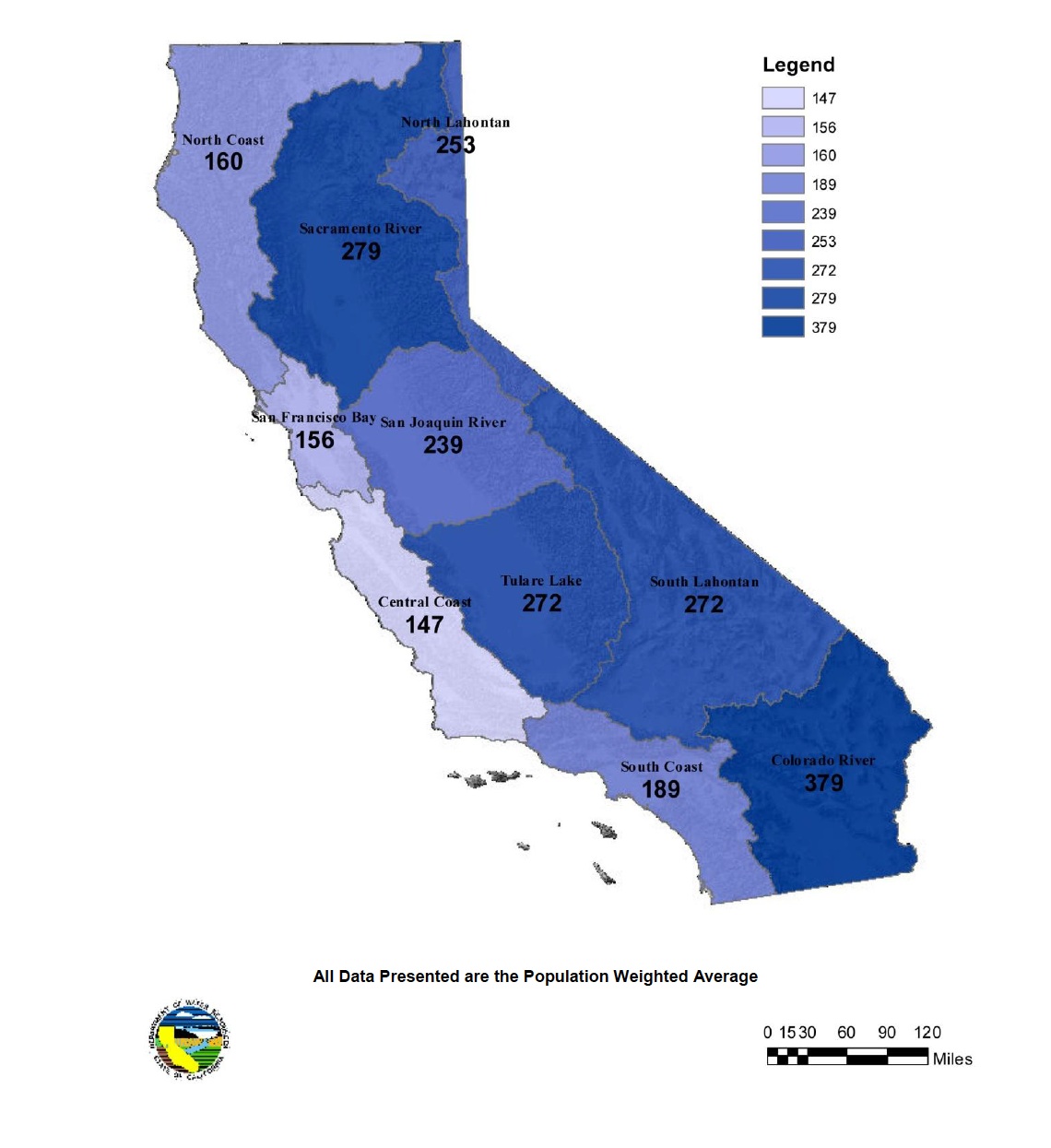
I stand corrected. A new report compiled by California’s Department of Water Resources (pdf) puts the Desert Water Agency’s consumption at 736 gallons per person per day. Here in Albuquerque, we’re at 150. Compare that to, say, Sydney, Australia, which is down to 83.

The Desert Water Agency number is part of the first phase of California’s “20 by 20“, an attempt to get water agencies to cut per capita use 20 percent by 2020. I’m guessing the Desert Water Agency isn’t going to have to break much of a sweat to get down to 589 gallons per person per day.

California per capita water usage, by region

California per capita water usage, by region

In fact, the map that breaks down the current usage numbers by region suggests there’s a lot of easy improvement possible in California’s municipal water usage. A state that’s flush enough to have vast areas of the state above 200, and even the densely populated south coast region from Los Angeles to San Diego at 189 has plenty of room to move. I realize we talk about California water with the rhetoric of a looming crisis. And there are some real problems to be sorted out. But these numbers show that California’s municipal water users have a lot of room to move.

Hat tip to ACWA for linking to the report.