Stuff I Wrote Elsewhere: More Water in the Desert than Usual

From the morning newspaper (sub/ad req), a look at water flowing through the woods:

Michael Porter made an auspicious discovery one morning this week in the waterlogged Rio Grande woods — silvery minnows.

For a week, high flows have brought water into newly created habitat on the river’s west side, south of Central, and the endangered Rio Grande silvery minnows have apparently wasted no time taking advantage of their new digs.

“They’re already moving in,” said Porter, a fish biologist with the U.S. Army Corps of Engineers. Porter’s discovery came the same day a host of dignitaries from local, state and federal agencies gathered to formally cut the ribbon on the Bosque Revitalization at Route 66, 121 acres of ecosystem restoration stretching along the west side of the Rio Grande through Albuquerque.

Water in the Desert: High Flows on the Rio Grande

If you’re in Albuquerque, it’s  a great weekend to go out and see your river.

The Rio Grande is flowing at nearly 6,000 cubic feet per second through the city right now (Saturday evening, 5/22), courtesy of a spike flow to help Rio Grande silvery minnow spawning. The high flows allow water to get out of the main channel and into constructed low areas along the Albuquerque reach of the river, as well as some minor overbanking into the bosque (0ur riverside woods) itself. As near as I can tell, it’s the highest flow we’ve had since 2005.

For those not familiar with the 21st century Rio Grande, our river once spread over a vast and shallow flood plain, miles wide. Today, it’s confined to a narrow central channel, and the ecosystem that used to thrive as high spring flows spread out across the valley floor has been choked off. What’s happening is a very modest simulation, at a small scale, of what used to be an annual affair.

I’ve been out of town all week and was afraid I would miss the peak flows, but when I got back from our trip at midday today, I checked the USGS web site

high flows on the Rio Grande

high flows on the Rio Grande

and saw it was peaking, so Nora and I went down this afternoon for a look. The picture was taken in one of the new constructed side channels, on the east side of the river just south of the Central Avenue (old Route 66) bridge. The channels are built to take water only when the river’s high, creating a shallow, slow water area for the fish to spawn.

There are some interesting issues with the engineering approach to ecosystem restoration, which I hope to find some time to explore next week for the newspaper. There are constraints on how much water you can allow down the river – primarily the railroad bridge at San Acacia, but also some levee issues and development in the flood plain. Some folks argue that fixing those problems would allow even higher flows, which would allow a more natural overbanking and reconnection between the ecosystem and the river.

(Sorry for the picture quality, taken with my cell phone camera.)

Not Everyone Thought Irrigating the Salton Sink was a good idea

Reading the late 19th and early 20th century literature of the Colorado Desert, one could be forgiven for thinking there was a certain inevitability of the massive irrigation works that so changed the Salton Sink (renamed with characteristic enthusiasm as “Imperial Valley”.)

It still seems inevitable. It was the time of manifest destiny, of “reclamation”. But I was pleased last night to stumble across a contrarian voice. It’s John C. Van Dyke, an eccentric art historian who chucked it all in 1898 and went for a horseback ride around the deserts of the southwest. For three years.

Van Dyke’s The Desert is a lyrical bit of nature writing to warm every desert rat’s heart. It’s also the only thing I’ve found written at the time (please, let me know of other examples) that questioned the wisdom of turning water into the Salton Sink:

It might be thought that this forsaken pot-hole in the ground would never come under the dominion of man, that its very worthlessness would be its safeguard against civilization, that none would want it, and that everyone from necessity would let it alone. But not even the spot deserted by reptiles shall escape the industry or avarice (as you please) of man.

Van Dyke’s epic wander and subsequent writing came as Charles Rockwood and the California Development Company were engaged in their first attempts to divert water northward from the Colorado River into the desert. Van Dyke makes an odd argument against it – that the great desert’s true valley came through its role “in the matter of producing dry air”:

To turn this desert into an agricultural tract would be to increase humidity, and that would be practically to nullify the finest air on the continent….

The deserts should never be reclaimed. They are the breathing-spaces of the west and should be preserved forever.

Stuff I Wrote Elsewhere: PCBs in the Rio Grande

Greetings from the not-so-wilds of Taos, New Mexico, where I picked up this morning’s Albuquerque Journal to find this (sub/ad req), on the surprising discovery of PCBs in the Rio Grande just downstream from the main Albuquerque storm water outfall:

If the nuclear weapons lab were responsible, dealing with this problem would be simpler. Attentive activists and state regulators are pushing hard to try to ensure the lab does not contaminate the Rio Grande, and the lab’s federal sponsors have deep pockets with which to respond.

But the Albuquerque PCB problem, which appears at this point to be far larger than any PCBs linked to Los Alamos, seems so far to be an orphan.

It’s the latest in a series of columns in which I attempt to move beyond the current discourse over environmental contamination in New Mexico, which seems to be skewed by political concerns regarding the source of contamination, rather than an assessment of where the greatest risks actually lie.

See here for the previous installment.

on blaming “drought”

A couple of stories recently caught my eye, in which “drought” is blamed for what is largely an issue of water overconsumption.

The first was a City News story on San Diego water supply. The reporter said this:

California and the Colorado River basin have been in a years-long drought, which has forced reductions in deliveries of water from the Colorado….

Wrong.

All Colorado River water contractors have received their full allotment over the past decade. As I’ve written before, despite the drought, Lake Mead (and therefore the Lower Basin) has received its full allotment of water each year of the drought.

I don’t want to be too hard on the CNS reporter who wrote this. The author was obviously just capturing what’s the conventional wisdom – which is to blame drought, rather than the fact that consumption exceeds supply.

Case study two is an AP story blaming drought for dropping levels in the Ogallala Aquifer:

Lingering drought during 2009 forced farmers to rely more on irrigation wells drilled into the Ogallala Aquifer and drew down the water at the steepest rate in a decade.

When you have to rely on overdrafting your aquifer to cope with the dry side of the natural range of variability, brother, you’ve got a consumption problem.

But it’s always easier to blame “drought.”

Stuff I Wrote Elsewhere: Kirtland Fuel Spill Update

From this morning’s paper, an update on the Kirtland Air Force Base jet fuel spill (sub/ad req.):

State regulators on Friday denied the Air Force a requested 45-day extension on a deadline to turn in plans to deal with a jet fuel spill threatening Albuquerque groundwater.

“Urgent action needs to be taken to address this threat to Albuquerque’s drinking water supply,” James Bearzi of the New Mexico Environment Department wrote in response to the request Friday afternoon.

As a compromise “in the interest of comity,” Bearzi’s letter granted Kirtland Air Force Base an extra 15 days to turn in plans for the next steps in dealing with the problem.

But in granting the extra time, Environment Secretary Ron Curry complained about repeated Air Force delays.

“We feel that there’s been sufficient time for them to respond,” Curry said in a telephone interview Friday afternoon.

California Über Alles

I had breakfast this morning with a bunch of California expats.

California Bear Flag

It’s a weird label. We don’t normally think of ourselves that way. But I’ve been feeling nostalgic about the land of my birth lately. Not sure why, but it probably has something to do with seeing palm trees, citrus groves and bougainvillea last month on my sojourn to the deserts along the Arizona-California border.

My grandma had an elegant bougainvillea that grew out of a planter box on her San Bernardino house, framing her front door. Mom’s a San Bernardino native, making my sister, Lisa, and I second generation Californians. Lisa and I grew up among citrus groves along what was then, in the 1960s, the suburban fringe of the slowly expanding Los Angeles metro area.
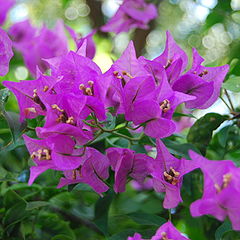
Bougainvillea, courtesy Wikipedia

Bougainvillea, courtesy Wikipedia

Like much about California, grandma’s bougainvillea seemed effortless to me. I realize now that was a mistake, that the southern California of my youth was very much an invention. But when you’re a kid, you don’t think that way. Stuff just is, and you take that for granted. In fact, the bougainvillea is a South American import, and even its lovely red “flowers” are fake. They’re really leaves which evolved the color as a sort of faux flower to attract pollinators to a tiny little flower that sits within colored leaf clusters.

The proximate cause of this morning’s musings was Emily Green’s post about the Rancho Santa Ana Botanical Gardens. It was just a few miles from my house, and Mom and Dad used to take my sister and I there all the time. I know now that Rancho Santa Ana is special, a haven for plants native to the semi-arid coast plain amid the wet climate imports that dominate the built environment of LA. But, as I said in a comment over at Emily’s, as a child I didn’t know that there was anything special about the place: “When I was a tyke, my sister and I used to shamble about gleefully in what we simply called ‘the botanic garden’. From the vantage point of childhood, there was no other.”
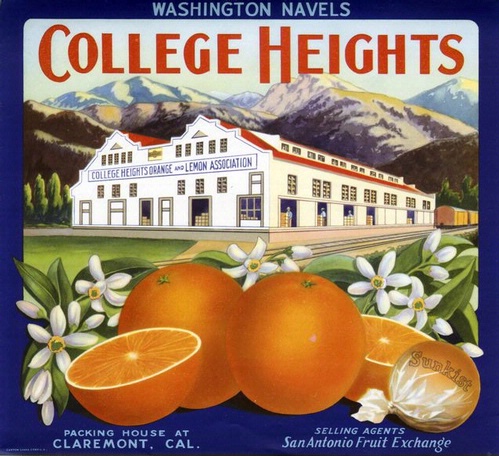
Claremont packing house orange crate label

As an adult, both when I lived there and especially now from the vantage point of 20 years away, I have come to view Southern California as one of humanity’s great creations. Gifted with tremendous natural bounty, it was then populated by people with what seems like a peculiarly self-selected inventive spirit. LA didn’t have a port, so they built one. It didn’t have water, so they built three great rivers. They grafted orange trees onto lemon root stocks and built an agricultural empire that gave way over time to one of the planet’s great supercities. I am a child of that. My grandfather drove a melon truck in the Imperial Valley in 1915 when he and grandma were first married, and went on to be the sort of real estate developing, water importing Republican who built the place.

This is, of course, nostalgia talking. It is not clear what the next steps in California’s invention might be. As Peter Raven points out in Emily’s LA Times piece:

“It makes sense that we’ll come to a point where we’re sustainable,” he said. “The question we must ask ourselves now is how long it will take and what we will lose in the process? What kind of a landing do we want to have? What kind of world do we want to live in? We need to put forth an enormous energy to keep the kind of world we really want.”

River Beat: It Could Be Worse

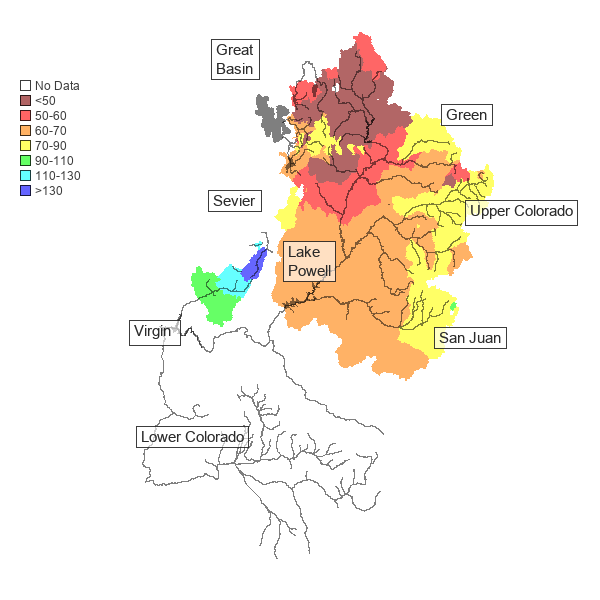
I guess the best you can say about the updated forecast for Colorado River flows for the rest of the 2010 water year is that it could have been worse.

Colorado Basin Forecast, CBRFC

Colorado Basin Forecast, CBRFC

A wet April in the northern reaches of the Colorado River basin has pushed the Lake Powell inflow forecast, out today from the Kevin Werner and the crew at the Colorado Basin River Forecast Center, to 66 percent of average. That may sound terrible (and it is), but it’s up from a 63 percent forecast a month ago.

Some other key points on the system:

  • Navajo Reservoir, in northwest New Mexico: 87 percent
  • San Juan River at Bluff: 77 percent
  • Green River at Flaming Gorge: 43 percent (yikes!)

A reminder that we’re already past the point of no return in terms of downstream releases from Lake Powell through the Grand Canyon into Lake Mead. The low inflow from the upper basin into Powell means that Mead is likely to continue to drop this year, and by the end of the year drop below Drought of the ’50s levels to reach the lowest its been since the reservoir was first filled in the 1930s.

Stuff I Wrote Elsewhere: Jet Fuel Leak

Which spill to cover?

Some environmental journalism tradecraft here. There is a nagging problem for reporters who cover contamination problems. As a society, we spill nasty shit all the time, in all sorts of places, from the sheen of oil and lead wheel weight residues on our streets to the nitrates beneath dairies to the old dry cleaners scattered across our cities to the PCBs running out municipal stormwater drains. The New Mexico Environment Department is currently monitoring 27 spills in the metro area that I know about in which hazardous contaminants have reached the groundwater.

People who work these problems for a living use a simple formula: risk equals probability times consequence. That is, what are the chances of the contaminant reaching a pathway via which it could threaten human or environmental health (probability) and how bad would it be should that happen (consequence)?

By that measure, the Kirtland Air Force Base jet fuel leak that I wrote about in yesterday’s newspaper pretty much tops the list right now in New Mexico, which is why I afforded it the treatment I did (sub/ad req):

A new estimate puts the volume of a Kirtland Air Force Base jet fuel leak at nearly 8 million gallons.

Those are Exxon Valdez-scale numbers, and the fuel is slowly creeping through the water table beneath an Albuquerque neighborhood toward municipal water wells. State officials say there are serious questions about whether the Air Force is acting quickly enough to deal with the problem.

“It’s probably the biggest groundwater contamination problem in the state right now,” said Bruce Thomson, head of the University of New Mexico’s Water Resources Program.

More than 10 years after the spill was discovered, the Air Force still does not know the full extent of the contamination, according to a sharply worded April letter from the New Mexico Environment Department to the Air Force.

The letter labels the spill “a significant threat to human health and the environment, particularly to well water in urban neighborhoods adjacent to Kirtland Air Force Base.”

There appears to be no danger to the people living on top of the spreading contamination. The real danger is to Albuquerque’s water supply. Two municipal water supply wells are in the fuel’s path. If it reaches them, the wells will have to be shut down.