Yankees Once Again March on Georgia

This time it’s not Sherman, it’s the Corps of Engineers, and it has something to do with fish. Via Shaun McKinnon and WaterCrunch, the story of Atlanta’s attempt to get the Corps to reduce its releases from Lake Lanier, which is running dry. That’s a problem, because it’s Atlanta’s primary source of water. The Corp’s answer: WaterCrunch: “No.” The reason? Shaun: “The Corps said the water was required to protect endangered mussels and sturgeon.”

This is gonna be ugly.

Water in the Desert: Cattle Edition


cattle and water

Originally uploaded by heinemanfleck.

Here’s one of the simple but classic ways we manipulate water here in the western United States. It’s called a stock pond. You carve out a little hollow in a drainage, pile up the dirt on the downhill side, and presto, you’ve got a water supply for your cattle. If not for the cattle, it would make a wonderful little wetland. You’d likely get cattails springing up, a nice marsh developing, etc. But the cattle beat down the ground all ’round. Though, I guess it’s accurate to say that without the cattle, it wouldn’t exist at all.

This is on the edge of El Malpais National Monument, on the dirt road that skirts the western edge of the monument’s big lava flows. Lissa and I were out there a couple of weeks ago looking for the site where Henri Grissino-Mayer found the old Ponderosa pine trees he used for his amazing 2,000-year-long New Mexico rainfall chronology. Up on the Malpais – the lava badlands – the Ponderosa grow low and slow, and are ideal for precipitation reconstruction. Henri sent me some satellite photos with little circles and arrows to try to help is find some of the actual trees. We failed, in part because tromping around the Malpais is a serious pain in the ass. But we found a lot of amazing old Ponderosa. And these lovely cows.

Further reading:

Drought From Orbit

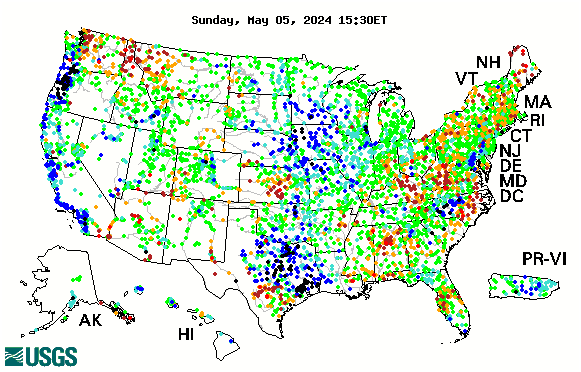
This is one of my favorite views of U.S. climate, providing a quick and easy way to squint and get a feel for what’s going on across the entire continental U.S. It’s the USGS streamflow map, with color showing today’s flow relative to the long term mean for this date. Red’s dry, blue and back are the wettest. It integrates a lot of information into a quickly digestible package, because streamflow integrates over space and time at useful scales.

Climate Quiz

For the climate warriors in the audience, a quiz. Who said this?

Mankind has a record of reacting after a disaster strikes. Dams are built after floods, not before. So far in human history, disasters have not taken place on a global scale. Therefore we don’t really have a tested mechanism for dealing with global threats, such as a long-range, worldwide degradation of the environment. If we ignore the present warning signs and wait for an ecological disaster to strike, it will probably be too late.

The distinguished biologist Garrett Hardin has pointed out how very difficult it is psychologically to really believe that a disaster is impending. “How can one believe in something – particularly an unpleasant something – that has never happened before?” This must have been a terrible problem for Noah. Can’t we just hear his complacent compatriots: “Something has always happened to save us.” or “Don’t worry about the rising waters, Noah; our advanced technology will surely discover a substitute for breathing.” Unfortunately, the Bible doesn’t tell us much about Noah’s psychological trials and tribulations. But if it was wisdom that enabled Noah to believe in the `never-yet-happened,’ we could use some of that wisdom now.

Hint: Not Al Gore.

Tallying Drought’s Horrifying Toll

More bad news out of Australia:

“There’s no doubt that much of the estimated winter crop is now lost due to the ongoing dry conditions,” Macdonald said Saturday.

“Wheat and barley are among those crops hardest hit — as a result we could see everything from bread to beer made in New South Wales cost a little more as Christmas approaches.”

Macdonald said the average glass, or schooner, of beer could rise by between 10 and 20 cents due to the shortage of barley. Despite this, beer would still taste the same, he said.

Emphasis added.

The Virtues of Being Close to the Ground

I stumbled today on Kim Hannula’s delightful blog, in particular her post about hiking with her four-year-old son:

He pointed to something that looked like white hairs on an over-excited yeti. Fibrous ice crystals, holding up pebbles and leaves and bits of frozen dirt. Every shadowed spot was covered with them, when we stopped and looked. On the hillsides, on the trail… everywhere.

They looked, actually, like vein fillings – fibrous vein fillings. Perhaps I shouldn’t be surprised – ice is, after all, a mineral, if one that melts readily under earth’s surface conditions. And like fibrous veins, I think I could figure out a deformational history from some of them.

(P.S. If you know of any other good geology blogs, mention ’em in the comments.)

The Devil in the Climate Change Details

So how do “they” know that the climate change we’re seeing is caused by people?

There is no big “aha” smoking gun here, which is why the Nobel for the IPCC’s scientists is so appropriate. Our understanding is based on a long and laborious accumulation of little bits of science. Let me cite a single example, just out in Geophysical Research Letters. It’s “Contributions of natural and anthropogenic forcing to changes in temperature extremes over the United States,” by Gerald Meehl and colleagues. They looked at the record of temperature extremes – things like length of growing season, which is a function of time between last frost of spring and first frost of fall. It’s a record that shows clear changes. But how to explain those changes? We know there are various things that can “force” climate – solar variability or volcanoes, for example, or changes in trace gases in the atmosphere emitted by humans. Meehl and his colleagues looked at the possibility that known natural forcings all by themselves could explain what we’ve seen. Then they looked at the anthropogenic forcings. The only reasonable explanation, according to their data, is greenhouse gases emitted by humans:

The natural forcings experiments (including only solar and volcanoes) show little change in these extremes indices for the latter part of the 20th century. This indicates that the recent observed changes in temperature extremes over the U.S. have been mostly due to changes in anthropogenic forcings associated with increases of GHGs.

What the New York Times’ Andrew Revkin calls “the tyranny of the news peg” means there will likely be no big headlines for the new Meehl et al. paper. It’s one tiny piece of the puzzle. But it serves as a nice example of the enormous body of work out there for which the IPCC has been honored.

The Drying of Atlanta

Watercrunch details the imminent drying of Atlanta. It’s worth remembering here that, as opposed to sub-Saharan Africa, likely no one will starve to death in Georgia. But it’s still a quite extraordinary situation:

The thought of a huge city the size of Atlanta running out of water sounds apocalyptic in our age of progress.

Winning the Nobel: The Price of Fame

Trying to download a section of the Intergovernmental Panel on Climate Change’s report this morning, I’m getting a “server busy” message. One might argue that, from the perspective of getting one’s message out to the world, winning a Nobel Peace Prize is a good thing. Of course, it might just be a coincidence.