Water in the Desert


John_Sadie

Originally uploaded by heinemanfleck.

Lissa and I took Sadie for a walk this morning to the ponds out in the bosque beyond Tingley Beach. They were finished in 2005, and are really starting to grow up. Baby cottonwoods line the edge, with cattails growing like bonkers at the southern end. We saw what we think was a green heron. Didn’t get a close look, and didn’t have binoculars with us, but one of the biologists who works down there confirms they have green herons around. They’re a smaller bird than the great blues and the night herons we’ve seen before.

I’ve started a Google bosque map, and added the ponds as its first push pin goober.

I’m Jimmy Carl Black, the Indian of the Group

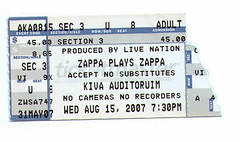
Zappa ticket stubBack in the summer of ’78, my friend John Colton visited me in L.A. It was his first visit, and while we were there, he made sure we drove around Beverly Hills, looking for jockeys on rick people’s lawns.

Dweezil and the gang played Uncle Reemus at last night’s Zappa Plays Zappa Plays Zappa gig in Albuquerque. They played much of the canon – Peaches en Regalia and Muffin Man, my two favorites, as bookends, with a wickedly funny and technically devilish visit to Brown Shoes, along with Ray White belting the Illinois Enema Bandit with cheerful fury. And Montana, and City of Tiny Lights, and My Guitar Wants to Kill Your Mama, and on and on.
My sister, Lisa, got tickets for my birthday, and it was as fine a birthday present as I could have imagined. It’s a risky endeavor, because Frank Zappa’s music is so beloved and so technically challenging that Dweezil and the band could easily have fallen on their collective faces. We’ve always known Dweezil can play guitar, but could he play his dad’s stuff? They didn’t fall on their faces, playing with a combination of technical mastery and loving good humor.  I’ve never seen such a concentration of old men with pony tails, and it was all good fun.

Before the show, the guy sitting in front of me turned and asked me if I knew “Weasels Ripped My Flesh.” He told me a story about sitting in a bar in Los Alamos, watching a trio, and realizing the drummer was Jimmy Carl Black. He went home between sets and got his copy of “Weasels” so Black could autograph it.

“I have everything Zappa ever recorded,” he said. He’d seen him five times. He has a T-shirt with Frank’s autograph. His son’s middle name is “Zappa.”

I should’ve asked him if he has a lawn jockey.

What Eli Did on his Summer Vacation

The New York Times has a story today about Eli’s summer vacation project:

The rabbit-proof fence — or bunny fence — in Western Australia was completed in 1907 and stretches about 2,000 miles. It acts as a boundary separating native vegetation from farmland. Within the fence area, scientists have observed a strange phenomenon: above the native vegetation, the sky is rich in rain-producing clouds. But the sky on the farmland side is clear.

Not Quite So Great

Jim Belshaw sends along a Felicity Barranger story on the dwindling of the Great Lakes. Per usual, climate change is blamed, though other hypotheses are also on the table:

Although the drop in levels in all three lakes is variously ascribed to climate change or new rainfall patterns, evidence is growing that people caused some losses in Lakes Huron and Michigan.

Gravel mining early in the 20th century by private companies and dredging by the Army Corps of Engineers, particularly in the mid-1960s, may have widened and deepened the St. Clair River, through which those two lakes drain into Lake Erie.

The flow may be eroding the riverbed. The erosion may in turn result in increased outflow, more than can be replenished by rain or snowmelt, according to a study by a group of Canadian coastal engineers.

Autumn’s Advance Guard


Autumn’s Advance Guard

Originally uploaded by heinemanfleck.

I haven’t been taking notes, so I can’t be sure, but Aug. 12 seems awfully early for roasting chiles. It’s the smell of fall here in Albuquerque, as they put the big gas-fired roasters out in market parking lots. You buy a bag and they roast ’em for you on the spot. The only other time I’ve blogged about it (which is the closest I come to keeping reliable records on such things), it was Aug. 27. A couple of nights ago, though, walking out to my car after work, it just smelled like fall. Still hotter than hell. Maybe it’s something about the quality of the light, as the sun starts to run back south, fleeing its summer peak.
I had to make a U-turn across traffic to get this, at the little mercado at the corner of Broadway and Mountain on the northeast edge of downtown Albuquerque. Hatch chile. Mmmm.

Stuff I Wrote Elsewhere: Desalination Edition

El Paso desalination plantEveryone’s talking about desalination lately as a source of “new” water here in the southwest. The picture at right is El Paso’s new desalination plant, which opened last week. It’s the largest inland desalination plant in the United States, capable of delivering a substantial fraction of El Paso’s water. In this morning’s Journal, I join the discussion:

To many, desalination looks like an inevitable part of arid New Mexico’s future. The reason: The state’s fresh water supplies are pretty much tapped out. We have probably built our last dam, supplies of fresh groundwater are shrinking and the only fresh water option left is moving water from one use to another.
“New Mexico is a water-limited state,” said Peggy Johnson, a hydrologist with the New Mexico Bureau of Geology. “We’ve probably outgrown what our fresh water resources can do for us in the long term.”

For a reality check on the enthusiasm, Bruce Thomson offers this:

“These salt brines are really old and are not being recharged,” said Bruce Thomson, head of the University of New Mexico’s Water Resources Program. “So maybe Rio Rancho will have a water supply for 100 years, during which time the community will grow to perhaps five times its current size. After that, they’ll be out of water but with five times the current demand. Then what?”

Water in the Desert

As deserts go, the place I live now is modest. Albuquerque is in the 10 inch (25 cm) per year range. The deserts of my youth, where I developed my fondness for arid landscapes, were the real deal – creosote and year-round sun. I can remember once as a teenager sitting with a friend on a bluff overlooking the Colorado River at Yuma, Arizona. Average annual rainfall there is 3 inches (7.5 cm). Rivers have a whole different meaning in a place like that.

Aquafornia, a blog I’ve been reading with pleasure lately, has a post today about Borrego Springs, a community on the edge of the Imperial Valley not all that far from where I sat those many years ago looking down on the Colorado. These desert places I so loved in my youth are improbable – the bone-dry creosote landscape interspersed with splotches of artificial green. From Aquafornia’s bit on Borrego Springs:

On my trip to the Salton Sea this summer, it was hard not to notice the bright, improbably green agriculture growing in the middle of the hot, dry barren desert. The town is facing fundamental questions about how to survive with limited water resources and how this could change the character of the whole town.

Journalists Killed in Somalia

From the BBC:

Two Somali journalists have been killed in the capital Mogadishu in separate attacks within hours of each other.

The owner of HornAfrik radio and television, Ali Iman Sharmake, died when his car exploded after apparently running over a landmine.

He had just been to the funeral of one of his leading radio presenters, Mahad Ahmed Elmi, shot dead hours earlier.

Praising his colleague hours before his own death, Ali Iman Sharmake said: “Elmi was a symbol of neutrality.”