
California Drought

California drought mapA riff on skin moisturizers might seem a bit frivolous by way of explaining California’s current drought conditions, but it would not be the first time the reality of Southern California clashed with its iconic image:

Julia Sandoval, an aesthetician at the Ra Organic Spa in Burbank, has been living it up with creams containing alpha lipoic acid, an antioxidant.

“I have seen the dry season reflected on everyone’s skin who comes in,” Ms. Sandoval said.

That’s Jennifer Steinhauer, at the end of an interesting piece on current conditions in Southern California, where the hills I grew up beneath are in danger of burning up. LA has had it driest winter since people started counting such things, and if you look at the long term along coastal Southern California, you’re really looking at essentially six years of dry.

This week’s drought monitor  offers up an unusually lengthy and truly grim look at the tail end of winter across the west:

After hoping for a wet and cool March, the opposite occurred instead – unseasonably dry with near-record warmth – and nearly every Western basin registered a decline in snow packs with significant meltouts.

In central California, they’re shipping out their cattle to other places where there’s something to eat. The Hollywood sign almost burned down.
Water in the Desert

I wish I’d had a camera, but I’ll have to attempt a word picture instead.

I was out riding in the foothills with some friends yesterday morning, doing repeats up the road to the Elena Gallegos picnic area. It’s a gentle and persistent climb that winds up an alluvial fan splaying out of the Sandias. It’s a classic desert landscape, where Albuquerque’s wealth has found a bit of elbow room, meaning the road is lined with discrete adobe-style houses. Big houses.

Off to the right as we were riding up the first time, I saw the spray of sprinklers from one of these big houses, backlit by the sun, watering some sort of big expanse of lawn. The backlighting highlighted the effect of the wind, which was blowing away a significant fraction of water the homeowner was apparently attempting to get on some sort of lawn. The home was on a slight hill above the road, so we couldn’t see the lawn, just the water blowing south, to someplace presumably other than its intended destination.

It’s a beautiful desert landscape, just below the edge of the piñon juniper, with sage and yucca and a gravelly alluvium well suited for not lawn. The water was still running when we made two more repeats up the hill, meaning at least half an hour.

This is groundwater, being pumped out of an aquifer at a rate substantially higher than it is being recharged. This is how we use water in the desert.

Framing: The Results

Yesterday I pointed to framing by Bob Loux, head of the Nevada’s effort to block Yucca Mountain. Loux used the nuclear transportation danger frame in a presentation before the Sparks City Council, urging the council to pressure the Walker River Paiutes to block rail transportation of waste to Yucca Mountain. Today, we see the results:

The tribal council passed a resolution Tuesday removing the tribe from a federal environmental impact study that included a rail segment for shipments of spent nuclear fuel along the outskirts of tribal lands north of Walker Lake.

“After considering the information we had gathered to date and discussions with our membership, the tribal council made the decision not to continue with the Department of Energy’s process,” tribal Chairwoman Genia Williams said in a statement.

“The tribe will not allow nuclear waste to be transported on rail through our reservation,” Williams said.

The Walker River Paiutes had faced pressure from tribe members and from nearby communities worried about the possibility of nuclear waste traveling through northern Nevada.

An Example of Framing

Press release today from the Coal-to-Liquids Coalition:

A leading energy developer told Congress today that liquefied coal offers the United States an extraordinary opportunity to take control of its energy destiny in the face of the nation’s growing reliance on foreign fuels and rapidly escalating prices for imported oil.

“At today’s prices, coal-to-liquids is economical and has the power to enhance energy security, create jobs here at home, lessen the U.S. trade deficit, and provide environmentally superior fuels that work in today’s vehicles,” said John Ward, vice president of Headwaters Incorporated, a provider of clean coal technologies for power generation and transportation fuels refining.

Charging at the Loading Dock

The “loading dock” is a metaphor in the science policy wonk world for a process by which scientists just sorta drop off information for folks, hoping that they somehow find it useful. Mitchell Berger, a New Jersey public health planner had an letter in Science April 6 placing an interesting twist on the issue:

It is disappointing that, at a time when many political and governmental officials are emphasizing the importance of collaboration, information sharing, and community involvement in pandemic flu planning and preparedness, interested professionals and members of the public are compelled to pay high fees or wait for weeks for an interlibrary loan request to be filled when articles from medical and scientific journals are readily available online and could be easily shared with a broad audience.

Not only must a poor schlub wait at the loading dock for the scientists to dump off something potentially useful, but once they do, the poor schlub must pay. (And not just for the research paper. The poor schlub must pay to read Berger’s letter.)

Harrison’s Rose


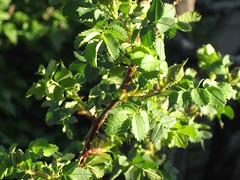
Harrison’s Rose

Originally uploaded by heinemanfleck.

Lissa’s Harrison’s rose is the product of some adventure. Our first try involved stealing a clipping from a certain prominent government building, all Tom Cruise Mission Impossible-like, swooping in like secret agents. But it never took root. Then Tim Berners-Lee invented the Internet, and she bought one on line.

It’s a classic old American heirloom – the Yellow Rose of Texas, if you will. There was a brief period in American history when the Republic of Texas claimed everything west to the Rio Grande, so it’s on home turf here of a sort, and it seems to be liking the country just fine. It sent out runners this year in both directions, and it’s on the verge of busting out in bloom. Last year, that happened around about April 25 or so, which means we’re on schedule.

The garden is one of the great joys of our marriage. Lissa and I share a sort of haphazard aesthetic. Lissa is the creative genius, able to visualize through the blank spaces. I simply wait for things she plants to grow. Both of us are flexible in our accommodation of the results, happy to give up quickly on failed experiments and follow our vaguely guided ecosystem when it chooses to head off in its own direction.

On a spring evening like this one, we often go out and wander through the garden together, pointing at this and that, tugging at a weed here, tying up a slumping vine there, marveling at the inevitable surprises. This spring it’s a bunch of random tufts of grass, planted one place several years ago, suddenly making themselves at home everywhere.

From my little office in the back of our house, I can look out over the garden. The sun’s just now dropping behind the neighbor’s house, well beyond Texas’s western boundary. The breeze is jiggling the big elm over the back fence. I can see my pond out the window, and the Harrison’s, waiting to bloom.

An Example of Framing

Press release today from the House Science Committee’s Republicans:

Today, in the first congressional hearing with authors of the Working Group II section of the Intergovernmental Panel on Climate Change’s (IPCC) fourth assessment report, Climate Change Impacts, Adaptation, and Vulnerability, the Science and Technology Committee was told that many different factors will determine the impacts of climate change and adaptation will play a significant role in reducing negative impacts.

“One issue that most of us agree on is that our country will experience impacts from climate change and we need to be ready to adapt to them,” Ranking Member Ralph Hall (R-TX) said. “I have faith in American innovation in finding solutions to help us adapt to theses changes. In the long run, the key to addressing climate change will be clean, affordable, and reliable energy technologies.”