Famine Response

Drought-induced famine is largely a political rather than climatological disaster, as this account by Teshome Erkineh of response to drought conditions in Ethiopia demonstrates. It happens when societies, for whatever reason, fail to cope with climate variability. A million people died in 1983-84 because of drought. In 2003, under what was a more severe drought in meteorological terms, societal mechanisms put in place following the 1980s drought were sufficient to avoid severe famine, according to Erkineh:

Twenty years on, Ethiopia is much better prepared for drought. The country has developed an early warning system, coupled to response mechanisms, that has been shown to be effective: in 2003 more than 13 million Ethiopians were affected by drought, but a major famine was avoided.

Erkineh’s piece is part of a package papers on Climate Risk Management in Africa: Learning from Practice, published by the folks at IRI.

Ionospheric Plasma Blobs

The Blob movie poster

I have absolutely no earthly idea what ionospheric plasma blobs are, but I’m pretty sure they’re a serious threat to life as we know it, or possibly they’re associated with the villain in a 1950s science fiction film, or else I read about them in Zippy the Pinhead. Whatever, I’m pretty excited that Pimenta and colleagues have not only seen them for the first time, but measured their zonal drift velocities! Science can save us!

Increasing Greenland Melt

Marco Tedesco at the University of Maryland suggests a new technique for remote sensing of snowmelt atop the Greenland ice sheet. When he uses it, he reports:

Long-term results show that snowmelt extent has been increasing at a rate of ?40,000 Km2 per year for the past 14 years.

Snowmelt detection over the Greenland ice sheet from SSM/I brightness temperature daily variations,  GEOPHYSICAL RESEARCH LETTERS, VOL. 34, L02504, doi:10.1029/2006GL028466, 2007

Corn, Subsidies and Food

maize

We subsidize ethanol so we can use it instead of gasoline in our cars. The price of corn rises. Poor folk in Mexico can’t afford their staple food:

Mexico is in the grip of the worst tortilla crisis in its modern history. Dramatically rising international corn prices, spurred by demand for the grain-based fuel ethanol, have led to expensive tortillas. That, in turn, has led to lower sales for vendors such as Rosales and angry protests by consumers.

Stuff I Wrote Elsewhere

More (sub. or ad req.) on the question of when a “secret” is not really “secret”:

In the past, the annual review was made public immediately on request. But policies implemented in 2003 granted agency employees widespread discretion to mark documents “official use only,” delaying or preventing the release of many documents once routinely made available.


The NNSA’s Sandia report card is unclassified, meaning it contains no secrets involving nuclear weapons or other national security matters. It has fallen instead into an expanding gray area of government information that taxpayers cannot see even though it is not legally “secret.”


Congressional investigators last year reported that the NNSA’s parent agency, the Department of Energy, held “many millions of pages” of such documents.


Any Department of Energy employee can mark a document off-limits to public view, and members of the public have little recourse short of a formal Freedom of Information Act request, which can take months to years to process.


Use of such quasi-secret designations “has escalated sharply over the last several years,” said Steven Aftergood, an expert on government secrecy policies who works for the Federation of American Scientists in Washington, D.C.

“I killed a buzzard with it.”

Carroll Shelby's cobra

I’ll probably lose whatever dirty hippie cred I had left, but this is the car I lust after – Carroll Shelby’s Cobra. I mean, not just the car Shelby designed, but the one he designed for himself:

“It’s a special car. It would do just over three seconds to 60 (mph), 40 years ago,” Shelby told the crowd before the sale.

“I killed a buzzard with it,” he said. “Nasty, nasty.”

Nukes and Climate Change

The collision of nuclear power and climate change is one of the more fascinating political and public policy debates afoot. Today’s case in point: a Financial Times story about a new Deutsche Bank study:

Germany will miss its CO2 emission targets, face rising electricity prices and become “dramatically” more reliant on Russian gas if it keeps to its policy of phasing out nuclear energy, a new study warns.

The 60-page paper by Deutsche Bank will add to the pressure on Angela Merkel, chancellor, to renegotiate the phase-out deal agreed by the previous government in 2000, despite her pledge not to reopen the controversial debate.

Rising concern about global warming and energy security has sparked a lively dispute in Ms Merkel’s Christian Democrat-led grand coalition government about the wisdom of renouncing nuclear energy. Michael Glos, the conservative economics minister, has campaigned vigorously against the phase-out, triggering equally vigorous opposition from Sigmar Gabriel, the Social Democratic environment minister.

David’s Dirty Hippies

David Roberts, who has gotten a lot of leftie blogosphere traction with his dirty hippie post, is at it again.

Here’s David, describing the point he made on a conservative talk show (“one of the B-list Limbaughs”) yesterday:

The IPCC is one of the most rigorous scientific processes ever developed, and its new report pegs it at greater than 90% confidence that humanity is driving recent warming.

Here’s David a couple of weeks back defending his willingness to abandon the consensus:

Yes, we have to leave science to the scientists. But science is not a priesthood that can or should impose quietude on the rest of us. Our informed gut feelings about how things will turn out are legitimate. People make statements beyond what’s strictly supported by the peer-reviewed evidence all the time. For some reason, internet wonks seem to hold public advocacy on global warming to a strangely prudish set of standards. We don’t impose these kinds of strictures in other areas.

Continue reading ‘David’s Dirty Hippies’ »

Drought in the Southwest

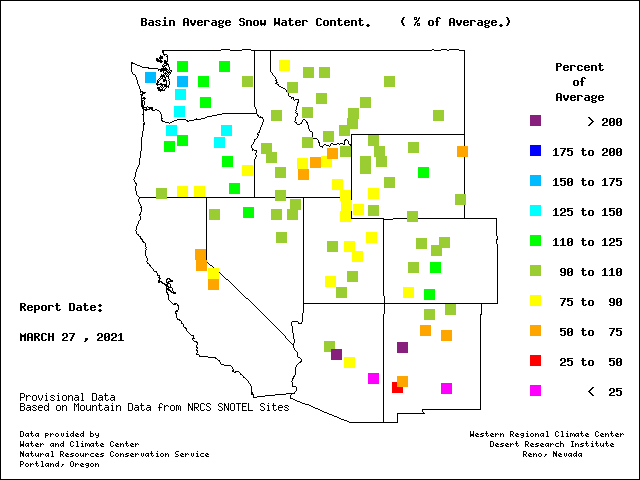
Western Regional Climate Center snowpack map

One of the difficulties in thinking about drought conditions is the tendency to look out your window. Out mine, there’s a nice little blanket of snow, and I’ve got to kick snow or mud off my feet when I come in out of the backyard. But the West is a big and exquisitely interconnected place, and the fact that Albuquerque’s been wet doesn’t begin to tell the story.

David Miskus, in the latest federal drought monitor, points out the contradiction in his assessment of southwest conditions:

Since October 1, basin precipitation has averaged only half to two-thirds of normal, and Jan. 16 SWC (ed: snow water content) was around half of normal, including the Sierra Nevada and major ranges in Nevada, Arizona, and southwestern New Mexico.

You can see that on the Western Regional Climate Center map above – all those bits of orange and yellow and even red across the southwest. You’ve got to get all the way over to central Colorado and New Mexico before you begin to see normal to above-normal precipitation. Those are the places most of us live – Denver and the east slope communities in Colorado, Albuquerque in New Mexico – but those are places that only contribute modestly to the region’s water supplies.

Some reservoir level numbers suggest the extent of the dilemma. As of Jan. 1:

  • Elephant Butte, New Mexico’s biggest reservoir, was just 41 percent of its Jan. 1 average
  • Lake Powell, one of the two giants on the main stem of the Colorado River, was at 64 percent
  • Lake Mead, the other Colorado River giant, was at 65 percent

So you Colorado and New Mexico residents feeling all wet and happy take note: all is not quite as it appears out the back window.