

This is not the U.S. precipitation pattern you expect in an El Niño winter. Here in Albuquerque, we’re living under a bit of an illusion, with the fourth storm since Christmas currently snowing east and north of us and clouds and a threat of rain here in New Mexico’s largest city. But you only have to travel up to Quinault, up on the Olympic Peninsula west of Seattle, to grasp the pattern. The new U.S. Climate Reference Network station there has received 23.6 inches of rain since Jan. 1. The typical El Niño pattern tends to be drier than normal across the Pacific Northwest, and wetter than normal across the southwest. But we’ve been getting instead what the National Weather Service forecasters down here call “bowling ball storms,” staring up in the Pacific Northwest and diving down across the Great Basin rather than coming in off of the Pacific. Southern California and Arizona, as you can see, have been extraordinarily dry the last three months. We’ve been getting the edge of the storms here in New Mexico, but even here, it’s been a lot drier than I think people perceive it to be.
The Press Release Problem
When I wrote a brief squib last month about the new Holland et al. paper on sea ice decline, I made fun of myself for picking the worst-case scenario, suggesting a “a chance of an ice-free late summer arctic by as soon as 2040.” Apparently I was not alone. In her RealClimate post on the paper and its journalistic aftermath, Cecilia Bitz offers a nice explanation of the work and offers a similar observation to mine. The ice-free 2040 was the most extreme of a number of scenarios:
There is considerable uncertainty in future model projections, and Figs 2 and 4 illustrate why it would be better not to focus too much on the year 2040, which to our dismay was highly publicized.
In understanding why this happened, it is useful to look at the NCAR news relese:
The recent retreat of Arctic sea ice is likely to accelerate so rapidly that the Arctic Ocean could become nearly devoid of ice during summertime as early as 2040, according to new research published in the December 12 issue of Geophysical Research Letters.
In the news release, only the “ice-free in 2040” model run is discussed. It is the model run featured in the animation included with the news release. Is it any surprise that this is the scenario journalists chose to focus on, given that this is what the scientists, through their news release, told them was the most important?
ENSO Peaking
The monthly ENSO assessment, out today, suggests El Niño may be peaking (the “Kelvin waves” it talks about are essentially big pulses of warmth moving west to east across the equatorial ocean, which are a key feature of El Niño):
Most of the statistical and coupled models, including the NCEP Climate Forecast System (CFS), indicate that SST anomalies are near their peak and that decreasing anomalies are likely during February-May 2007 (Fig. 5). Recent observed trends in the upper ocean tend to support those forecasts. Decreasing upper-ocean heat content in the central equatorial Pacific has been progressing east in association with the upwelling portion of the most recent Kelvin wave. In the absence of any further Kelvin wave activity, the upper-ocean heat content should return to near average in a few months. However, there is considerable uncertainty in this outlook, given the resurgence of MJO activity in late December 2006. It is possible that the enhanced precipitation phase of the MJO, which is currently entering the western tropical Pacific, might trigger a more persistent pattern of cloudiness and precipitation over the anomalously warm waters of the central equatorial Pacific during the next several weeks. If that occurs, then the equatorial easterlies over the central Pacific will likely weaken possibly leading to the initiation of a fifth Kelvin wave.
The Aquadoc
Mike Campana, one of my favorite water academics, launches WaterWired with a reprise of the case against bottled water.
Daybook
- weather: Looks like we’re on the El Niño one-storm-a-week track here, with another wet patch headed for New Mexico through the weekend. This’ll be the fourth in a row.
- book1: Andrew Revkin’s The North Pole Was Here. Don’t be fooled by the whole “children’s book” thing. It’s a ripping good read, and Revkin has clearly taken both his subject matter and his audience seriously. Grownups who read climate books written for grownups are likely to already be interested in climate, so really, what’s the point? This audience, on the other hand, matters a great deal.
- book2: Late Victorian Holocausts, Mike Davis’s account of the interplay between Victorian empire and our friend El Niño in the making of some really ugly global famine. Eek! Is it environmental determinism?
- paper of the day:Is there any climate scientist working today more dramatically entertaining than Lonnie Thompson? I mean, really, you latte-sipping modelers with your fancy computers and your parameterizations and your heated offices. In this week’s episode, the swashbuckling Team Thompson returns from the foreboding Dasuopu glacier in the Himalayas to reveal the dramatic influence of industrializing Asia: “Unlike the Greenland ice core-derived sulfate concentrations that have declined since the 1970s, sulfate concentrations deposited on the Himalayan ice fields continue to increase, having nearly doubled since 1970.”
- word of the day: pelf: money, from the old French word pelfre (the spoils)
Stuff I Wrote Elsewhere
This is one of those Prufrock moments, when it is impossible to say just what I mean. From the paid job blog, on my old friend Ed McGaffigan:
Reporters depend on the generosity of smart people, people who understand how things work and are willing to spend the time to help us understand it too. In my two decades as a reporter, I can think of only a handful of people as smart, generous and important to my work as Ed.
Water in the Desert
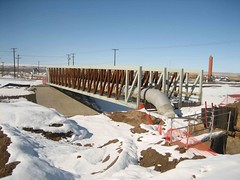
When I was in Phoenix a couple of years ago, I made a pilgrimage to the Frank Lloyd Wrightish Biltmore. Phoenix is flat-out desert, hot, just 7.5 inches of rain (19 cm) a year. But the Biltmore is an oasis, green, cool and shady, the implication being that you can beat back the desert if you’ve got enough money. But here’s what I liked most about the Biltmore: its driveway is a bridge across a concrete Central Arizona Project river. In first world deserts, we build cities and abstract ourselves from the complex plumbing needed to bring them water. And in so doing, we abstract ourselves from the water itself. But at the Biltmore, as you drive into the shady oasis, you can’t ignore the plumbing needed to make it that way.
I’ve been thinking about this whole abstraction problem over the last week as Albuquerque lies under a blanket of snow. This is unusual for us, and it’s got us thinking about water in a much more direct way than usual. Usually, the snow that provides New Mexico’s water supplies falls in the northern mountains. To the extent we use it here in the Middle Rio Grande Valley, it’s used in irrigation ditches down in the valley. Albuquerque’s municipal water is currently supplied essentially entirely by pumping groundwater. But that is going to change in the next couple of years, as we start using San Juan River water. A massive plumbing project is underway around town to capture, treat and distribute the water, but once the construction-related traffic delays are over, that system too will be abstracted. But for a brief moment, as we lie under a blanket of snow, we have a chance to actually think a little bit about our water supply, experience it directly. Continue reading ‘Water in the Desert’ »
Cycling in the Desert


One of the great things about Albuquerque is that I can ride all winter. It can get cold, but with the right clothing it’s rarely enough to keep me indoors. There’s never enough snow on the ground to keep me cooped up for more than a day or two. Until the great storm of ’06.
At some point, though, someone (the gummint?) plowed the bike trail. Still a bit sketchy in spots, but ridable. Picture taken here.
Europe vs. America on Climate: a Hypothesis
The ubiquitous Andy Revkin has a delightful little bit of speculation in this morning’s New York Times regarding the differences between U.S. and European attitudes toward climate change:
Some climate experts muse that the innately variegated climate across the country might help explain why it has taken longer for human-caused global warming to rise to the level of a national priority here than in Europe.
The Inconvenience of the IPCC

I see via Prometheus that David Roberts has taken up my challenge offered in the comments of a previous thread about whether Al Gore is representative of the mainstream consensus or an outlier (as suggested by Andy Revkin in his recent New York Times piece).
I argued that Gore’s treatment of hurricanes and sea level rise goes beyond the mainstream consensus on those issues. Roberts, in his new post, defends Gore:
Because the IPCC, held to punishingly conservative standards of peer-review and consensus, is silent on the hurricane question … does that mean everyone has to be silent? Al Gore chooses to pick a side, in effect predicting which way the chips are going to fall. In that he goes beyond the IPCC — and beyond what the relevant scientific community is willing to label consensus — but he doesn’t contradict the IPCC. He uses his judgment to supplement the IPCC. And he’s been right on this issue for decades, and understands it about as well as any layman on the planet, so I’m not inclined to brush his judgments aside.
It seems perfectly reasonable to me for him to say the following: “Based on some new and emerging research, and based on my sense of the direction of the science over the last 20 years, and based on my holistic understanding of the phenomenon, I believe global warming will increasingly make hurricanes measurably stronger and more destructive.”
I agree that Gore is free to do this in advancing his political arguments, but I think observers like Roberts need to recognize the slippery slope it represents.