Global Warming Has Its Winners, Too

Global warming has its winners as well as losers:

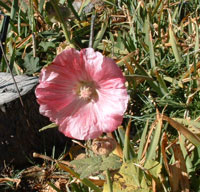
hollyhock

That’s a hollyhock in the front garden, still blooming away two weeks after the average first fall freeze date in Albuquerque. Overnight lows for November in Albuquerque this month have averaged 42 F, 7 1/2 degrees above average. Daytime highs are 8 degrees above average.

Obviously I’d be an idiot to hang anything on a single fortnight’s data, but this is consistent with a long term trend, with a “growing season” (last spring frost to first fall frost) averaging two weeks longer here than it used to. Good for the garden, eh?

update 6:30 p.m.: I almost forgot half the reason for this post, which is that the National Weather Service is forecasting a freeze Wednesday morning.

(click through for the fine print)
Continue reading ‘Global Warming Has Its Winners, Too’ »

105.1

With a couple of fun longish rides this weekend, including a lovely trek through the bosque yesterday with Jaime, I had my first 100-mile week since last March, when the knee drama began.

bike mileage graph

It’s not all about the numbers, of course. It’s also about three casual hours on the bike chatting with my pal, and the golden leaves down in the bosque. But the numbers also are part of the fun, and the numerical milestone matters. Green dots are weekly miles, black line is a four-week rolling average.

No Niña just yet, but pay attention

Don’t panic just yet, but it’s worth paying attention to a couple of signs out of the monitoring and forecast community that La Niña (the cool equatorial Pacific that tends toward dry winters here in New Mexico) may be about to sneak in the back door. The latest CPC forecast, out Thursday, said as much:

ENSO-neutral or weak La Niña conditions are likely during the next 6-9 months.

Klaus Wolter’s MEI index, which brings together a number of different measures of ENSO activity, just slipped into the negative (La Niña) phase for the first time in more than a year. One month there does not a La Niña make, but it’s worth watching.

And the Pacific Decadal Oscillation index has also gone negative. I’ve been strongly cautioned against reading too much into the month-by-month PDO numbers, because they’re much more useful as a measure of decadal-scale oscillations (remember their name). But again, worth watching.

We don’t need no stinkin’ subsidies

I don’t mind saying that Al Zelicoff is a bit of a nut. But I mean that with the greatest respect, because you frankly can’t argue with the results (1.2 meg pdf, and more here). At Al’s ordinary (OK, slightly larger than ordinary) upper middle class Albuquerque home down the street from me, he has slashed his fossil fuel consumption, as the graphs in the pdf linked above show. No particularly wacky adjustments to an ordinary middle class American life required, just a bit of ingenuity. OK, the spreadsheets and sophisticated statistical analysis Al brings to the task are not exactly normal American middle class. This is a guy who pulled out his laptop at lunch (we were eating Thai) to show me his latest weather/energy consumption correlation analysis. But really, what he’s done, anyone could do. Without subsidy:

Much of the southwest – including large swaths of heavily populated California and Arizona are in more or less the same solar flux zone as Albuquerque and there are state-by-state subsidies for installing small PV systems. New Mexico has no such subsidy, and I must admit I’m not a fan of subsidies in any case as they tend to distort markets. Better, I think, to remove the subsidies – both overt and hidden – from fossil fuel costs and their horrific externalities.

Meth and the Newspaper

I tried posting a comment last week over at Tim McGivern’s blog, but it seems to be caught up in some moderation queue either technological or human, so I thought I’d throw this up here instead.

Tim took a shot at the Journal for its “feckless” coverage of the meth problem. My comment was that one can always criticize the newspaper for not doing enough about any important issue, but it’s not fair to suggest, as Tim seems to want to, that the Journal’s ignoring it. The paper had a front page package (see also this – sorry, sub. req.) on Sunday, Oct. 23 (front page Sunday package = the prime newspaper real estate) by Leann Holt on the subject that was incredibly powerful and moving:

Kim is intimately acquainted with the horrors of methamphetamine use. The 23-year-old discovered the burned, lifeless body of her 5-month-old son after waking from a drug-induced stupor one morning almost two years ago.

Sometime during the previous night, the baby had rolled off a bed and onto a space heater. His charred blanket was still wrapped around him when his mother found him. She never heard him cry.

Kim is serving seven years in prison for her son’s death. Her other two children, ages 7 and 5, are being adopted by her mother.
“I want people to know what meth does,” the sobbing young woman said during a telephone interview from Grants Correctional Facility. “I want them to know what it leads up to. It brought me nothing but trouble.”

The number of children in state custody has risen by 21 percent over the last 18 months— and state officials blame the use and production of methamphetamine for most of that increase.

Officials say the abuse and neglect children suffer in a home with meth is much worse than with other drugs.
Sexual abuse is common.

Homes mired in extraordinary filth and riddled with dangerous chemicals are to be expected when meth is involved, said State Police officer Donald Garrison.

“These children are living in houses not even suitable for animals,” he said.

“Deplorable filth, loaded weapons, chemicals and pornography are almost trademarks of a meth house,” said Rey Martinez, a professor and researcher at Highlands University who is studying the effects of meth on children.

That’s about as not feckless as a newspaper story could be.

More on that Pesky Single Number

Jim Hansen and buds offer an explanation of the 2005 global temperature numbers, in part in response to last month’s Washington Post story on their data. Money quote:

The existing record in the period of instrumental temperature measurements occurred when the 1997-98 “El Nino of the century” occurred on the back of a strong two-decade warming trend; in addition, the global temperature impact of the El Nino, which typically lags the El Nino by a few months, coincided almost precisely with calendar year 1998. As a result, the 1998 temperature jumped about two standard deviations above the prior record. Thus, if the 1998 global temperature level is reached without help from a large El Nino, such a result would be a measure of how intense the underlying global warming trend has become.

As Roger Pielke Sr. loves to point, there’s more to climate than surface temperatures. But it is, after all, where we all live, so in terms of human understanding and experience, the number nevertheless has some relevance. And to the commenter who suggested that “a sample going back to 1880 isn’t very meaningful,” that all depends on what you mean by “meaningful.” Given that human societies make significant decisions on decadal timescales, I would argue that a climate record going back to the 1880s is meaningful. The past century’s climate sure seems meaningful to me.

(hat tip RealClimate)

Environmental Determinism

I’ve been struggling to understand “environmental determinism,” and why some people think it’s so icky. Thanks to Wikipedia, I finally get it. I was stuck on the plain English meaning of the words, and thought I had stumbled down the rabbit hole of some sort of academic argument over the relative importance of environmental boundary conditions and human response in determining the trajectory of societies.

Apparently there’s an older, uglier meaning of “environmental determinism” that explains, for example, why my ancestors who grew up on the beaches of California ended up as lazy surf bums, only interesting in drinking beer and screwing. In other words, to quote the wikipeople, “The basic argument of the environmental determinists was that aspects of physical geography, particularly climate, influenced the psychological temperament of individuals, which in turn shaped the culture and society that those individuals formed.” You can see how that leads you down a racist path in a hurry. I know plenty of surfers interested in other things besides beer and sex. Like surfing, for example.

Dude, no wonder people thought it was icky.