
Global Warming Kills Trees

Before I slipped away for vacation last week, I was able to write this (sub. req.):

New Mexico’s massive pi?on die-off of 2002 and 2003 might be a harbinger of life here in a warming world, new research suggests.

High elevation forests that had survived previous droughts saw as much as 90 percent pi?on mortality, a team of researchers led by University of Arizona ecologist Dave Breshears reported Monday in the Proceedings of the National Academy of Sciences.

“Across a whole landscape, this system got whacked,” Breshears said in a telephone interview.

Drought weakened the trees enough that bark beetles could kill them, but warmer temperatures appear to have played a key role, the scientists found.

The temperature difference? 1 to 2 degrees Fahrenheit above the long-term average? might not sound like much. But the scientists say it made the difference, leading to tree death in areas relatively unaffected by the drier drought of the 1950s.

“This is a different kind of response than we saw following the 1950s drought,” said Breshears, who has been studying pi?on woodlands since the 1980s. “This drought was hotter.”

Breshears, in an interview, was careful not to blame the 2002 die-off on human-caused global warming, saying no one event can be unequivocally linked to the planet’s long-term rising temperature trend.

But he said the dramatic drought-induced changes in the Southwest’s landscape since the turn of the 21st century are consistent with global climate change projections.

“We’re more likely to get more frequent, more intense droughts,” Breshears said.

For those of you not in the U.S. southwest, the pi?on/juniper woodland is a dominant middle-elevation forest type that was decimated a few years back – whole hillsides turned from their usual green to a frightening greyish brown. Like dwindling snowpacks, it’s a warming effect that you can see on the ground, now, but until Breshears et al. did this work, no one had established the link. It’s still a controversial link, as the comments from Julio Betancourt in my story suggest. (Betancourt, a terrific scientist who I respect on these issues and who probably knows the drought of the 1950s better than anyone, believes we don’t enough about 50’s dieoff to be sure the current dieoff is worse.) But caveats notwithstanding, it’s nevertheless important work of the sort that matters – climate science helping us understand impacts on the ground.
Einstein’s Great Mistake

Like every card-carrying science writer, I was somehow obligated to do an Einstein story (sub. req.) this year, the 100th anniversary of his annus mirabilis. When I asked my favorite physicist, Carl Caves, for help finding a topic of relevance today, he suggested the EPR paradox, and pointed me toward a delightful grad student of his, Bryan Eastin, who’s working on the issues raised in the EPR paper:

To Bryan Eastin, Albert Einstein’s most interesting idea may be one that was wrong.

It was 1935, and Einstein and two colleagues were trying to make sense of the world of quantum physics. They failed? but in such an interesting way that physicists today still wrestle with the questions they raised.

The year 2005 has been declared the “World Year of Physics” in honor of work Einstein did a century ago. They call 1905 Einstein’s annus mirabilis? the miracle year. Four papers written in rapid succession that year laid the foundations for modern physics.

In the years that followed, Einstein’s brilliance made him an icon, his name synonymous with genius.

To really understand the depth of Einstein’s insight, it is instructive to wander into Eastin’s cubicle in a ramshackle wing of the University of New Mexico’s old Physics and Astronomy building.

There, in a tattered three-ring binder, Eastin is working out the implications of what might be considered Einstein’s great mistake. Such was the power of Einstein’s intellect that a new branch of physics? “quantum information theory”? has developed around it.

Eastin, a 27-year-old UNM graduate student, is working on his doctorate in quantum information theory.

Following Einstein down the rabbit hole, Eastin and his colleagues are pointing the way toward a remarkable new type of “quantum computer,” far more powerful than the ones we use today.

“Even when he was wrong,” said Carl Caves, Eastin’s UNM faculty adviser, “he was better than the rest of us.”

Lee’s Ferry

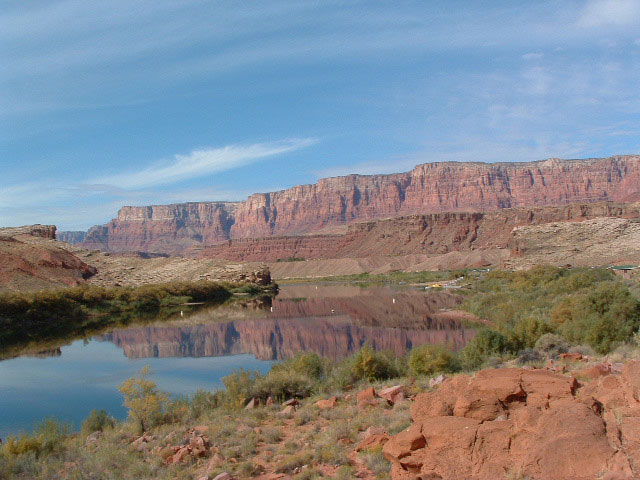
There’s no point in even bothering to try to take a picture of the Grand Canyon, so here’s Lee’s Ferry:


Lee's Ferry

L and I just got back from a lovely week circling the Four Corners. We saw:

  • Aspens turning where the head of the La Plata River meets the feet of the San Juan Mountains
  • Ruins in the Dolores Valley, where the Anasazi toiled in the shadows of Mesa Verde and get no respect because of their cliff-dwelling kin
  • The old orchard at Lee’s Ferry, a wonderment on the flood plain of the Paria – a blooming desert
  • The Grand Canyon

Balloons

Our Balloon Fiesta is almost over. This morning I rode north with a couple of friends. There were many balloons in the sky. (insert cliche here)

They’re lovely and all, but it’s worth duly noting Burque Babble’s observations:

THIS IS TOM JOLES, Tonight at 10, FIRST ON FOUR, Six U.S. Soldiers Are Killed In Iraq, find out local reaction tonight from Balloon Fiesta Park, and speaking of the fiesta, ONLY ON FOUR, LIVE BREAKING COVERAGE OF Richard Abruzzo’s views on the ongoing debate in Kansas between the teaching of Evolution and Intelligent Design. Abruzzo recently crashed his balloon in Kansas and he tells Eyewitness News’ Colleen MAH o nay (who is evidently not Irish in heritage but some form of Athabascan Native American) his views on the educational debate in that State. Plus, weatherman Larry Rice inexplicably stands out LIVE at a darkened Balloon Fiesta Park to tell us how Typhoon Brittany off the coast of Japan might impact winds at tomorrow morning’s launch. THAT’S TONIGHT… ONLY ON FOUR.

(Hat tip Coco.)

Moving Beyond the Hockey Stick

Michael Mann was in town speaking at the University of New Mexico yesterday. I wrote about his talk (sub. req., lots of quotes from the story below the fold) and got to spend some useful time talking to him about big picture climate issues. (Thanks, Mike!)

I didn’t have much space, so the story was short, and I chose to focus more on regional climate issues than hockey sticks. I’m kinda sick of hockey sticks, and it was interesting to see that Mann’s recent work, the stuff he chose to talk about in his UNM talk and the stuff I’ve been reading recently, is moving beyond the stick in ways that I think are incredibly useful.

(click through for more)
Continue reading ‘Moving Beyond the Hockey Stick’ »

Why It Is Increasingly Difficult For Me To Use Free Software

Gnumeric is one of the computer tools I most frequently use. But the version I’m using is 1.2.1, which is some two years old. Why have I not upgraded, to take advantage of the sweet new features the Gnumeric team has been developing? I hope my answer to that question will be of some interest to my GNOME project friends.

When I was active in the GNOME project, it was routine to spend an hour or two a day of my free time working on whatever – writing user docs, helping manage bug reports, chatting on IRC with my pals, compiling the latest whatever in the background. I loved the people (still do!) and I loved the work. And I loved the software, too. I believe in the political and ethical notions of freedom and sharing that free software embodies. And I also prefer the freedom and flexibility to control your own data and computational destiny that you get with the Linux platform and the software stack that rides on top of it.

When I decided a couple of years ago to step down from my formal GNOME obligations so I could use my free time to start working on a book project, I expected that I would still be able to kick in a bit of free time to update user docs, triage bug reports, and help with some of the grunt work. But I quickly reallized that if you can’t spare the minimum amount of time and effort required to keep the latest versions of the software stack built, there’s no way to make useful contributions to the development effort. That bar is quite high – too high for me given my new self-imposed obligations.

As a user, I remained (and remain) enthusiastic. But as the time I was actively hacking recedes, the distance between the software stack on my computer and the latest interesting development work grows. The solution, of course, is simple – upgrade! Between Fedora and Ubuntu, this ought to be a relatively straightforward proposition. But at this point you have to remember that I am not a really a hacker. To make the contributions I did, I had to learn some modicum of command line skills. But every time during my active days I had to do a serious system upgrade, I faced a chore and a crap shoot. When it went smoothly, great. When it didn’t, I had to spend hours Googling and IRC’ing how to manually change the “.frabinator_conf” file, and get the “gurglebarger” module to load before the “bergenhafter” module, and why won’t it talk to my printer? Or worse, why won’t it boot? So when I stopped hacking, I stopped doing full system upgrades, because I’m supposed to be writing now, not hacking config files by hand.

For the way that I write, Emacs is still a beloved tool, and Gnumeric even frozen in time in 2003 still meets pretty much all my number-crunching needs. Libxml – god love Daniel Veillard, one of my heroes – always builds no matter what the calcified state of my stack. Increasingly, thought, all the cool new software is out of my reach as the kernel and the stack advance away from me. Occasionally I’ll see some cool new gadget I want to try. I’ll download it and try to compile it and it’ll tell me that I need to upgrade the frabinator. Sorry, no go. Gotta get back to writing.

The purpose of this screed is not to plead for y’all to stop working on the stack. That would miss the whole point of the power and joy of free software. The people who own the pieces of the stack love it, and want to make it better, and are doing amazing things with it that benefit the users who get the latest version. But people like me are always going to be left behind.

Made for TV Miguel

Is this really true, or just some amazing joke: “a made-for-TV movie about Miguel aired on prime-time Mexican television.” Miguel’s embarassed? Fool. This is pop culture superstardom, lain at his feet! I don’t know if chicks dig free software hackers, but a made-for-TV movie?

Cool Domain Names

I like cool domain names. One-word ones are cool because (sort of like the special allure of a 3-digit REI member ID number) they mean someone was thinking early on in the age of the Internet. That’s why, aside from being the coolest food blogger I know of, Albuquerque’s Miss Tenacity deserves special respect.

Here’s another I recently ran across (via Secretly Ironic, another good one) that I particularly admire: Team Moose and Squirrel.

(Updated 2: 22 p.m. to cure some horrid prose)