“I’m melting! I’m Melting!”

Phil Mote and colleagues have a paper in the latest Bulletin of the American Meteorological Society updating their work on western snowpack and climate change. Bottom line – the snow’s melting:

The largest decreases have occurred where winter temperatures are mild, especially in the Cascade Mountains and northern California. In most mountain ranges, relative declines grow from minimal at ridgetop to substantial at snow line. Taken together, these results emphasize that the West’s snow resources are already declining as earth’s climate warms.

They don’t have snow records back real far, so the results get a bit tangled up in the PDO and other decadal-scale patterns. But it seems pretty clear that as things get warmer, the snowpack patterns are changing. This is important in a region that depends on winter snowpack as a water storage mechanism to meet summer water usage needs.

More here.

Appell on Mann

David Appell in the March Scientific American on the hockey stick (only a bit is free, but Benny Peiser happily violated Scientific American’s copyright via his mailing list, so I’ll test the bounds of fair use and quote a bit more):

To construct the hockey-stick plot, Mann, Raymond S. Bradley of the University of Massachusetts Amherst and Malcolm K. Hughes of the University of Arizona analyzed paleoclimatic data sets such as those from tree rings, ice cores and coral, joining historical data with thermometer readings from the recent past. In 1998 they obtained a “reconstruction” of Northern Hemisphere temperatures going back 600 years; by the next year they had extended their analysis to the past 11,000 years. In 2003 Mann and Philip D. Jones of the University of East Anglia in England used a different method to extend results back 2,000 years.

In each case, the outcome was clear: global mean temperature began to rise dramatically in the early 20th century. That rise coincided with the unprecedented release of carbon dioxide and other heat-trapping gases into the earth’s atmosphere, leading to the conclusion that industrial activity was boosting the world’s mean temperature. Other researchers subsequently confirmed the plot.

The work of Mann and his colleagues achieved special prominence in 2001. That is when the Intergovernmental Panel on Climate Change (IPCC), an international body of climate experts, placed the hockey-stick chart in the Summary for Policymakers section of the panel’s Third Assessment Report. (Mann also co-authored one of the chapters in the report.) It thereby elevated the hockey stick to iconic status–as well as making it a bull’s-eye. A community skeptical of human-induced warming argued that Mann’s data points were too sparse to constitute a true picture, or that his raw data were numerically suspicious, or that they could not reproduce his results with the data he had used. Take down Mann, it seemed, and the rest of the IPCC’s conclusions about anthropogenic climate change would follow.

That led to “unjustified attack after unjustified attack,” complains climatologist Gavin A. Schmidt of the NASA Goddard Institute for Space Studies. Although questions in the field abound about how, for example, tree-ring data are compiled, many of those attacking Mann’s work, Schmidt claims, have had a priori opinions that the work must be wrong.

“Most scientists would have left the field long ago, but Mike is fighting back with a tenacity I find admirable,” Schmidt says. One of Mann’s more public punch backs took place in July 2003, when he defended his views before a congressional committee led by Senator James M. Inhofe of Oklahoma, who has called global warming a “hoax.” “I left that meeting having demonstrated what the mainstream views on climate science are,” Mann asserts.

Wearing Pink

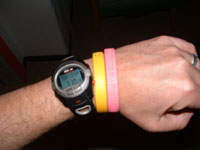
I came home to find a bunch of pink rubber bands on the couch. I put one on:

pink bracelet

A couple of months ago, a friend at work asked me how much longer I was going to wear the yellow. “I don’t know,” I said. The real answer is, “As long as Lissa does.” I asked her if she was going to take off the yellow and switch to pink. She said no, she’ll wear them both.

Then so will I.

Back from the far Side

Back in the realm of the living. Notes from my multi-faceted absence:

William Connolley has a good rundown on the Moberg et al. paper with the latest version of the hockey stick. Is it me, though, or is anyone else out there frustrated by the fact that most of the mental energy associated with the discussion of this fascinating paper involves its place in the climate wars rather than its abilty to shed light on climate? All of the most interesting science must be framed in terms of its place in the debate, rather than its place in our understanding of climate.

Sick, and lacking any good computer games to occupy my mind (my old Sim City 2000 just couldn’t hack it), I turned to PyGTK and DV’s libxml python bindings, and whacked together a little app to better keep track of a whole bunch of my writing.

When I don’t exercise, I start to feel sickly. When I’m as sick as I was over the last week, I can’t exercise. You see the problem. This morning I hauled the bike out of the garage, set it up on the trainer, and rode for half an hour, staring at the heart monitor the entire time. My lungs did not appreciate it, but the rest of my body seemed to be rejoicing under the load. I imagine these complex metabolic pathways that have been built over the years of training getting all stopped up like debris clogging a rain gutter. This morning I broke through the debris.

Laid Out

Laid out by the flu, made all the worse by the fact that I was on a work trip when it hit, leaving me not much choice but to sit off by myself, refuse to shake anyone’s hand, and suck it up until I could get home.