
The Problem with Consensus

My climate science blogging brethren have been typing up a storm about Naomi Oreskes’ Dec. 3 Science essay on the consensus about climate change, and amidst all the noise I missed Roger Pielke Jr.’s thoughtful take (he’s quoting here in his blog from a 2001 Nature paper):

Consider once again global climate change. For many years, policy debate has centred on the degree of certainty that decision-makers ought to attach to competing visions of the future climate. Lost in this doomed enterprise is the point that climate will certainly have an increasingly strong effect on the environment and society, simply because of growing vulnerability related to factors such as population, wealth and use of land. If a goal of climate policy is to reduce the effects of climate on the environment and society, then effective action need not wait until we are more certain about details.

Seen in this light, efforts to reduce uncertainty via ‘consensus science’ – such as scientific assessments – are misplaced. Consensus science can provide only an illusion of certainty. When consensus is substituted for a diversity of perspectives, it may in fact unnecessarily constrain decision-makers’ options. Take for example weather forecasters, who are learning that the value to society of their forecasts is enhanced when decision-makers are provided with predictions in probabilistic rather than categorical fashion and decisions are made in full view of uncertainty. As a general principle, science and technology will contribute more effectively to society’s needs when decision-makers base their expectations on a full distribution of outcomes, and then make choices in the face of the resulting – perhaps considerable – uncertainty.
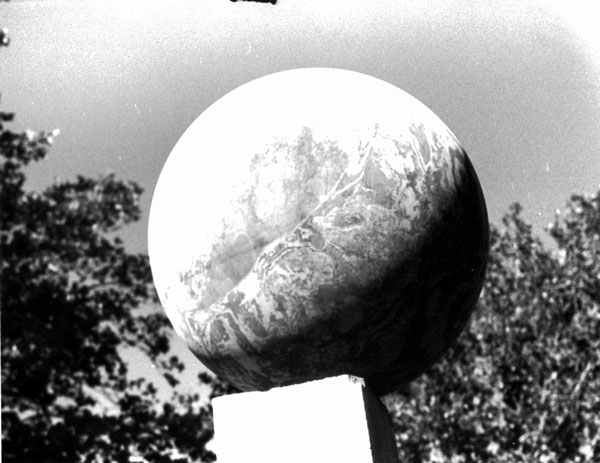
Exhibit B

Daughter Nora today made a print of this photograph of the first missing bowling ball. Label it Exhibit B:


Missing Bowling Ball

If you have seen this bowling ball, please notify the authorities.

A Garden Sprinkler!

Another bowling ball suggestion:

I suggest adding a garden sprinkler system for further hilarity.

(Obviously taking due care to protect loudspeaker, light and webcam in
the process)

No doubt the loudspeaker, light and webcam will have to be of the all-weather variety, so this shouldn’t be a problem.

Bowling Ball Wars Continue

A reader suggests that continuing to replace the bowling balls as they are stolen would be wrong: “Noooo “they” will win then. John, there’s principle at stake here!”

This reader’s alternative suggestion:

1. Point webcam and light at ‘crimescene’
2. Place loudspeaker near ‘crimescene’.
3. Rig loud speaker and light to trigger when bowling ball is lifted from post.
4. Post hilarious pictures of thief having the living-be-jesuses scared out of him on your Blog site.
5. We laugh ourselves hoarse and you hopefully keep your bowling balls in future.
6. Thief is scarred for life and develops a Pavlovian fear-response whenever he thinks of stealing something in future. He gives up his now impossible life of crime and goes to college were he excels in medicine. He later develops a cure for cancer and in his Nobel prize acceptance speech credits YOU with changing his life.

I think we’re on to something here. Rube Goldberg in the service of humanity.

RealClimate on Crichton

Gavin Schmidt on RealClimate gives his take on Michael Crichton’s new anti-global warming novel. Schmidt’s discussion reads like a fundamental primer on the subject. My favorite bit:

The characters visit Punta Arenas (at the tip of South America), where (very pleasingly to my host institution) they have the GISTEMP station record posted on the wall which shows a long-term cooling trend (although slight warming since the 1970?s). “There?s your global warming” one of the good guys declares. I have to disagree. Global warming is defined by the global mean surface temperature. It does not imply that the whole globe is warming uniformly (which of course it isn?t). (But that doesn?t stop one character later on (p381) declaring that “..it?s effect is presumably the same everywhere in the world. That?s why it?s called global warming”). Had the characters visited the nearby station of Santa Barbara Aeropuerto, the poster on the wall would have shown a positive trend. Would that have been proof of global warming? No. Only by amalgamating all of the records we have (after correcting for known problems, such as discussed below) can we have an idea what the regional, hemispheric or global means are doing. That is what is meant by global warming.

Bowling Ball Suggestions

Readers offered several suggestions for dealing with our bowling ball problem:

  • Some coarse chicken wire covering the bowling ball and your choice of weak or strong current. Might want to get a sparky (Australian: electrician) to suggest a non-fatal voltage… something like an electrice fence amount of unpleasantry : )
  • Being in America you’ve got access to firecrackers right? Could one be rigged to ‘go off’ when the ball is lifted from the post?
  • Goodwill has bowling balls for .75 to $1.25 here so it’s cheap enough to replace them. I say, keep replacing them.

Stuff I Wrote Elsewhere

On the “scientization,” as Daniel Sarewitz calls it, of a political/policy debate:

Since 1988, Sandia has spent some $10 million of taxpayer money on study after study of its Mixed Waste Landfill, an unlined dump on the southern side of Kirtland Air Force Base. For more than three decades, it was filled with all manner of hazardous and radioactive waste.

Each step of the way, Sandia officials have said the evidence was sufficient to support their argument that the landfill does not pose a risk and that the waste can safely be left where it is.

Each step of the way, activists have disagreed, saying the landfill could contaminate the aquifer and needs to be excavated.

And each step of the way, additional studies have failed to settle the issue, and instead become new subjects of contention.