Arctic Warming

Andrew Revkin broke the details Saturday of the Arctic Council’s new report on global warming in the arctic, which is official due out Nov. 9:

A comprehensive four-year study of warming in the Arctic shows that heat-trapping gases from tailpipes and smokestacks around the world are contributing to profound environmental changes, including sharp retreats of glaciers and sea ice, thawing of permafrost and shifts in the weather, the oceans and the atmosphere.

The study, commissioned by eight nations with Arctic territory, including the United States, says the changes are likely to harm native communities, wildlife and economic activity but also to offer some benefits, like longer growing seasons. The report is due to be released on Nov. 9, but portions were provided yesterday to The New York Times by European participants in the project.

As it happens, I’m in the midst of reading The Whale and the Supercomputer, Charles Wohlforth’s terrific new book on climate change in the arctic. Wohlforth spends time both with the natives who have lived along the arctic circle for millennia and the scientists new to the region trying to understand climate change from the view of both. I highly recommend it.

Figuring Out Where the Good Science Is

Those of you who follow the science policy wars – the question of how you determine where the science is on controversial policy questions – might be interested in a story by Annette Cary in the Tri-City Herald (reg. req.) Friday about litigation over whether the Hanford nuclear plant made people sick.

Cary does a good job of laying out the dilemmas in what could be a classic case study. You’ve got a Big Science consensus, in this case represented by a CDC study saying, essentially, “no harm.”

“The best science that money can buy suggests no link between emissions and thyroid disease,” said defense attorney Randy Squires in a earlier motion hearing.

You’ve got plaintiff’s lawyers arguing that the data used for the CDC study is based on such uncertainty and imperfect knowledge that one has to fall back on first principles understanding.

“The one well-established risk factor for thyroid cancer is radiation,” downwinder attorney Brian Depew told the judge as about 20 downwinders and their family members listened in a Spokane courtroom.

And you’ve got a judge who has to decide.

The Magic of Free Software and the Self-Organizing System

The magic is not predictable, and sometimes it’s difficult to call it up when you need it. But when it happens, it’s a delight to watch.

The case in point is gnome-utils. It’s a little package of utilities that ships with GNOME, things like the dictionary and a system log viewer and such. It was my first serious involvement with the GNOME project back when I started, the place I did my first CVS commits, and I’ve always maintained a certain fondness, keeping an eye on the docs and a subscription to the bugs alias. The list of people who have contributed to it over the years is like a historic who’s who of GNOME. Heck, even GNOME’s astrophysicist emeritus, Mark Galassi, has code in there!

Of late it’s been something of a chore to maintain, though. Glynn Foster most recently bore the burden, but needed to bail and try to find a new maintainer. And, out of the woodwork, a new team has materialized, which has been attacking the problem with gusto. Davyd Madeley, Vince Noel, Glenn Mason, Dennis Cranston (Dennis has actually been doing a great job of maintaining the file search tool for a while, which is rather like keeping a 1957 Ford pickup on the road – you really admire the person who does it, and are glad it’s not you.) James Bowes.

Davyd today suggested a way to see if a bit of the magic could be made to rub off on the applets. Check it out.

New Mexico State Fair

This is a Google experiment.

Last month, I was incredibly frustrated when I went to Google to get schedule information for the New Mexico State Fair and couldn’t find the fair’s web page. Today, after a conversation at the office about this travesty, I spent some actual time with Google and could not find the fair’s web site in the first 10 pages of Google. I found Matt Bohnsack’s Fair pictures, and my own Fair pictures. But the actual web page was nowhere to be found. My hope is that by linking to it, I can lend it a little bit of googlejuice, so people who need information about the state fair can find it. Becuase it’s a really fun fair. Y’all should go next year.

TCS on the Hockey Stick, part CXVI

Here’s what I said Oct. 7, in response to a paper in Science by Hans von Storch raising questions about Michael Mann’s hockey stick paleoclimate graph:

Those opposed to action to reduce greenhouse gas emissions have made the hockey stick a central focus, acting as though all they need to do is knock Dr. Mann’s legs out from under him in order to doom the whole global climate change enterprise.

Here’s how David Legates and Willie Soon described the hockey stick yesterday in Tech Central Station in their discussion of the von Storch paper:

In global climate reports — particularly the United Nations’ Intergovernmental Panel on Climate Change (IPCC) Third Assessment Report (TAR) in 2001 — it’s used as proof that mankind’s industrial revolution has over the last hundred years started dangerously pushing up global temperatures, thus justifying restrictions on emissions of human produced greenhouse gasses.

It’s not that I’m smart. It’s just that these people are so predictable, everyone playing their well-rehearsed roles. It would be funny if it wasn’t so tedious.

Kerry up in FYSS

Those of you closely following battleground state polls will be happy to know that the latest Fleck Yard Sign Survey has been completed. On my morning walk:

Kerry/Edwards: 10*
Bush/Cheney: 4

* Actually on one of those 10 the “Edwards” had been carefully covered up, so maybe 9.5/4? I’ve no earthly idea what the margin of error is, and there were a shitload of “decline to state” houses. Also one particularly entertaining house – a beat-up old van in the driveway with a peace sign sticker on the back and a Bush/Cheney yard sign.

Pont Neuf

So when I mentioned the art I saw last week in Portland, I didn’t go into detail.

I had a morning to kill before my flight out, so I went to the Portland Art Museum. It has become my custom when I’m traveling for work to try to find the local art museum. I’ve seen art in Philadelphia, Boston, Toronto, Fort Worth, Washington D.C., Chicago and Cleveland this way. And now Portland.

I was thinking as I wandered the Portland museum about the reasons this gives me such pleasure. It has a lot to do, I expect, with my childhood. My father is an artist, and art has always been a central part of my life. I was dragged through many a museum as a youngster, which might suggest a possible explanation.

But I think it’s deeper, the fact that I was surrounded by art all of the time – my father’s paintings on the wall, the smell of oil paints in his studio – art as a thing intrinsic rather than a thing separate – water to the fish. To say that my father is my favorite artist would be to state something both subtle and obvious. My whole aesthetic is based on gazing at his work from the earliest days of my life. It’s hard to imagine how it could be otherwise. My sister’s the same way. Like I said, water to the fish. (One of my earliest memories is lying on my parents’ bed at nap time, staring deeply and intently at a piece of my father’s on the wall, an abstraction of Mesa Verde, I think. That very same painting, or one very much like it, is hanging on the wall of Mom and Dad’s living room. I have tried to con them out of it, but my Golden Son Powers of Persuasion have thus far failed.)

In fact, the whole museum thing didn’t really grow on me until I was a teenager. We went on some studio tours of working modern artists (Big Boys, as I would later hear Lissa describe them), and I began to link up what I was seeing there with what hangs on the walls of museums. It started to come together, my intrinsic understanding with the extrinsic World of Art.

My first great museum art epiphany was a show at the L.A. County Museum of Art called Art and Technology, with this amazing giant moving ice bag by Klaus Oldenberg Claes Oldenburg. I thought it was hilarious! And I remember upstairs on a landing at the L.A. County slipping out again and again to see Ed Kienholz’s Back Seat Dodge. At some point after that, I saw a moving Mark Rothko retrospective, panel after panel of variations on his two colored rectangles, an impossible obsession worked again and again through what I now understand to have been a troubled life. I think it was probably that Rothko show that sealed the deal – as if there were really any doubt. I still get goose bumps when I see a Rothko.

The foundation of my marriage is based on art. (Lissa has the catalog of Kienholz’s L.A. County retrospective, something she bought at a used bookstore before we knew one another. She and I had the L.A. art scene in common before we met. She was the one who remembered Oldenberg’s name.) She loves Christo, partly because of his shear audacity and partly because of the slightly loopy nature of his pieces. Which brings us back to Portland, where they had the documentary show of his wrapping of the Pont Neuf – his sketches, some of the cloth and tackle they used, correspondence with the mayor of Paris (Jacque Chirac), and photos of an earnest Christo. One imagines a young Woody Allen playing him in the film. “No, that’s right. I want to wrap the bridge. Yes. In cloth.” Pause. “Well, it’ll be a tan color, not too obtrusive.” I was surely wishing my L could have been there with me – it was a fun show.

They also had a collection of Edward Weston photos – not someone I knew much about, so the show was greatly rewarding. He used to hang with Paul Strand, another early modern American photographer who I only recently became acquainted with during a similar expedition, this one in Boston with sister Lisa.

And they had The Western Motel, a piece by Ed and Nancy Kienholz.

A Wet Year

A blog reader and neighbor asked about rain in the ‘hood. As I have a rain gauge and too much time on my hands, here you are, Mark:

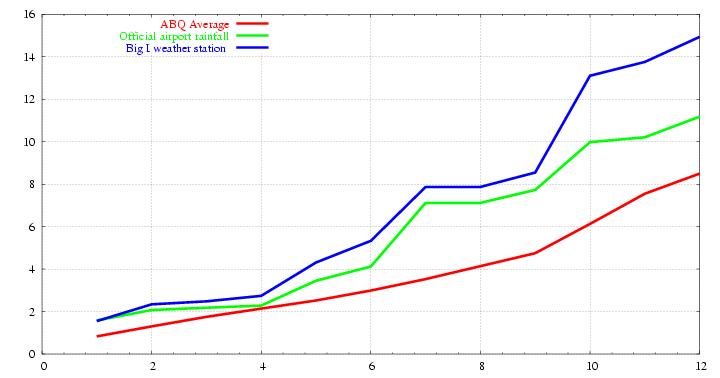
Rainfall graph

That’s cumulative rain for the 2003-04 “rain year,” which starts Oct. 1. (They do it that way so the whole winter precip season is captured in a single year’s statistic.) The red line is the long-term average at the official Albuquerque weather station. Green is the rain/snow at the official gauge this year, which is about three miles from my house. Blue is my rainfall.

By any measure, it’s been an extraordinarily wet year. I’ve only got five years of data at my house, but the official ABQ gauge is at a very similar point on the city’s elevational gradient, so there’s no reason to think my numbers ought to be a whole lot different. Most of the difference was a monster July (the tenth month on the graph), when I had a couple of huge thunderstorms that hit my house but largely missed the airport. The 4.5 inches I got in July is by far the wettest month since I put the rain gauge up. These can be hit-or-miss affairs. But in general, looking at the long-term statistics this afternoon, I found that I’m often reading higher than the official ABQ number. A bit of a puzzle.

Hunting the Elements

Alex Witze has a delightful story about Jim and Jenny Marshall, who are collecting all the elements:

In their townhouse in Denton, Texas, chemistry professor Jim Marshall and his wife, Virginia, have compiled perhaps the world’s only collection of every element from hydrogen (atomic number 1) to uranium (atomic number 92).

Not content with that, they have also traveled to most of the places where each element was discovered, bringing back a sample of the original minerals.

The Marshalls also have a web page documenting their adventures.