
Climate Modeling as Hypothesis Testing

Climate models don’t prove anything. They are merely a set of hypothesis-testing tools for understanding how the intrinsically complex system that is our climate works. As such, they must be tested against the available data. Gerald Meehl and colleagues at NCAR have conducted another such test (published in the October Journal of Climate).

It’s frequently argued that the models are the best we’ve got in understanding what might happen in the 21st century as we increase the level of greenhouse gases in the atmosphere, because the “experiment” we can physically conduct will take a hundred years, with some risks related to the outcome. But in fact, we’re reaching the point where greenhouse gases and the other climatological drivers have varied enough over the last 100 years that we can begin to conduct the experiment through a sort of hindcasting. That’s what Meehl et al. have done in their latest Journal of Climate paper.

They plugged in five climate forcers into the model, two natural (solar variability and the cooling effect of stuff spewed out by volcanoes) and three man-made (greenhouse gases, ozone and sulfate aerosols). They ran simulations with various combinations to see what might reasonably explain the actual variance we see in 20th century climate records. The result:

The late-twentieth-century warming can only be reproduced in the model with anthropogenic forcing (mainly GHGs), while the early twentieth-century warming is mainly caused by natural forcing in the model (mainly solar). However, the signature of globally averaged temperature at any time in the twentieth century is a direct consequence of the sum of the forcings.

In other words, using the models, the greenhouse warming hypothesis is the best fit with the data. Again, this isn’t proving anything, but it’s nevertheless important for two reasons. First, it provides added confidence in dealing with the “attribution problem” – to what extent can the climate change we have seen thus far be attributed to anthropogenic effects?

And it provides increased confidence that the models might have something useful to say about what might happen in the future.
ES Cells and the Heart

I’ll leave it to Chris Mooney to sort out the political implications of this, but there’s an interesting paper in Friday’s Science (sub. req.) by Fraidenraich et al. on the use of embryonic stem cells to treat cardiac defects.

A review also in Science (more $ req.) by Kenneth R. Chien of UC San Diego, calls it “an exciting new study … (that) expands the potential therapeutic repertoire of ES cells.”:

These investigators provide direct evidence that ES cells can rescue otherwise lethal cardiac defects in mouse embryos.

I’ve not followed the embryonic stem cell debates closely (am I the only one who’s uncomfortable with the way this issue has been transformed from science into tribal politics?), so I may be munging the science here. But as I understand from reading Chien’s review, the importance here is not that the transplanted embryonic stem cells differentiate into cardiac cells. Instead, the embryonic stem cells secrete stuff that gets the regular cells to do what they’re supposed to.

Here’s how Rick Weiss explained it in yesterday’s Washington Post:

The new work offers the most definitive evidence yet that the versatile cells, derived from embryos, can help repair organs two ways: by filling in damaged areas — the primary focus of stem cell research to date — and also by secreting potent chemicals that can make tissues rejuvenate themselves.

Warming and Drought

My story on warming and drought is up:

Four hundred years of “epic drought,” from A.D. 900 to A.D. 1300, may offer clues to what western North America faces in a warming world, according to new research.

That ancient drought coincided with a time in which the planet was warm, leading scientists to suggest that something similar may be in store as our planet warms again.

Our current drought, the worst by some measures since record-keeping began, coincides with a period of rising temperatures and increasing drought in the West. But it “pales in comparison” with the megadrought that settled over the West a thousand years ago, according to Ed Cook, a climate researcher at Lamont-Doherty Earth Observatory in Palisades, N.Y.

“This is not intended to minimize the impact of the current drought,” Cook said in a telephone interview, but to point out that “things could be much worse.”

The work is not a prediction that human-caused global warming will definitely cause drought, Cook said. But given our growing understanding of the relationship between warmer temperatures and Western drought, the possibility that greenhouse warming could lead to a drier West must be considered, Cook said.

“The point is that it would not be a good thing,” Cook said.

von Storch

Roger Pielke Jr. has offered an interesting framework for watching the fallout from Hans von Storch’s paper in Science last week challenging Michael Mann’s “hockey stick” climate graph:

In this highly politicized atmosphere, given how many scientists spoke out in support of or against Mann et al.’s “hockey stick” it will be very interesting to see reactions among scientists to Von Storch’s new paper. (It won’t be so interesting to see how advocacy groups react, as it will be completely predictable.) Specifically, given the close connection of support or refutation of the earlier paper with explicit political agendas, scientists who were critical of Soon and Baliunas may be very hesitant to comment on Von Storch et al., except in a negative way. Conversely, we can expect howls of support from those scientists who supported Soon/Baliunas.

Continue reading ‘von Storch’ »

Balloons

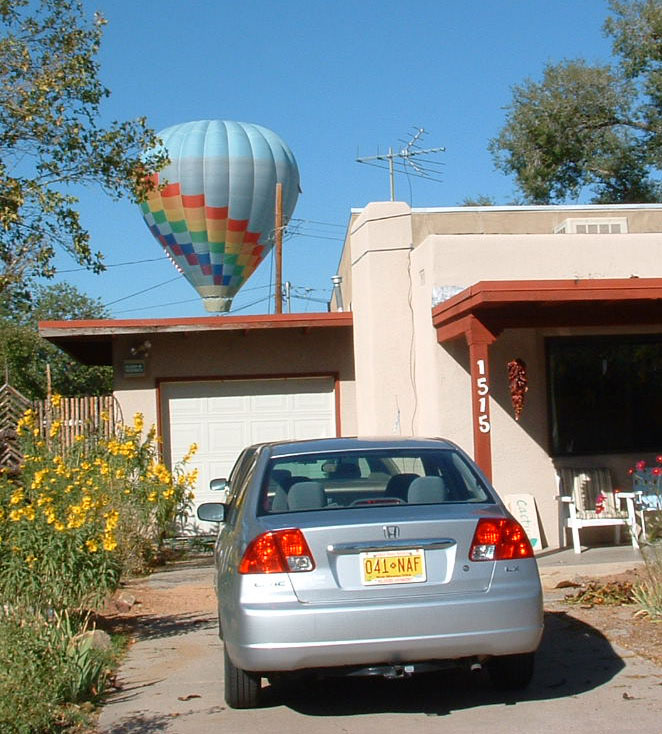
It’s that time of year in Albuquerque. Lissa snapped this flying over our house this morning while I was in the shower:


Balloon flying over my house.

It landed at the apartments around the corner.

It’s our 15th year, and I’m not jaded. It’s still fun to see hundreds of hot air balloons flying over my city.

Why Cell Phones are so Annoying

A news story in Nature explains why cell phone conversations on the subway (or wherever) are so annoying.

Apparently we have a harder time ignoring someone talking when we only hear one person’s side of the conversation. A group of British psychologists tested the idea on the train with both cell phone conversations and face-to-face conversations in which only one side of the conversation was audible. Then they quizzed other passengers about how annoying it had been. The result – it’s more annoying when you can only hear one side of the conversation.