Here in New Mexico, we take our cacti seriously.
Or maybe the cowpoke is just wondering: Where did these saguaros come from?

Here in New Mexico, we take our cacti seriously.
Or maybe the cowpoke is just wondering: Where did these saguaros come from?
The southwestern travelogue continues, this week taking us to the Valles Caldera, where Lissa and I took advantage of their decision to cautiously open things up for a mountain biking experiment this weekend.
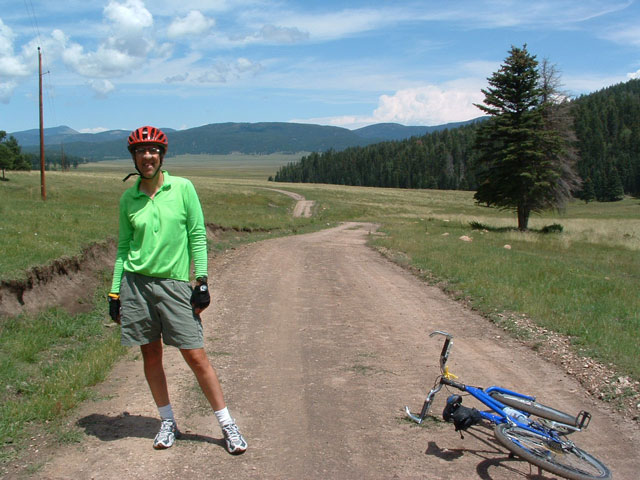
We pronounce the experiment a success, though the fact that we don’t really mountain bike made even the beginner trail a bit arduous.
I once described the Caldera as being, to a geologist, like “a secular sort of sacred ground.” It was there, in a volcanic formation, that Brent Dalrymple in the 1960s found the rocks that clinched the deal for the theory of plate tectonics, launching a revolution in earth science.
For that alone the Valles would be a spectacular place, but there’s so much more. Created in a massive volcanic eruption 1.2 million years ago that created a crater 15 miles wide, the Caldera is a geologic wonder. There’s no place short of an airplane where you can see the whole thing, because subsequent volcanic eruptions dotted the crater with massive volcanic humps. The humps are covered with pines (it was one of the humps on which Dalrymple found his Rosetta Stone), and beautiful meadowed valleys thread among them.
The problem is that until recently the bulk of the Caldera was in private hands. The federal government bought the land in July 2000, setting up a trust to administer it. It remains a working ranch, and public access is being slowly introduced, with an eye toward finding ways to let us in without screwing the place up.
This weekend’s mountain biking was one such experiment. They opened several routes, from the relatively less hard to the relatively more hard, along the old logging roads that cover the Caldera. They limited the numbers, and sold tickets. It wasn’t cheap – $20 each. But since the whole point of the Valles experiment in federal land management is to try to find ways for preservation to pay for itself, I didn’t mind.
Our ride took us across the main valley (that’s what you see in the background in the photo above) and up into the woods for a long, level traverse of one of the volcanic humps.
Red-winged blackbirds were everywhere in the valley, and mountain bluebirds. “If I was a bird, I’d live here,” Lissa said. We didn’t see any elk, but we could, uh, tell they had been there. (Last time I was there, when I went for the story linked above, we saw a huge herd of elk as we were leaving the place. Magnificent.)
mjh: No worries. It’s your job to reflexively attack and mine to reflexively defend. Keep holding up your end, and I’ll keep trying to hold up mine.
mjh – It’s fallacious to pick a single day’s paper and try to say anything useful about fairness and balance, any more than I could pick a single rainy day and say that the drought’s over. Take a couple of weeks’ coverage, do an honest assessment of postive/negative Bush/Kerry coverage and then you might have something.
My personal experience as, to borrow Clandestino’s phrase, “one who works in a local newsroom,” is that readers with strong views on any polarized issue tend to view the newspaper as strongly biased against them and in favor of their opponents, no matter what we do. Rush Limbaugh and Amy Goodman have both made a cottage industry out of this truism – though Rush’s cottage seems quite a bit larger.
Earlier in the week I mentioned drought at Mesa Verde. Now that we’re back and I’ve had time to collect my thoughts and do more research, there’s a bit more to say.
Lissa and I slipped away for a lovely few days on the road, up in southern Colorado.
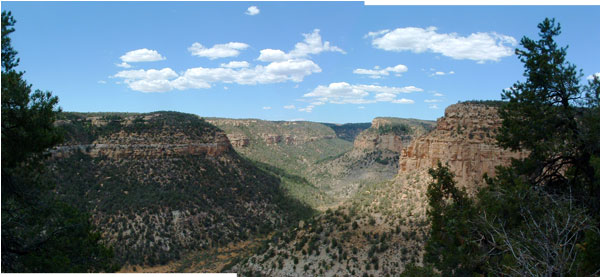
We camped at Mesa Verda, a favorite spot as much any more for the beautiful piñon-juniper woodlands as the ruins. It’s on top of a gently tilting mesa, rising up out of the San Juan Basin into the foot of the San Juans, the rugged southwestern corner of the Rocky Mountains. It’s been wracked by fire and drought over the last four or five years, but if anything that makes it more interesting. We’ve been going long enough that we can see and understand the change.
We spent some time hiking on the mesa, and also took a day to drive up from Durango over Coal Bank Pass to Silverton, some real-deal mountains (Coal Bank Pass is 10,640 feet.).
A bit of serendipity also landed us in Farmington, New Mexico, in time for the town’s parade celebrating the start of the 40th annual Connie Mack World Series. In addition to baseball players, there was a remarkable person in an inflatable smoothie costume:
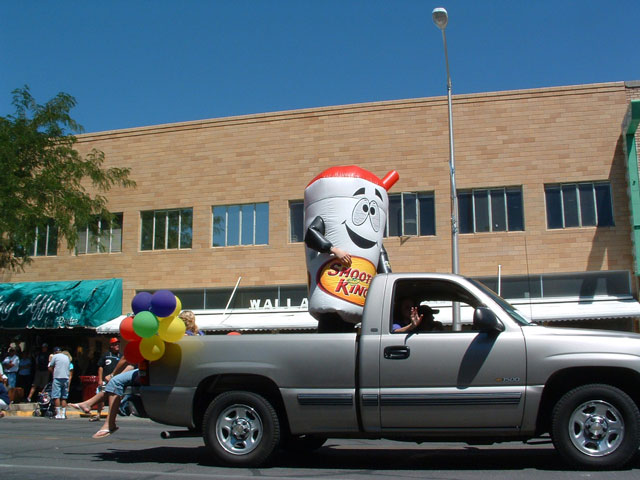
All hail the Smoothie King.
I pronounce my Google experiment a success. I am now the number one search result for “sufficiently obscure”.
A glance at Inkstain’s server logs this morning showed a big increase in traffic yesterday, which seems to have come from a bot at Turnitin.com. Apparently they offer services for educators who want to detect and deter plagiarism by students.
Pity the poor kid who plagiarizes from my blog – but for more reasons than just that.
The path of Hurricane Alex starts to look interesting for those of you in northern Europe.
I was surprised to note that if one Googles more balloons, my blog entry of last week is the second hit. Given the possible permutations available in our language, it occurs to me that this is likely to happen with any two-word phrase that is sufficiently obscure.
The available evidence suggests there’s some validity to my hypothesis. Consider this a test.