
GNOME Dictionary

Put Red Hat on an old box we had for daughter Nora because her main computer is on the fritz, and she’s been poking around it a bit.

“You know what I love about Linux?” she announced this afternoon. “The dictionary.”

She’s talking about the little GNOME dictionary, what sits on the panel and hooks into the dict.org servers. It’s a handy little tool, for which she has not a good Windows alternative.

And I helped make it. I do the docs and a bit of the bugzilla work on it these days. Nora didn’t know this. It was a big thrill for both of us, a connection to all this wacky GNOME stuff dad spends so much time working on.
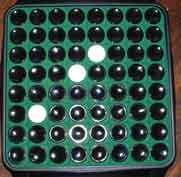
Othello

I hate to lose at board games, but there’s a tension between that and parental pride when I play Nora.

Othello Game Board

In this case, Nora was playing black and I was playing white. She creamed me. I was very proud.

jfleck has competition

A colleague pointed out yesterday that the phrase (word? term?) “J-Fleck” has been popping up recently as shorthand for that fabulous celebrity couple Jennifer “J-Lo” Lopez and Ben Affleck. After confirming this via Google, I have begun weighing my options. Should I relish this brush with celebrityhood?

Or, perhaps, is litigation in order?

Roswell Redux

Roswell’s dubious claim to fame is the allegation that an alien craft of some sort landed nearby back in 1947. The town largely shunned this weak form of civic celebrity until the late 1990s, when it dawned on Roswell’s civic fathers and mothers that there was money to be made. The 1997 “50th Anniversary of Something, We’re Not Sure What” was a big success, but apparently things have waned some in the intervening years, according to Wyatt Buchanan of the Plainview Herald:

A few bands played outside, which was the highlight of the event. One act, The Dibs, drove 24 hours from Long Beach, Calif., to play to what they were told would be a crowd of 15,000-20,000. There were maybe 15 people watching, each fighting for the shade.

At the end of their set, the band begged people to buy their CD so they would have enough gas money to get home. (I bought one. It?s good, really good.)

(Thanks to Dave Thomas for the link.)

GNOME 2.4 diaries

My solicitation for themes for the GNOME 2.4 release notes has yielded a singularly lackluster discussion, which in and of itself is illustrative. But a few possible slogans have emerged from the hurly-burly:

  • GNOME 2.4: Closer to Being Ready for the Enterprise
  • GNOME 2.4: Accessibility Support Has Improved
  • GNOME 2.4: We Fixed a Lot of Bugs

But perhaps I’m just feeling cynical.

Paintball Expenses

Driving to work the other day, I saw a cleanly dressed young man panhandling by the freeway onramp with a hand-lettered cardboard sign. I was going by too quickly to be sure I read it right, but I think it said:


Need help with paintball expenses

Again, I’m not sure that’s what it said.

GNOME 2.4 Diaries

Starting to work in earnest on the GNOME 2.4 release notes, I sent the following note to the desktop-devel list:

Last time ’round, the main theme of the release notes was “usability,
performance, appearance, and accessibility support”. If we had a slogan,
it was a desktop that “just works”. What is the dominant theme of the
2.4? What should we be pimping here?

Some answers:

  • Sucks less
  • Multimedia, Usability, Accessability, and the Web
  • Usable, accessible, simple.
    Simplicity works.
  • Just works -> Just rocks
  • “The Caring Desktop
  • The desktop that cares
  • A Nice Desktop
  • A Desktop With Certain Qualities
  • Something Nice
  • Some Stuff With Certain Qualities
  • GNOME 2.4 — the Family-Sized Desktop
  • The desktop with a heart
  • Enterprise Ready
  • Enterprise Friendly

Is It About The Bike, Or Not

Sally Jenkins, the Washington Post sportswriter who ghosted Lance Armstrong’s two autobiographical books, offers a useful explanation of our fascination:

One minute, after nearly a month of suffering, decided who won this Tour. Lance’s ride into the history books was an essay in overcoming a succession of miseries and setbacks. He says he knew it was going to be a hard race when, the day before it began, a bird soiled the shoulder of his jersey. He got a stomach virus from his small son. He developed tendinitis in his hip. He rode a climb called the Galibier with his back brake dragging against the wheel because of a mechanical problem. He crashed twice. He got back up and rode through it all, while his competitors crashed and faded around him. What it may have amounted to in the end is that Lance felt, as race announcer Phil Liggett said, “The magnetism of a finish line.”

It’s in this respect that the best qualities of Lance Armstrong are available to you and me. Lance serves no purpose if people think that he survived cancer or wins races solely through some specialness, some rare gift. The most useful purpose he can serve is to tell people it’s an absolutely universal human experience to be tired and ill.