Freedom and the Invariant Section

The folks at Debian-legal are having a discussion of the GNU Free Documentation License. At least some members think the license does not meet their “free” test. At issue is the ability to use the license to declare portions of a doc “invariant”, meaning they cannot be modified down the line. From the FSF explanation:

The idea of invariant sections is that they give you a way to express nontechnical personal opinions about the topic.

The classical example of an invariant nontechnical section in a free manual is the GNU Manifesto, which is included in the GNU Emacs Manual. The GNU Manifesto says nothing about how to edit with Emacs, but it explains the reason why I wrote GNU Emacs–to be an essential part of the GNU operating system, which would give computer users freedom to cooperate in a community. Since the GNU Manifesto presents the principles of the GNU Project, rather than features of GNU Emacs, we decided that others should not remove or change it when redistributing the Emacs Manual.

At least some in the Debian community believe this conflcts with their definition of “free”. If the Debian community acts on this, it would essentially mean that all of GNOME would no longer be considered free software in the eyes of the Debian community. This would be a great bother. I would prefer that they accede to the wishes of those who believe a doc meets their tests if it includes no invariant sections, but whatever. I believe the license ensures freedom, so I’m fine with it.
Lack of Optimism

I’m facing a hard problem right now in my free software life. It all goes back to an observation Dave Mason made some long time ago that I always have remembered – “I don’t want to be a hacker.” Being a hacker takes a huge amount of time and energy, is profoundly alluring, but is fundamentally different than being a free software contributor. I want to be a free software contributor. But lately, in order to do that, I need to be a hacker, which I really don’t want to do.

I have a limited amount of time for GNOME. It’s a lot of time, often an hour or more a day, but it is not expandable. Right now, there’s a great deal of important work that needs to be done in preparing for the GNOME 2.4 release, especially working out some issues associated with building the docs, and understanding some issues involving the help browser and its relationship with Scrollkeeper. All of that is predicated on my being able to build the 2.3.x stuff. Which I can’t do. In a perfect world, I just fire up the build scripts and let them run. But both of them stop short, at different places under different conditions, I spend the limited amount of time I have trying to fix get them fixed and working, I fail, and then I’ve used up the time I have for the day. And I accomplish effectively zero.

The result, of course, is that you’ve got to be a hacker in order to contribute in the way I need to. And I don’t want to be a hacker.

Optimism

Leave it to the Icelanders to make the call so early. While the rest of us wait patiently, it apparently is tradition in Iceland to call the first Thursday past April 20 the “first day of summer”. Another testament to the power of naming stuff.

As per the usual, gifts are involved.

Dates

Lissa and I spent a good bit of time yesterday just sort of wandering – lunch downtown, then an exhibit tracing the history of plastics at the University of New Mexico library, then coffee and a stop in the food co-op. Just idle wandering.

This evening, we killed two hours walking up and down the aisles of Home Depot, looking at stuff- picking which bathroom fixture we liked best, fondling tile, looking at paint chips, picking out a 4×4 in the lumber aisle.

After 18 years of marriage, that’s the time that matters most. Never mind the fancy dinner date stuff, it’s the idle wandering that’s best. I treasure our time together in Home Depot.

Spring

While we’re on rituals of spring, consider the grounds crew laying out the clean chalk baselines down first and third, their geometry interrupted only by batters boxes on one end and infinity on the other. Consider the clean white uniforms of the boys of spring. Consider Myron Noodleman. Consider the linescore:

team runs hits errors
Sky Sox 2 6 3
Isotopes 11 11 0

All is again right with the world.

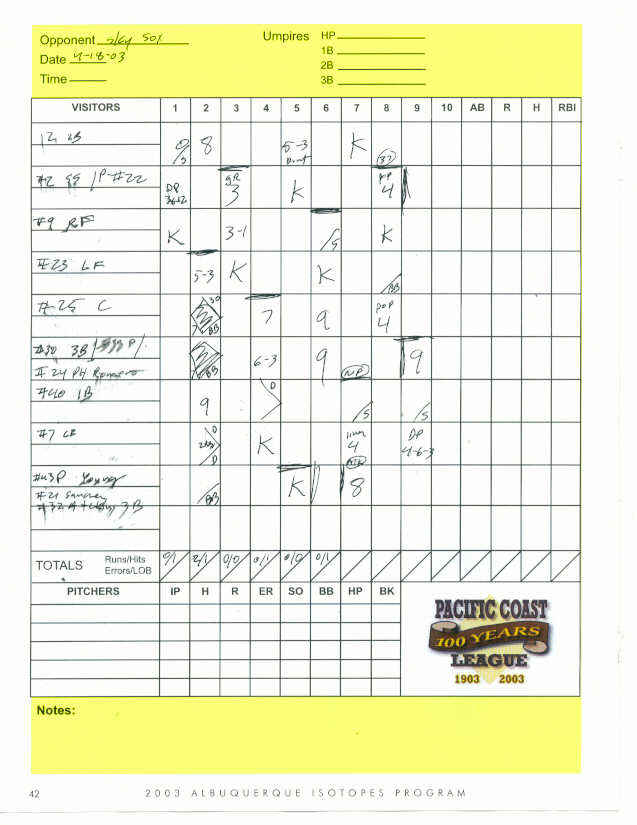
Sky Sox scorecard
Isotopes scorecard
Lissa and I went to the new Isotopes Field Friday night for our first ballgame since the Dukes left our great city bereft of baseball. It was cold and windy (April games always surprise us, but we’ve long learned to ignore our optimism and bring blanket and coats.), but perfect.

Cereal

As it happens, I did forget today’s holiday until now, but luckily ate cereal anyway.

The festival of “Cerialia” (“Cerealia”? The spelling seems several.) is a particularly entertaining one, what with the exchange of hospitality among the common people and the letting loose of foxes with burning torches tied to their tails[1]. What a sight! We’ll have to see if we can hunt down a fox today that we might try it!

Today is also St. Alphege’s day. He seems to be the chap who persuaded Svend Tyggeskaeg (aka “Forkbeard” – geez those Vikings knew how to slap a nickname on their marauders) to stop raiding England. So today we eat cereal and celebrate St. Alphege’s stand for peace and, if we can find a fox, we’ll tie a torch to her tail this evening. (Hmm, wonder if Sadie would go for it.)

[1] Blackburn et. al., Oxford Book of Days, p. 160

The Physiology of the Perfect Ride

Playing hooky from work today, cool morning (but not cold), a little wind but not so’s to be too much trouble. Just me and my bike. The perfect ride.

Our story begins on Wednesday, when I had what I can only describe as a shitty ride. I wanted to do intervals, so I set my heart monitor, warmed up well, and started cranking. It’s a workout I’ve been doing variations on for the last couple of months – warm up well, then do repeats cranking up to a sprint until I hit my anaerobic threshhold (167 – my max is 185 – 190), slowing down to low heart rate recovery (128) – lather, rinse, repeat.

Wednesday I just didn’t have it. It was hard to get the heart rate up, it hurt, I had to really struggle to get the heart rate up over 167 (my usual break point), recovery took forever. But like a dumbshit, I listened to the heart monitor and not my body, and kept banging away at it.

It wasn’t until I got home after an unpleasant hour of this that I figured out why. I was wheezing. Just a touch, but enough to impair my lung function. I was going into oxygen debt sooner. My anaerobic threshhold was probably five or 10 beats lower than normal.

I’ve never been seriously asthmatic, but as a child I had occasional serious attacks, and I grew up in one of America’s smoggiest cities, before the air pollution efforts of the late ’60s and 1970s really took hold. The results were apparent on a doctor’s visit a few years ago. I was there to talk to him about sleep apnea, but he’s a pulmonary guy, so (I think out of habit) he gave me a lung function test. Two tests, one normal and then a second after using an inhaler. I was amazed. I felt fine, no difficulty breathing, just normal. But after the inhaler, my lung capacity was about 15 percent greater. That means when my lungs start to shut down with asthma (pollen or exercise-induced or both) the numbers must have gone south in a hurry.

I found some exercise physiology charts that suggest what may be going on here. I don’t think my case is as extreme as those diagrammed there, but I get the idea.

Today, I warmed up 10 minutes, stopped and took a couple of shots from my inhaler. Bang. My lungs felt clear, my legs were spinning, my heart rate easy, I was able to crank it up whenever I wanted without the pain. I rolled easily at a pretty high aerobic rate out to the river and through the bosque, with a nice easy climb back up out of the valley and home, a bit less than two hours, perfect start to my day off. There’s for sure something to be said for a day of rest, but I clearly need to spend some time sorting through and understanding better this pulmonary function issue.

Weather

Telsa observes what must be a defining difference between her European mind and my oh-so-New World way of thinking – the question of how one dresses for the weather:

In America once, Alan grabbed his coat and got a strange look. “It’s sunny. It’s not going to rain.” “Just in case..” “No, you don’t understand. It won’t change today.” It’s not like that here. In cold weather you still make sure you have something you can take off in case it brightens up. And in bright weather you still carry along a jumper or a coat or a hat or something. Just in case.

One wonders what other false confidence, what ill-advised certainty, we might project unto the world. Arrogance in the face of weather may be ill-advised, humility a good thing.

The Why’s of Tech Writing

Joel Spolsky wonders:

Why does every technical manual and book include a section at the beginning on “conventions used in this document,” full of ridiculous and useless tips like, “Tips are indicated by a lightbulb icon in the margin”? Is it because you’re paid by the word?

We aren’t (paid by the word) and we don’t (begin our docs that way). Go free software!