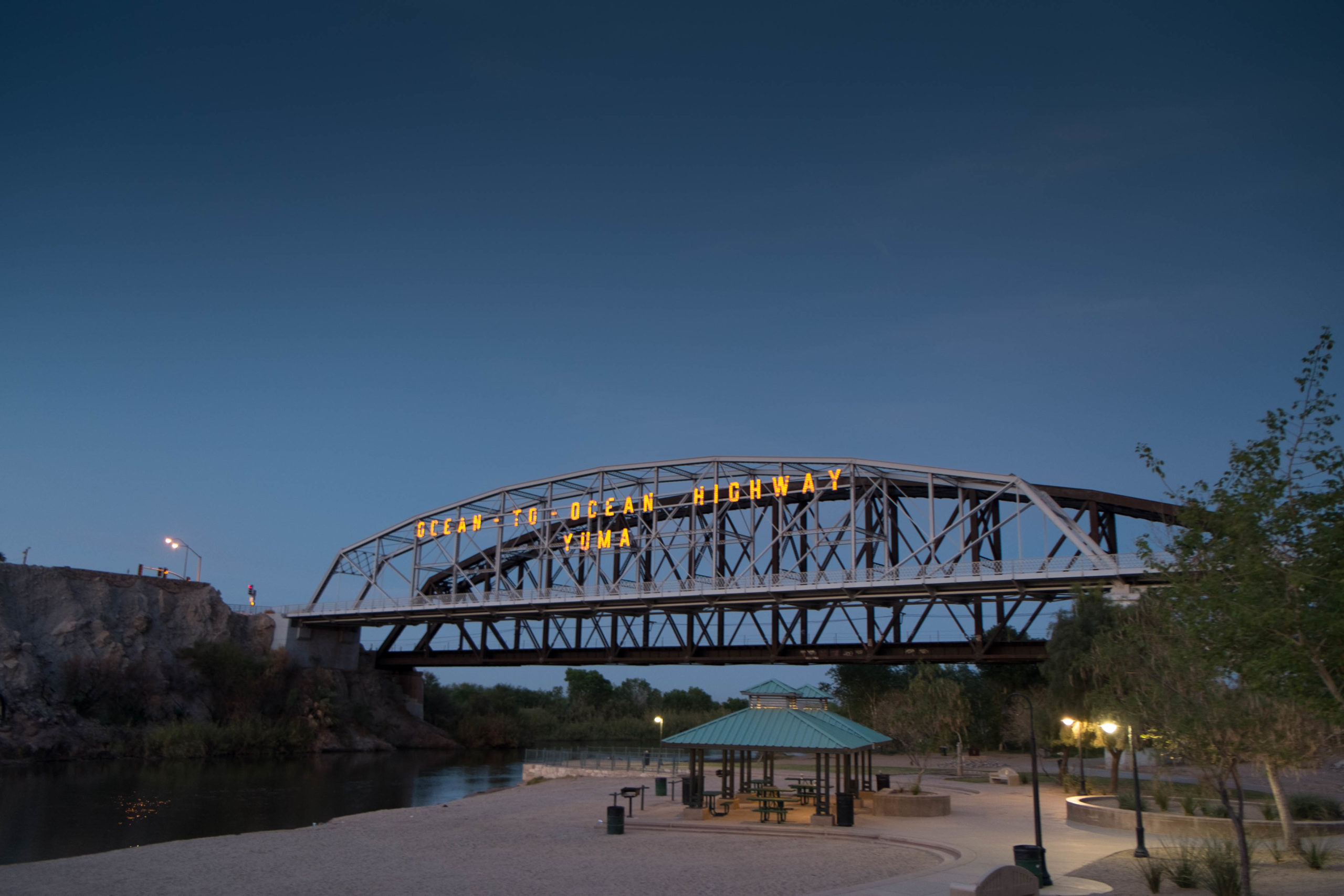
Yuma Ocean-to-Ocean
Hunting through my photo archives for a reporter doing a piece on the new Eric Kuhn-John Fleck book, I found this old favorite – Yuma, one of my favorite places on the Colorado River.
Yuma Ocean-to-Ocean
Hunting through my photo archives for a reporter doing a piece on the new Eric Kuhn-John Fleck book, I found this old favorite – Yuma, one of my favorite places on the Colorado River.
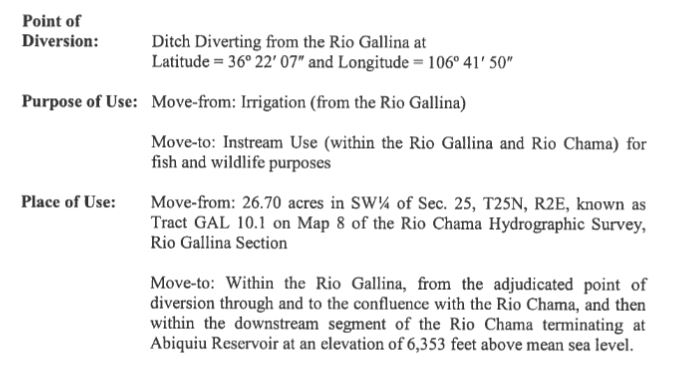
Granting a New Mexico Instream Flow Right
Water policy folks in other western states may yawn at this, but in New Mexico it’s a big deal. The New Mexico Office of the State Engineer has approved the state’s first instream flow water right. Here’s a summary from Audubon, the group that put the deal together, explaining how it works.
The deal would allow water to flow down a stretch of the Rio Gallina, just upstream from its confluence with the Rio Chama. Previously the water had been diverted during high flows to a holding pond to irrigate about 40 acres of land on the Gallina’s south side.
It has long been believed that New Mexico law allows instream flows, but the right is implicit, not explicit. Here is the explanation from the folks at the Utton Center at the UNM School of Law:
In 1998, the Attorney General of New Mexico issued an opinion stating there is nothing in the New Mexico Constitution,statutes, or case law barring the State Engineer from approving an application to change the purpose of use of an existing water right to instream flow. The opinion concluded that New Mexico law does not require a diversion to beneficially use water and a court would likely define beneficial use to reflect current concepts of public interest,waste, and reasonable use. The Office of the State Engineer (OSE) indicated, in a parallel memorandum, that it could act favorably onan application for instream flow if there was sufficient dominion and control over the flow, such as accurate and continuous gauging devices to perfect the right and demonstrate continued use of the water.
We haven’t had anyone actually try to establish such an instream flow in the two decades since. Until now.
I look forward every year to the annual gathering of the New Mexico Water Dialogue. It’s always a great meeting – the speakers etc. But even more so, it’s a great gathering of our version of “the network” – the diverse collection of folks across cultures and geographies in our state who understand the importance of collective dialogue about our shared future.
This year we’ll be hearing from Dave Gutzler (UNM climate) and Melinda Harm Benson (UNM geography, a resilience scholar who’s helped many of us think carefully about how to frame our goals and understandings of the way our water system works). I encourage folks among my New Mexico readership to click the link above and sign up to attend.
If past trends in greater Phoenix – agricultural land transitioning to urban – the area is on track to groundwater “safe yield”, according to new research by an Arizona State University team:
Under (business as usual) conditions where population is expected to increase and agricultural activities to gradually decrease, our results indicate a reduction in the use of groundwater of ~23% that, in turn, will likely allow achieving safe-yield. If the decrease in agricultural activities will be less drastic or remain constant in time (i.e., more food will be produced locally), additional water from more energy-intensive water sources (groundwater and CAP) will be needed.
A shift in the trend – less ag land decline – makes it less likely that Phoenix would meet the goal, the researchers found. A shift to more renewables means an even better prognosis for groundwater, given the significant use of water for power plant cooling. And it probably goes without saying that a multi-decadal drought would make things harder.
The paper is Guan, Xin, et al. “A metropolitan scale water management analysis of the food-energy-water nexus.” Science of The Total Environment 701 (2020): 134478. Found behind a paywall here.
The Imperial Irrigation District board will take up a resolution this afternoon drawing a sharp line. If action isn’t taken to deal with the Salton Sea, the historic early-2000s deal that attempted to untangle California’s Colorado River overallocation (the “Quantification Settlement Agreement” or QSA) “will have been breached”:

Imperial Irrigation District board resolution language
The full text of the resolution and accompanying memo is here.
The framing questions I’ve used for my work on water over the last decade go something like this:
Those are the motivating questions behind a new paper Anne Castle and I have written. We’ve also added an increasingly important third question:
The paper, The Risk of Curtailment Under the Colorado River Compact, is available for free download at SSRN. (I think you have to sign up for an account to actually download the paper, but it’s free.)
Here’s the nut:
Water supply in the Colorado River could drop so far in the next decade that the ability of the Upper Colorado River Basin states – Colorado, Utah, Wyoming, and New Mexico – to meet their legal obligations to downstream users in Nevada, Arizona, California, and Mexico would be in grave jeopardy.
Legal institutions designed nearly a century ago are inadequate to address the significant risk of shortfall combined with uncertainty about whose water supplies would be cut, and by how much.
This report indicates that declines in the Colorado River’s flow could force water curtailments in coming decades, posing a credible risk to Colorado communities and requiring serious consideration of insurance protection like demand management.
The risk is most easily understood in this graph, from new analysis done by the Bureau of Reclamation. It basically shows that a repeat of the most credible drought in the recent record, that of the early 2000s, could in a matter of a few years drop levels in Lake Powell to “power pool” – the level at which Glen Canyon Dam can’t generate electricity, and at which it begins to become difficult to get enough water through the dam to meet downstream delivery obligations under the Colorado River Compact:
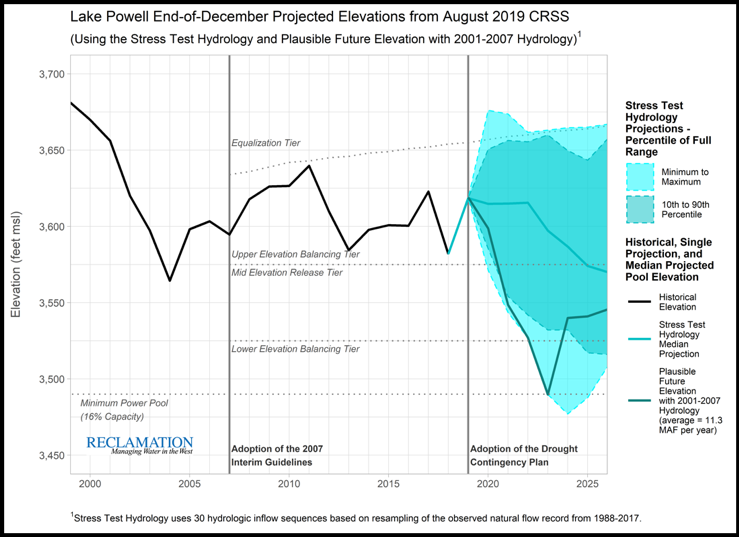
Lake Powell risks. Source: USBR
The line screaming down toward the bottom, in sort of dark greeny color, is the one to look at. A repeat of the drought of the ’00s could, with just four dry years, drop Powell to “power pool” levels. This is not some scary future climate change scenario. This is something that has actually happened in the recent lifetimes of folks working on the river today.
Our contribution (and really all credit to Anne’s thinking here, she’s the one who did most of the heavy lifting) involves a detailed discussion bringing together well-understood climate science and hydrology risks with less well understood uncertainties in the legal system. We have a lot of people right now arguing essentially, “Well, the Law of the River shows those other people will have to have their water cut!” So lawyer up!
There be the dragons.
Anne and I believe it’s important to have a clear and public discussion about the significant unresolved Law of the River questions as well evaluate our hydrologic risk, so we head into the next phase of Colorado River management discussions with our eyes fully open.
We shouldn’t over-emphasize scary worst case scenarios, because the odds that we’ll be on that worst case line are low. But they are not zero (this is a drought that actually happened not that long ago!), and failing to have a plan seems like something worth trying to avoid.
Among the options Anne and I consider:
Q: What does it take to win public acceptance of direct potable reuse of wastewater?
A: “a daily lived experience with the effects of drought or water scarcity”
That’s one of the key findings from a new paper I coauthored with a team led by the University of New Mexico’s Caroline Scruggs, working with Water Resources Program graduate student Claudia Pratesi: Direct potable water reuse in five arid inland communities: an analysis of factors influencing public acceptance.
We were interested in better understanding the connection between the technocratic answers to the reuse question (Science says it’s safe!) and the sometime cultural response (Yuck!). Dr. Scruggs has been working on reuse for years. I jumped in because of my interest in the science-policy interface, and in particular in the governance piece – how do decision making structures influence the kind of decisions that get made in a situation like this. As is the case with stuff like this, Claudia did a lot of the heavy lifting as part of her masters project.
I loved doing this project in part because of the way it embodied the interdisciplinary work we do in the University of New Mexico Water Resources Program – understanding the interface between the technical sciency parts of water management and the cultural and institutional pieces that are so important in getting stuff done.
Water is for Fighting Over
My friends at Island Press (an amazing outfit, so grateful to have had the chance to work with them) are offering all their titles, including Water is For Fighting Over, for 50 percent off right now.
You of course already have your copy, but it’s a perfect holiday gift for that water nerd on your list!
My Colorado River policy attention time is a finite resource, and I admit I’ve not paid terribly close attention to Utah’s Lake Powell Pipeline proposal. My reasoning has been that it’s likely so expensive relative to the water it would provide that, with the end of big federal subsidies, Utah’s eventually going to wake up and say, “Wait, what? We’ll have to pay how much?” Simply using less water is likely to be a lot cheaper, and the folks in Washington County clearly have that option available. My public policy attention triage strategy is essentially “Don’t waste a lot of time on this one, it’s likely to go away soon.”
I’ve been thinking that for a while. It hasn’t gone away.
Emma Penrod has an excellent piece in the latest High Country News exploring what she calls the “funding quagmire”, including some really helpful public journalism exposing previously hidden efforts to government project backers to try to make the project look as cheap as possible:
But as state and local officials wrangle over the specifics of who might eventually foot the bill, there’s still a chance that Washington County residents could avoid paying it. Under Utah’s Lake Powell Pipeline Development Act, it’s the state — not the county — that will end up doing so, should Washington County’s efforts to pay fall short.
Is that unfair? Washington County Water District Manager Thompson doesn’t think so. Growth in Salt Lake City was once made possible by large, expensive water projects funded by a nationwide tax base. If Utah writ large has to raise taxes to pay off multimillion-dollar budget deficits, then so be it, he says. In his mind, it’s Washington County’s turn.
the siblings’ first meeting
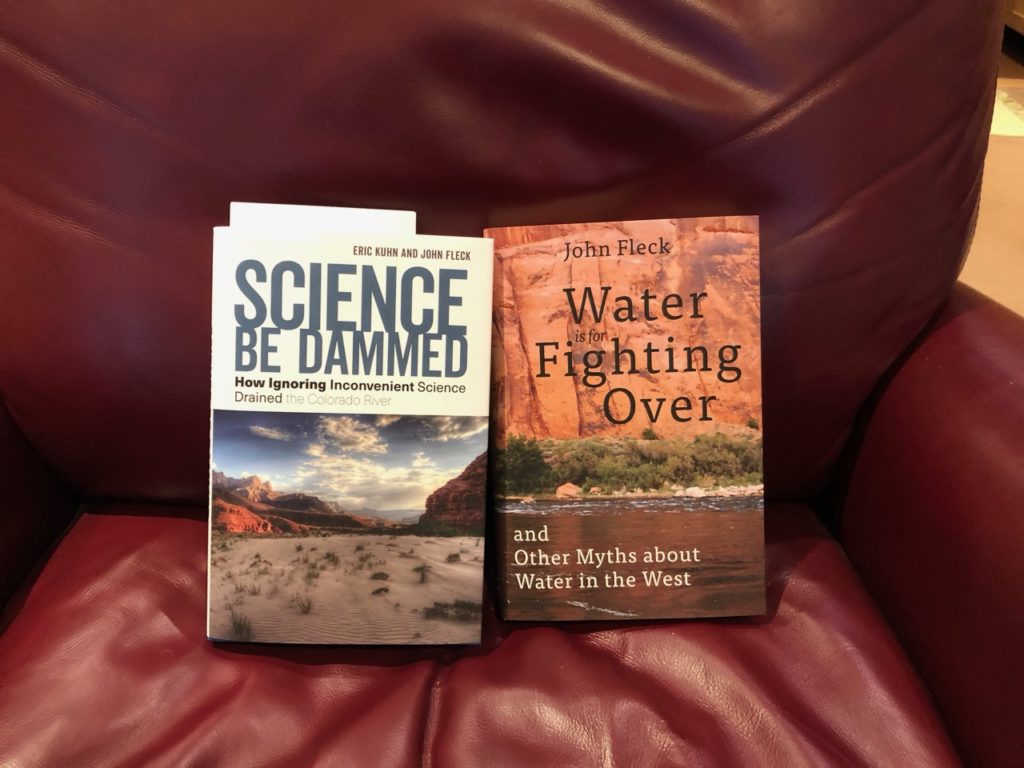
My early review copy arrived yesterday, ahead of the “official” Nov. 26 publication of the new Eric Kuhn-John Fleck book Science Be Dammed: How Ignoring Inconvenient Science Drained the Colorado. River. I’ve got but one – I talked to Eric this morning up in Glenwood Springs, Colorado, (in the Upper Basin) and he’s got a couple of boxes’ worth. Package tracking suggests my box with another 20 left Las Vegas, Nevada, last night (so currently beating their escape from the Lower Basin!).
So excited. Three years’ work with Eric, trying to tell a story that we think is so very important to understanding how we got to where we are in the Colorado River Basin, and how a better understanding can help us navigate the tough times to come. From the book’s closing chapter:
When E. C. LaRue wrote in 1916, before the Colorado River Compact, before Hoover Dam, before all the development that was to follow, that “the flow of the Colorado River and its tributaries is not sufficient to irrigate all the irrigable lands lying within the basin,” he prefaced his observation with a caveat. “More complete data,” he wrote, “would probably indicate a greater shortage in the water supply available” (emphasis added).
Each of those points has largely been lost to the history on which our modern operational understanding of the Colorado River Basin is based. The first, as we have seen in the stories of LaRue, Stabler, Sibert, Tipton, G. E. P. Smith, Stockton and Jacoby, and the modern climate change scientists is surely the most important. There is simply less water in the system than the edifice of laws and policies and infrastructure was premised upon. But LaRue’s second point may be the more important—the need for humility in the face of uncertainty, and the crucial need to design that humility and uncertainty into the institutions we build to use and manage the river.
We hope you enjoy it.