“we don’t have water”

Hay stack in Delta County, Colorado, 1940, Russell Lee

I had a nice talk Friday with Norman and Paul Kehmeier, father and son farmers in Delta County, Colorado, who get their water from Surface Creek, a tributary to the Gunnison.

I called after getting a note earlier in the week from Norman, who I’d met last year on a trip to Grand Junction:

Thought you might be interested to learn that Paul and I will be wasting very little water on alfalfa this spring for the simple reason that we don’t have water.

Grand Mesa, which sits above them, has less than 50 percent snowpack, Norman wrote, and with strong demand from downstream municipal water users and apple orchards, it may make sense to lease what little water they do have rather than growing alfalfa, as they usually do with it.

While those of us down here in the lowlands log in to the Colorado River Basin Forecast Center and check out the latest maps and streamflow forecasts, Norman and Paul can look out the window to see what’s coming. This year, a lack of snow in the lower elevations posed the biggest problem. It’s the low snow that melts off early, providing the spring runoff. That’s how it works in a system where you don’t have big reservoir storage above you.

They’re in the Colorado River Basin – the Gunnison meets the Colorado at Grand Junction – but in many ways it feels like a completely different thing from the Colorado River Basin many of us spend our time talking about. Despite the noisy arguments you hear, the supply of water from Lake Mead is rock solid stable and reliable compared to the year-in, year-out reality of farming in a place like Delta County, where there were 25,000 acres of alfalfa last year.

The Kehmeiers have some great water rights to irrigate their 300 acres. Their Surface Creek right is the fourth-oldest on the creek, dating to 1892. But that doesn’t help if there’s no snow in the high country above them.

Lake Mead, behind Hoover Dam, can hold 30 million acre feet of water when it’s full. Kehmeier Reservoir, the Kehmeiers’ little private reservoir, can hold 300 acre feet of water when it’s full. Neither will be full this year. The purpose of Hoover Dam is big, multi-year storage – to hold water over from wet years for use when it gets dry. The sort of reservoir the Kehmeiers use (there are many above the farmers in Delta County) holds some of meltwater from early in the year for use late in the year, stretching high spring flows out to supply farms during the low flows later in the year. Shortage in Delta County happens every time there’s a single year of low snowpack, which is often these days.

Paul explained the added problem they face that, when the snowpack is low, the water that’s left in the creek is primarily groundwater base flow. With geology dominated by the Mancos Shale, he said, the salinity is high.

So the Kehmeiers are hunkered down this year, “resolved,” Paul said, “not to be pessimistic.”

“There is one thing we won’t worry about,” Norman wrote, “and that is the viability of our alfalfa stands, because we have learned with some experiments over the past few years that alfalfa will survive quite well under deficit irrigation. It is a remarkable plant.”

Santa Fe, NM: Not like Cape Town

Julie Ann Grimm has a piece this week in the Santa Fe Reporter explaining Santa Fe’s approach to water management this year that’s a nice demonstration of why we don’t have incipient “Cape Town” situations (cities about to run out of water) in New Mexico:

Groundwater wells that have mostly been resting on the city’s west side since the construction of a Rio Grande diversion are likely to get put back into action this summer.

Dismal snowpack and low rainfall so far this spring mean water in the river is scarce.

These have long been the plans in Santa Fe, where officials decided in the early 2000s to build a massive infrastructure project to draw water off the river. The Buckman Direct Diversion went online in 2011, becoming a fourth source in the water supply portfolio for Santa Fe’s homes and businesses, along with two well fields and the Rio Grande. Since the reservoirs on the smaller Santa Fe River are also low due to the drought conditions, that leaves the wells.

Santa Fe has multiple sources of water that are relatively independent of one another, so they’re not vulnerable to the sort of single-point failure that has hurt Cape Town so badly. Albuquerque is likely to use a similar approach this year. This is one of the keys to municipal water supply resilience.


Meanwhile, Texas is newly mad at New Mexico over water stuff

Not to be outdone by our neighbors in the Colorado River Basin to the west, here’s a letter from Texas Rio Grande Compact Commissioner Pat Gordon to New Mexico State Engineer Tom Blaine complaining that proposed water rights for a New Mexico copper mine would further cut into Texas’s share of the Rio Grande, a subject about which we’re already engaged in litigation before the U.S. Supreme Court.


The “anticommons” revisited: that time Phoenix tried to leave more water in Lake Mead

Ry Rivard, a reporter for Voice of San Diego who is part of the Colorado River journalism posse, had the most tweetable summary of the dustup within Arizona and among the seven Colorado River basin states:


Four years ago, when I was young and naive, I pointed to what in retrospect I now realize was a warning sign of the train wreck we’re now seeing. Phoenix had rights to some extra Colorado River water it wasn’t using, and it wanted to leave it in Lake Mead. The Central Arizona Water Conservation District, the government agency that runs the Central Arizona Project, had the power to block this, and did.

It’s an example of what an academic colleague described to me at the time as “the anticommons” – where single users of a common pool resource have the power individually to block solutions that are in the collective best interest of the users as a whole.

Daniel Rothberg at the Nevada Independent did a great job in a piece yesterday of showing how politically and diplomatically isolated the Central Arizona Project’s managers have become right now, both within Arizona and in the basin-wide process of coming to terms with how to use less Colorado River water. It’s not just other states mad at Arizona. It’s other states mad at one water agency within Arizona – the CAWCD – and a bunch of other people within Arizona also mad at that the CAWCD.


Denver Water accuses Central Arizona Project of manipulating water orders to take more water from Lake Mead

Denver Water today joined state leaders in the Upper Colorado River Basin with a letter accusing the managers of the Central Arizona Project of manipulating water orders to get more water out of the Upper Basin’s reservoir at Lake Powell. The actions of the CAP’s managers “several compromise the trust and cooperation” needed to solve Colorado River problems, the letter from Denver Water’s Jim Lochhead said. Full text:


Background here.

On the U.S. part of the Rio Grande, the San Luis Valley is where most farming takes place

In water management, it’s normal to zero in on one’s local geography and not think about the larger system – especially when state lines carve up a watershed. Thus, faced with a terrible snowpack year on the Rio Grande, we’re having three largely separate conversations about agricultural water management on the U.S. part of the Rio Grande:

  • The San Luis Valley (the headwaters valley in Colorado)
  • The “Middle Rio Grande” (that stretch through Albuquerque where I live)
  • The “Lower Rio Grande” – New Mexico south of Elephant Butte Reservoir, plus El Paso County in Texas

Here is some interesting data by way of comparison about how people are using the water in those three sub-watersheds. It’s total crop revenue, which is a good measure of how much farming is happening in each place. Water people are often surprised to learn that the San Luis Valley is, by this measure, the most productive part of the system. These are 2016 (the most recent year available) total crop revenue numbers from the Department of Commerce.

  • Middle Rio Grande: $16.1 million
  • Lower Rio Grande: $376 million
  • San Luis Valley: $412 million


Colorado River Upper Basin states accuse Central Arizona Project managers of threatening the health of the Colorado River system

Upper Colorado River Basin state leaders, in a letter Friday (April 13, 2018), said the water management approach being taken by the managers of the Central Arizona Project “threaten the water supply for nearly 40 million people in the United States and Mexico, and threaten the interstate relationships and good will that must be maintained if we are to find and implement collaborative solutions” to the Colorado River’s problems.

The letter accuses CAP of “disregard(ing) the basin’s dire situation”, providing more water for Arizona at the expense of the rest of the basin. In doing so, it highlights a rift within Arizona, where an internal political feud over this and related issues has pitted CAP against the state Department of Water Resources and many of CAP’s own customers. That rift, in turn, has stalled diplomacy over efforts to develop a broad new plan to cut back water use across the Colorado River basin.

The letter, using language that is striking in the normally staid interstate diplomacy of Colorado River interstate water management, takes issue with CAP’s practice of using more water than it might otherwise – avoiding “overconserving”, in CAP’s words – in order to ensure continue big releases from Lake Powell upstream. That has the effect of expanding water use in the Lower Colorado River Basin at the expense of draining Lake Powell, the critical reservoir for protecting Upper Colorado River Basin supplies. The managers of the Central Arizona Project are “disregard(ing) the (Colorado River) basin’s dire situation at the expense of Lake Powell and all the other basin states” by using more water than they need to, the letter said.


On Twitter last week, in response to something I wrote here, Central Arizona Project General Manager Ted Cooke defended CAP’s practice, calling it wise placement of water orders under the 2007 rules governing reservoir storage on the Colorado River. Those rules attempt to even out storage between Lake Mead – which supplies the Lower Basin states of Arizona, Nevada, and California, plus Mexico – and Lake Powell, which maintains a storage bank for the Upper Basin states of Wyoming, Colorado, New Mexico (I raise my hand to declare an Upper Basin bias here) and Utah. The rules have created an incentive for the Central Arizona Project, which manages a big fraction of Arizona’s supply of Colorado River to avoid “overconserving” – again, this is CAP’s word – at a time when everyone in the Colorado River Basin is trying to use less water. The Upper Basin states (the letter was signed by the top water officials from all four) say that “attempts to maximize demands to increase releases from Lake Powell could ultimately accelerate lower reservoir conditions in both the Upper and Lower Basins and cause shortages in Lake Mead.”

The issue of the Central Arizona Project’s approach to this issue has been simmering for more than a year. Water managers have long known the rules created this incentive for the CAP’s managers, but the agency’s increasingly brazen public discussions of it have become problematic. The public version of the debate goes back to a March 2, 2017 meeting of the board of the Central Arizona Water Conservation District, the agency that runs the CAP. Tony Davis at the Arizona Daily Star nicely documented the debate in this story, quoting CAP water policy director Suzanne Ticknor explaining to her board the risk to Arizona of “overconserving”.

That word echoed through the Colorado River water community at a time when other states were struggling with how to conserve more water, not worrying that they might be conserving too much.

It also highlighted an increasingly divisive breakdown within Arizona on this issue. Kathryn Sorensen, director of Phoenix’s water department, was quoted in Tony’s story criticizing CAP’s approach. “The ‘risk’ of overconserving is a Colorado River that is less vulnerable to shortages and more resilient over the long run, a river that is more protective of our economy and our quality of life,” she told Davis. Others in Arizona have become increasingly critical of CAWCD/CAP approach. “CAWCD does not speak for Arizona,” Carol Ward-Morris of the Arizona Municipal Water Users Associated tweeted this week in response to my blog post about the allegation that CAP is “gaming” Colorado River water management rules.

The full letter, which has spreading quickly through Colorado River management circles this weekend, is here:


One of the worst years in a century of records on New Mexico’s Rio Grande?

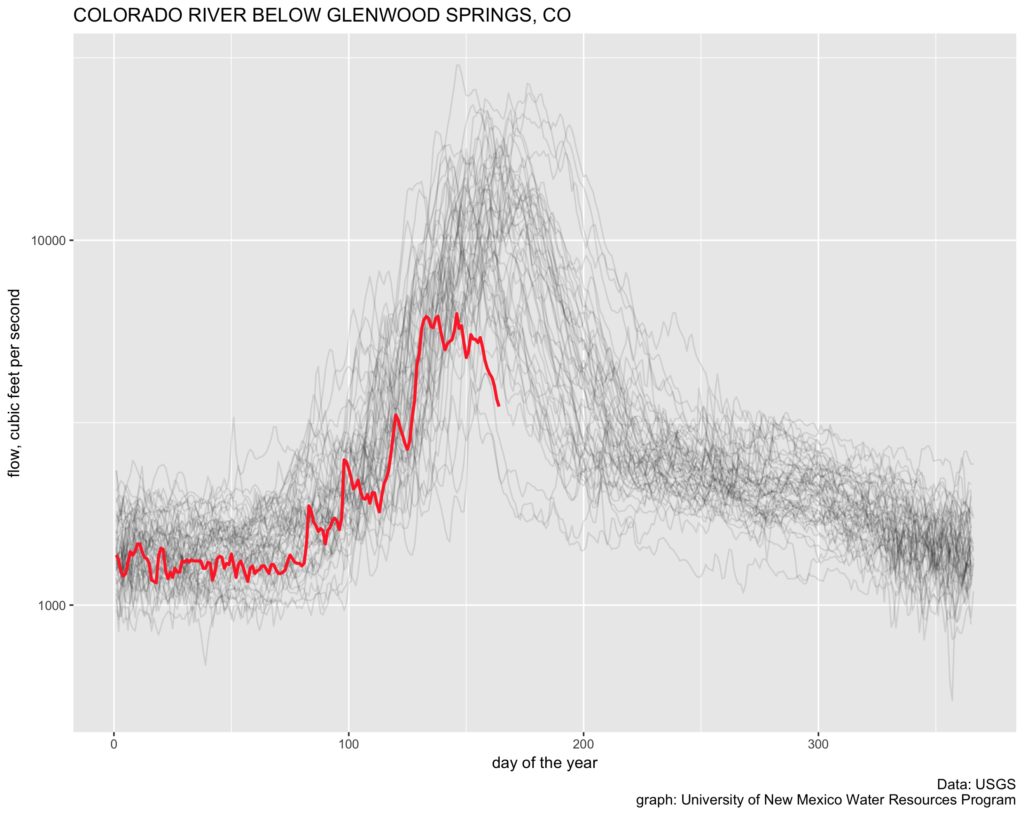
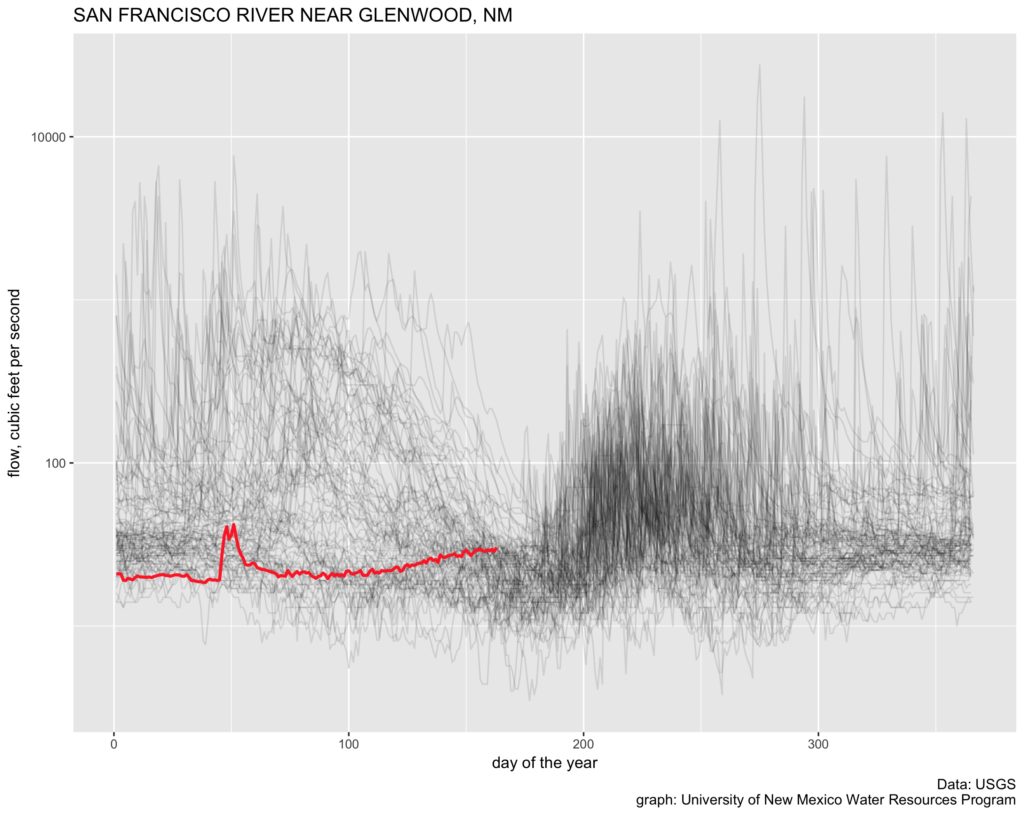
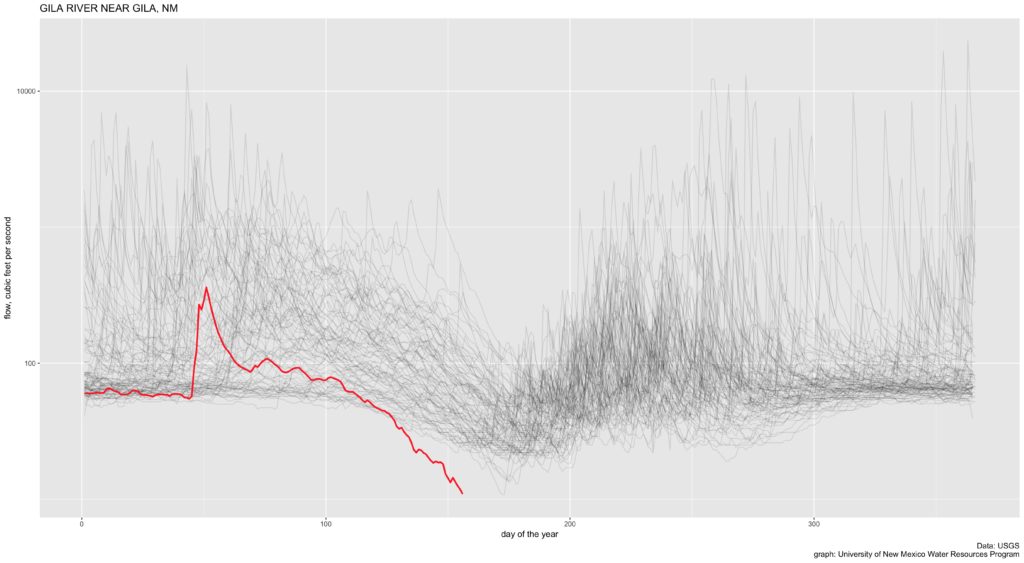
Experimenting with some data visualizations to try to help make sense of where this very dry year on the West’s rivers fits into historical context, I came up this morning with this:

The spaghetti is daily flow for each year in the USGS historic record for the gauge at Embudo in northern New Mexico – the oldest gauge in the country, with a nearly continuous record back to 1895. The red line is this year.

I’m not sure this visualization works for a general public audience, but for me it did the trick.

As you can see, at this point in the year, the river should be rising as snowpack melts. It’s dropping. And a quick glance at the graph showed that this year is, in fact, historic – the second driest at this point in April on record.

Code here.

Is the Central Arizona Project gaming reservoir levels to take more water from the Upper Basin?

This Central Arizona Project infographic has been a bit of a “WTF” moment in the Colorado River Basin management community:

Central Arizona Project infographic

Kudos to whoever designed this. I’ve struggled to find ways to explain this. First posted to the Internet, then apparently taken down, it’s a solid explanation of the tricky way the Central Arizona Project has been managing its use of Lake Mead water – call for and use enough water early in the year to drop Lake Mead far enough to trigger a big release from Lake Powell, then crank back the orders later in the year to put the brakes on and keep Lake Mead from dropping so far that it’ll slip below elevation 1,075 and trigger a shortage declaration.

That this would happen should be no surprise. It would be weird for Arizona to not try to use the rules, negotiated by all, to best advantage. What’s awkward right now is the brazenly public way CAP has been talking about this, managing Mead’s “sweet spot” by not over-conserving water. You can see displeasure with this even in Arizona in today’s blog post by Warren Tenney of the Arizona Municipal Water Users Association.

In fact, folks in the Upper Basin have long been aware of the risk and reality that Lower Basin water users, especially CAP, might manage their reservoir this way. The problem with CAP being so blatant about it is the optics. This heightens basin-to-basin tensions that don’t need to be heightened right now. Folks in the Upper Basin are working hard to come up with water management tools to reduce water use, and/or to fight off efforts to increase water use. In doing so, we run into a consistent argument: “Why should I cut back my use, or my aspirations, to prop up levels in Lake Powell just to benefit the Lower Basin?” The answer to that has to be that each basin benefits when the other cuts its use. But CAP’s very public “we don’t want to overconserve, lest we lose access to the big 9 million acre foot releases from Lake Powell” makes it a lot harder to persuade Upper Basin users to cut back as part of a “we’re all in this together” argument.

I don’t understand the politics here. CAP’s very public “sweet spot” discussion suggests CAP’s desire to win a political fight within Arizona outweighs any broader interest of Arizona as a state in being a cooperative participant in basin-wide diplomacy. Or maybe I do understand the politics. In my book, I opened the chapter about Arizona thus:

In the struggle to share the Colorado River, Arizona has always been its own worst enemy.

New Mexico Water: What Our Next Leaders Need to Know

My University of New Mexico water colleagues and I are hosting a conference May 17:

New Mexico Water:
What Our Next Leaders Need to Know

Following the 2018 gubernatorial election, New Mexico will have new leaders of its resource management
agencies. This conference will consider NM water & environmental challenges with presentations by former
senior state and federal officials. Speakers include former NM State Engineers, Secretaries of the NMED, and
former top level federal officials. All have lengthy experience NM.

Registration:
Registration before April 27: General – $30, Full time students – $10
Registration after April 27: General – $50, Full time students – $20

Register at http://cwe.unm.edu/outreach-and-education/2018-water-conference.html