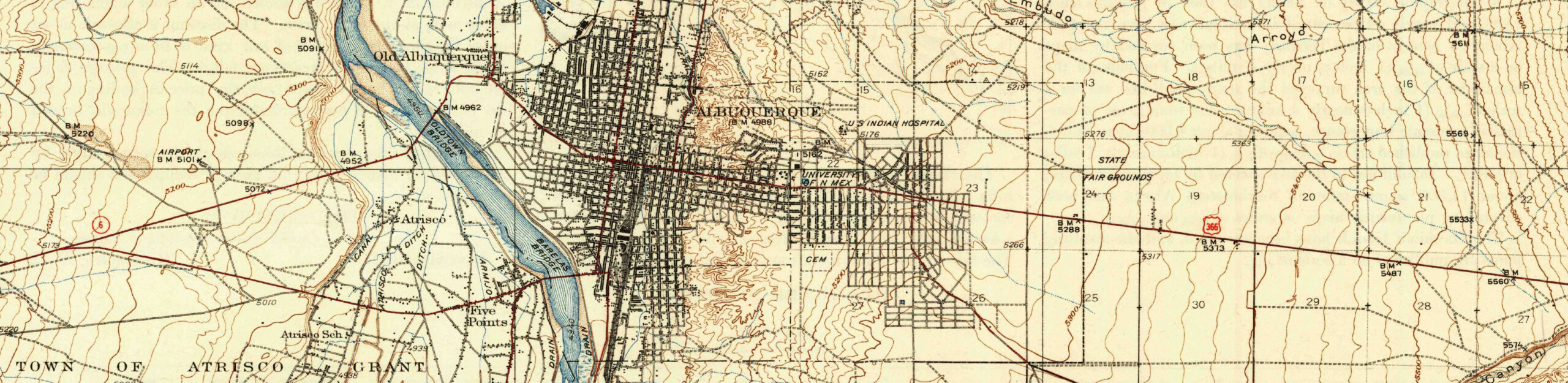

Gateway to a zoom 18 tile.
The dog came out of nowhere. The best ones always do.
I was bicycling the McCoy Dam service road in Albuquerque’s far South Valley, off the Gun Club Lateral irrigation ditch, past an ambiguous Albuquerque Metropolitan Arroyo Flood Control authority gate, down the hill from the old Vanderploeg Dairies property.
Earthen dam to my left, horse corral to my right. We call the flood control authority ”AMAFCA.” Knowing the name is part of the game. AMAFCA’s gates are blue. The gates are ambiguous in their intention, physically permeable in practice.
Dogs are part of the game.
Games
The philosopher Bernard Suits defined games thus: “the voluntary attempt to overcome unnecessary obstacles”. For Suits, this is a good thing.
Consider golf:
The utter ridiculousness of making it harder to drop a ball in a hole — as if there were a reason to do that in the first place! — by requiring you to use a stick to do so… we are creating a system full of complexity for ourselves. A toy system where the rigidity and weight of the stick, the chaotic interference of the swirling wind, the mental impact of the oohs and aahs of the spectators, the way the dew fell across the grass and reflected sun in our eyes, even how to deal with that cramp in our leg from walking all this way — where all these things are present in the toy.
“Tiling,” as the bicycling game is known, is what sociologists would call “ludic geography” – a game of place. It seems obvious in retrospect. The ubiquity of GPS devices by the middle of the last decade, first mounted to a bicycle’s handlebars, now miniaturized in watches, made it feel inevitable.
Ben Lowe, of Veloviewer, seems to have landed first on the idea of a map of tiles colored in after visited on one’s bicycle. (I rely here on the terrific history article on Ride Every Tile.) Simply coloring in the map was fun, and one of Lowe’s users quickly snapped to the possibilities: what was the largest NxN square of tiles all colored in? It was the first step toward Suit’s “unnecessary obstacles” – turning it into a game.
But the NxN square, for many, quickly became an unsolvable puzzle. My maximum Albuquerque square quickly hit 10×10, with the land of the Indigenous Sandia Pueblo to the north, where one does not trespass, and the military industrial complex (Kirtland Air Force Base) to the south, where the guards are heavily armed and the barbed wire doubled in protection of elements of the U.S. nuclear arsenal.
Message board discussions ensued in response to the shortcomings of “largest square” as a game: Should unattainable tiles just be automagically ticked off as having been visited? This seemed unsatisfactory – the whole point of the game was to visit the places, not to merely color in the map. One could, for example, wait for the annual base open house to bag the military installation tiles, or persuade a friend with a pass to get you in. A new challenge was needed.
The resulting innovation, the “clump,” or “cluster,” as it finally came to be known, is an interconnected collection of visited tiles, each surrounded on all four sides – north, south, east, and west – by a tile that has also been visited. The cluster became a puzzle challenge, a geometric problem worked out on the landscape. Find a way around the edges of the military base.

Via Squadrats, an explanation of clusters (also known as “yards”)
A group of Polish tilers added a layer of complexity by mapping smaller tiles. Original tiling used Open Street Maps’ zoom level 14, roughly a mile on a side. The Polish Squadrats group added zoom level 17, 1/8th the size of traditional tiles, dubbing the little ones “Squadratinhos” (and incorporating lovely mapping graphics). Zoom level 17 clusters are a blast, lots of intricate little tiling problems – how do I get into the edges of that golf course? How do I get my cluster through that mountain pass? I have literally stuck my arm, with its GPS watch, through fences – more than once! – to get a tile.
The norm had long been “human powered” only – Jonathan France, the British tiler, famously paddled the Thames to fill in its London tiles. I had a friend take me out paddling the Rio Grande for some particularly tricky tiles in central Albuquerque.
The Squadrats team eventually loosened their rules, allowing e-bike rides – a nod to old people like me, for whom a pedal-assist e-bike is often the ride of choice for long Sunday outings.
The group (person?) behind Ride Every Tile added other zoom levels, all the way from zoom level 0 (one tile, the entire planet) to zoom level 17 (~250 meters on a side, depending on your latitude). Ride Every Tile also recently added hexagons, a fresh challenge.

Red is my largest zoom level 18 cluster, smaller orange clusters waiting for a puzzle solution to connect them, and blue are all the other tiles I have ridden.
Zoom Level 18
As my age has gone up, my range, the distance I can ride, has gone down. So I recently coded up a tiling app that runs on my Mac that ingested the more than 7,000 activities I’ve recorded, 50,000 GPSed miles, mostly bike rides but also walks and hikes and runs and stand-up paddles, since I started GPSing things in 2008. The app allows me to tile at zoom level 18, which is ridiculously small – about the size of a typical crime scene – and therefore ridiculously challenging. I can’t just ride the road in front of the motel out by the interstate. To get the zoom level 18 tile clusters to connect, I need to circle around through the parking lot to the back: “the voluntary attempt to overcome unnecessary obstacles.” I’d largely solved the zoom level 17 challenges within easy range of my house, but at zoom level 18, there remain a delightfully large number of crime scenes left to visit.
I have a whole new world of unnecessary obstacles within an hour’s ride of my house.
trespassing, and dogs
A friend who cheerfully indulges my passion for tiling (if not exactly sharing it, though they appreciate the oddities when we ride together) recently texted me a picture of this passage from the artist Sally Mann’s new memoir Art Work. It is a disquisition on trespassing:
To be an artist means you must declare a loyalty to your art form and your vision that runs deeper than almost any other, even sometimes deeper than blood kinship, and certainly deeper than those trifling laws protecting land ownership.
I was on my Sunday morning bike ride when I got the text, near the top of Albuquerque’s Nine Mile Hill. It’s a fast highway with wide shoulders and the sort of marginal light industrial activity that thrives, or at least survives, where property values are low. It is not our most scenic of rides in conventional aesthetic, but it’s delightfully weird, and there were tiles to be had near the top. I stopped and texted my friend back a picture of the entrance to one of the tiles: “Beware of Dog” tacked to the telephone pole on the left, “Posted: No Trespassing” on a fence post to the right.
I’ve been eyeing that dirt road for a while. Once again, I didn’t have the nerve to get the tile.
The dogs are part of the game. In video games, we would call them “pursuer enemies,” like the ghosts in PacMan that chase you around the maze while you gobble up the – what are the things called that you gobble up in PacMan?
That is how I made the acquaintance of the dog along McCoy Dam, the one that came out of nowhere. I was never a strong bike racer, and I’m long removed from whatever sprinting ability I did have in my younger days. I wasn’t on the e-bike either (so no “dog mode”, the most powerful pedal assist). But my legs, spurred on by the barking, did their work, and my bike handling skills were up to the challenge posed by the sandy road, and the dog did what they always do, which is chase me just far enough to get beyond their self-understood perimeter of obligation.
The dog made clear that I was not to return via the road I came in on, posing a fresh puzzle – how to get out? Cutting back across the top of the dam under the watchful eye of the dog, an occasional desultory bark to remind me, I found an alternate route, got four new zoom level 17 tiles, and increased my cluster by 3.
The view from the dam, the valley cottonwoods stretched out before me, was lovely.

The benefits of tiling include this.
I really appreciate how you perceive and quantify the landscape in ways that are new to me.
This piece let me visualize what you do in ways I did not know, let alone understand.
🙂