Shut up and deal.
August 1: Dull day. Spent a good deal of the morning in Howard’s office, interviewing Barbara Stanwyck, a pleasant, heavy-faced girl, very wrong for Sugarpuss…
Screenwriter Charles Brackett, Aug. 1, 1941 diary entry, from SLIDE, A. (Ed.). (2015). “It’s the Pictures That Got Small”: Charles Brackett on Billy Wilder and Hollywood’s Golden Age. Columbia University Press. https://doi.org/10.7312/slid16708
Of course Stanwyck got the role of the singing, dancing, mobster’s girl Katherine “Sugarpuss” O’Shea in the 1941 screwball comedy Ball of Fire, written by Brackett and Billy Wilder, a role for which she was nominated for an Oscar. Stanwyck’s O’Shea is smart and lovable and very funny. Stanwyck very much made Ball of Fire her movie. Gary Cooper is frankly meh, the seven old guys are priceless, and Stanwyck owns the screen.
Lissa and I have been binge-watching Billy Wilder movies, of which there are many. Wilder cuts across so many interesting categories for us:
- the intellectual ferment of inter-war Vienna
- the Central European Jewish immigrant diaspora, and the very American-ness of the outsider take on and contribution to America
- journalism (Wilder cut his writerly teeth as a young tabloid reporter in Berlin, as I did for a brief stint in L.A.)
- deep narrative structure (Wilder and his collaborators, including Brackett, were masters)
- classic era Hollywood cinema
Mostly they’re just fun movies – even at his worst Wilder (and his screenwriting collaborators Charles Brackett and I.A.L. Diamond, along with directors they worked with in the early years, notably Ernst Lubitsch) is a reliable movie night choice. But one of the occupational realities of my life as a writer is the nagging “How did they do that?” The genius of team Wilder deeply rewards attention to this question.
One of the fun bits of the puzzle is the way Wilder himself is an unreliable narrator. Wilder was a talented creator of characters (compare and contrast Stanwyck’s Sugarpuss O’Shea and her Phyllis Dietrichson, the femme fatale of Double Indemnity), and as Cameron Crowe puts it in the introduction to his book Conversations with Wilder, “Perhaps the greatest character creation of young Billie Wilder … is Billy Wilder himself.”
As a friend who’s been turning me on to the literary form points out, we should always view a memoir’s main character as a literary creation. Wilder never wrote a memoir, but he was never shy about granting interviews, he told great stories and gave great quotes. So plenty of Wilder material to draw on.
That’s why I ended up with Brackett’s diaries on the stack of Wilder books from various libraries currently taking up the corner of my reading chair table. You get a lot of the Wilder-Brackett bickering, and the struggles of life in the studio system, which during the early years involved teams of contract screenwriters, and the loss of control as the writers’ scripts were handed over to producers and directors, and some Byzantine Screen Writers Guild politics. But the most interesting bits are the glimpses of the struggle to figure out how to make the stories work – the driving around trying to find the right derelict mansion for Sunset Boulevard, the casting of Sugarpuss (Lucille Ball was Brackett’s first choice), tailoring of the script once the actors had been signed, the struggles to route around the obstacles posed by the Hays Code, the endless writing and rewriting to create the big story lines and then get them to connect, and then the small pieces of which each big story line must be built to also work.
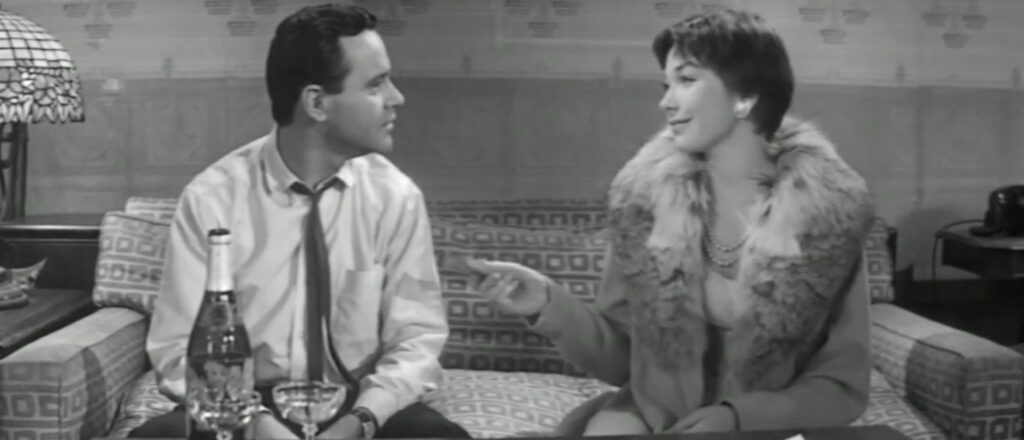
It’s the delightful messiness of the process that intrigues me, compared to the movie as we know it, frozen in permanence, the difference between the chaos of creation and the picture-perfect final product. The original idea for Sunset Boulevard – a comedy with Mae West? The epic closing scene of the Wilder-Diamond masterpiece The Apartment. Should C.C. Baxter watch out the window as Miss Kubelick runs up the stairs? Should he throw open the door and she kisses him? They pondered all of those before ending up at a game of gin rummy:
C.C. Baxter: I love you, Miss Kubelik.
Fran Kubelik: Three… queen.
C.C. Baxter: You hear what I said, Miss Kubelik? I absolutely adore you.
Fran Kubelik: Shut up and deal…
Of course Brackett couldn’t see Stanwyck as Sugarpuss O’Shea, standing as he was in the midst of the act of creation. Lucille Ball? Things might have turned out very differently. But they didn’t.
Wilder’s “The Apartment” is, on any given day, my single favorite film and also my single greatest example to hold up and tell others that “I get it; men suck” and “capitalism is like beer, the cause and solution to all the world’s problems.”
That Wilder and Izzy Diamond were able to not only write but produce/distribute such a diatribe on the failures of men and capitalism back in 1960 is testament to both their genius/guile and the failure of “Hollywood” to realize they were being schnooked, so to speak. The film is perhaps the greatest “screw you” to how horrible men were/are ever.
I’d put “Sweet Smell of Success” up there with “The Apartment” in this respect, but Wilder’s version of male self-loathing is better because it’s so “normalized” relative to the over-the-top disgustingness of Lancaster/Curtis. Heck, we almost think MacMurray and, for instance, Walston aren’t horrible. But they’re even more horrible than JJ, arguably. I most certainly loves me some end of the “Hays Code.” Those days were AMAZING and years before “Bonnie and Clyde.”
Given the movie’s “not all men” conclusion, I wonder where C.C. Baxter goes to work next.