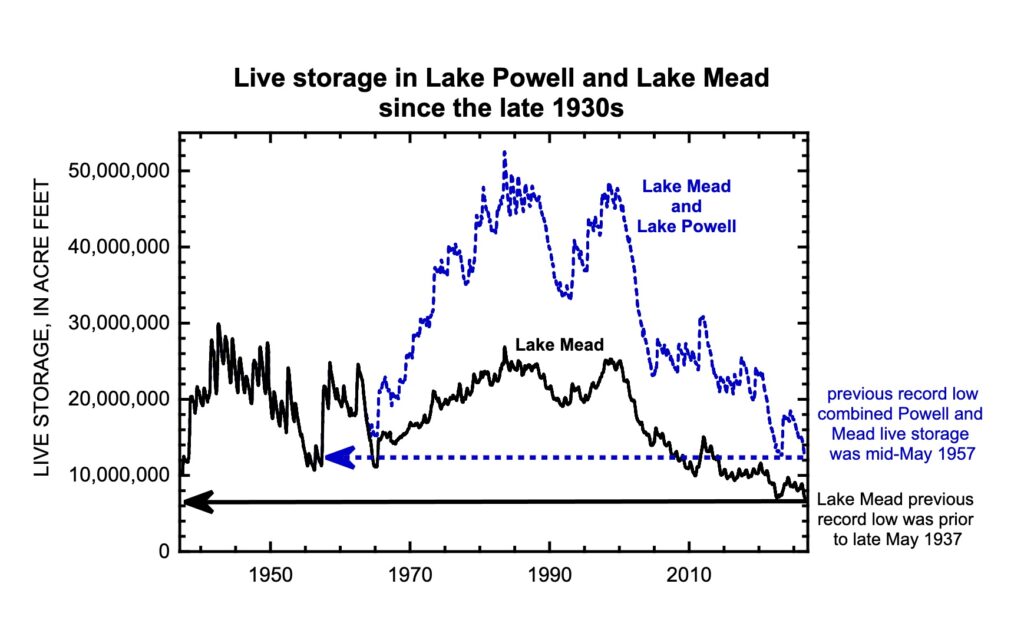
For Mead and Powell, fresh record lows. Data: USBR; Graph: Jack Schmidt
By Jack Schmidt and John Fleck
John C. Page, Commissioner of Reclamation, reported to Secretary of the Interior Harold L. Ickes, in announcing the growth of Lake Mead, that the indications are enough water will be caught and stored by Boulder Dam this spring to put the operations of the Boulder Dam plant on a firm or continuous power basis in June. – Kerrville Times, Kerrville Texas, May 13, 1937
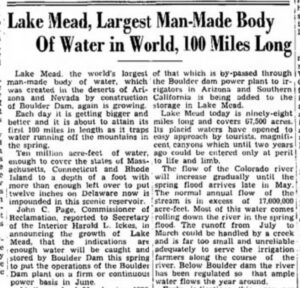
Kerrville Times, Kerrville Texas, May 13, 1937
When Lake Mead’s elevation crossed the threshold of 1,040 feet above sea level in the spring of 1937, stretching upstream 100 miles behind Hoover Dam in the deserts of the Arizona Nevada border, it was national news.
So much water!
As Mead drops past that threshold in the opposite direction in the summer of 2026, it’s telling a different story. So little water.
Two milestones in the last few days are worthy of note. The first is Lake Mead itself, which in the last two days dropped past the previous lowest levels in history set in 2022, meaning it is now the lowest it has been since the reservoir was first filled in the 1930s.
Lake Mead was at 7.012 maf yesterday (Aug. 6, 2026) (1040.5 ft). The previous record low was 7.018 maf (1040.58 ft) that was set on July 28, 2022. Thus, yesterday’s reservoir contents in Lake Mead are the lowest since at least May 1937.
Meanwhile, Lake Powell is now 85,000 af (1.51 ft) above its lowest historical amount since it was first filled in the 1960s.
But that does not fully capture the extent of the crisis. Total reservoir contents of all 46 reservoirs in the Reclamation data base (extending from Fontenelle and Grand Lakes to Lake Havasu) was at 21.27 maf on July 1, the lowest since at least May 29, 1965 (probably earlier, since the Reclamation data base doesn’t report many reservoir contents at that early date).
And California is looking to dot the landscape with A.I. platforms. But there’s lots of water in the Pacific for cooling! And Nuclear plants for power….The Times They Are A-Changin’ – Bob Dylan – 1964
Great Post on the historic lows of the two iconic water storage projects. .
Besides climate change, an additional cause of the low levels in Powell and Mead is the building of NEW state reservoirs upstream. Many have been built, and more are continuing to be built, such as Chimney Hollow Reservoir in Colorado. It is built to hold 90,000 acre feet of Colorado river trans-basin diversion water.
I suggest that the upstream reservoirs are at least part of the problem.
Is there something that allows states to divert water inside their state for CU, and not claim it as usage?