“Game on!” as a friend texted yesterday afternoon.
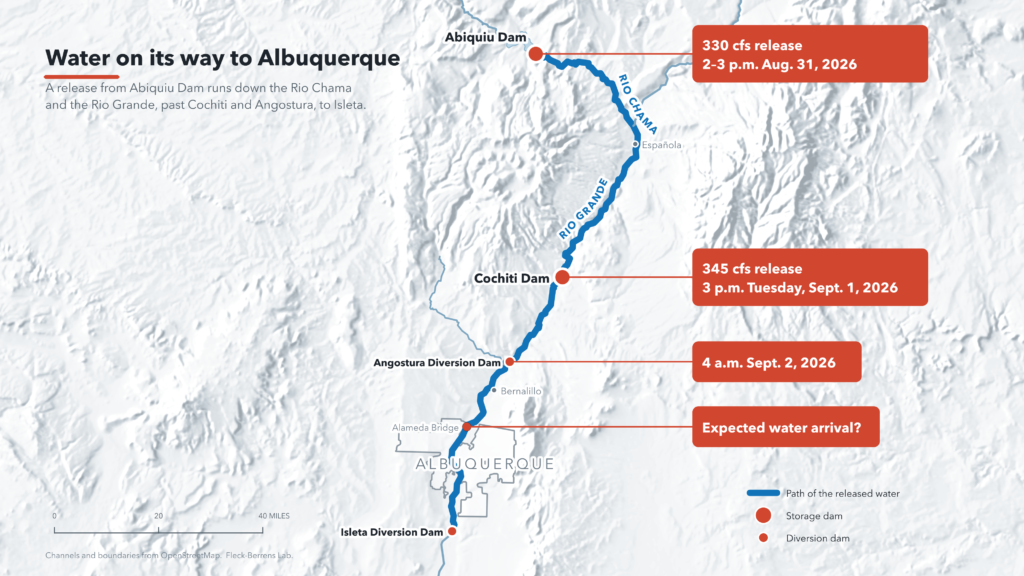
At 2 p.m. Monday (Aug 31, 2026) the Albuquerque Bernalillo County Water Utility Authority, along with the Middle Rio Grande Conservancy District and Audubon Southwest, began releasing a pulse of water from Abiquiu Reservoir on the Rio Chama in Northern New Mexico as an experiment – what might a several day pulse of water do to help the aridification-starved riverside forests along New Mexico’s Middle Rio Grande?
Here’s Bernalillo County Commissioner Barbara Baca, chair of the ABCWUA board:
This one-time release will allow us to gather important data about how water flows through the river following a period of extended dryness, the relationship between the river and groundwater, and the effect of such a water release on plants and trees. It’s also our hope that this will aid vegetation and wildlife affected by the ongoing drought.
As I and others have written previously, we’re seeing extraordinary stress on the riverside trees, the ribbons of green that flank the Rio Grande through New Mexico’s largest city.
The tradeoffs that we talk about every fall semester in the water resources class I teach, tradeoffs among competing and conflicting values, are becoming real. The motivating question I’ve used in my writing on water since my old newspaper days was to ask, as pointedly as I could, “When supplies run sort, who actually doesn’t get water?”
Two answers have become increasingly obvious in recent years along the Middle Rio Grande. What we’ve come to call the “accordion” of irrigated agriculture is squeezing, as pastures and fields without the super-senior water rights that apply to some of the irrigated lands of New Mexico’s Middle Rio Grande (or a supplemental well) go dry.
“The environment” is the other.
The question has never been “What do we say we value?”, but rather “What do we value enough to give up water in some other place?” This is about tradeoffs. More water in one place – an irrigated field or the river channel itself – necessarily means less water in some other place. My “what do we value enough to give up water” formulation shifts this from a question of what we say we value to what we actually value enough to give up water to preserve?
Behind the scenes for the last couple of weeks there has been an extraordinary effort underway to scrounge up some water currently in storage upstream for other purposes, and to rapidly put in place the tools to monitor the results. Nobody’s quite sure how much water will get how far into the bone dry Albuquerque reach of the river, how far downstream the pulse will make it, what the results might be for the riverside forest.
For my whole professional life, long before I shifted from newspapers to writing books, I had a joke when something remarkable happened: “That’ll be great material for my book!” This is that.
Sun’s almost up, I’m off to chase the water.
Thank you. Yes. What do we value enough and what will we give up. The water is illusive – there is the humidity, the dew, our sweat and such. Is what goes back into the air wasted? I have a friend who thinks so. Certainly what is accessible to us is a great importance. We must stop wasting water.
Surely we could flush our toilets with what we have showered in! I have a friend, and older woman, who hung her clothes out on the line to air out instead of washing them so much. But we live in a fast society and most people have not learned some of these ways of conserving water… perhaps city utilities could give discounted rates or bonus for smaller consumers.
And there is electricity – I think there is quite a bit of water that goes into one kilowatt of electricity I have forgotten exactly how much but significant , i remember that!
Thank you.
Ever am I amazed at the attraction of a band aid when an amputation is required.
I recall you were all over it at the time…this reminds me of the 2014 Colorado River pulse into the delta:
https://www.usgs.gov/news/featured-story/a-river-ran-through-it-and-brought-life-least-a-while
I hope they’ll incorporate data from that event–which had visible effects–into this new research effort.
Thursday, 9am, at the end of Campbell, below RGNC, there is noticeably more water in the river, though the change is from a shallow 18″ wide rivulet hugging the east bank yesterday to one perhaps 6′ wide in places. Better, but …
Haven’t there been some rains recently that also will help this out?
I’m glad they have tried to give nature a drink. This also reflects something of how the whole system used to behave with randomish bursts of water.