slots still available for UNM Water Resources Program fall 2017

UNM Water Resources Program students at the Valles Caldera

We still have some slots available for fall 2017 in the University of New Mexico Water Resources Program.

When I left my career in journalism, it was for the chance to join a community of people at the University of New Mexico who are passionate about water. We’re looking for students who think that way too, who are interested in developing the skills and knowledge to help solve the problem of ensuring sustainable and resilient water systems in the West and around the world.

The program is fundamentally interdisciplinary. We’ve got students right now studying the complexities of climate dynamics with UNM’s Dave Gutzler; the challenge of wastewater reused with Caroline Scruggs; the complexities of water law with Reed Benson; the complexities of thinking through what we mean by resilience and how we achieve it with Melinda Harm Benson. The same students. Studying all of these things. We take “interdisciplinary” seriously. (And yes, your tuition includes not one but two Bensons.)

Our core curriculum includes a three broad survey courses.

Our introduction is called Contemporary Issues in Water Management, which I teach along with Bob Berrens, my predecessor as director of the Water Resources Program, with frequent cameos from Bruce Thomson, Bob’s predecessor. Bob’s an economist, Bruce is an environmental engineer, and I’m a former journalist turned professional water wonk. “An economist, an engineer, and a journalist walked into a bar, see, and….” As I said, we take “interdisciplinary” seriously. We cover a lot of ground in a course that’s rooted in an effort to tease out and make sense of water policy and governance is in all its messy complexity.

In the spring semester, students tie physical hydrology and human elements together in the development of a system dynamics model of a watershed. Working with hydrologist Jesse Roach and economist Jinjing Wang, the students this spring are building a computer model of the Gila River watershed in New Mexico to ask questions about human use of water in the region, including its economic and environmental components. Throughout the first two classes, I’m teaching communication at the interface between students’ technical work and the political/policy world in which they’ll be applying it. I’m convinced that understanding deeply how politics and politics work in real world settings is crucial to success in water management. This is my passion.

The third core course is a field course. Students learn to measure water, then spend several days up in the Valles Caldera doing a rapid watershed assessment. See picture above. ‘Nuff said.

With the core out of the way, we then dispatch our students across the campus, assembling what one of this years’ students smartly described as a “choose your own adventure” curriculum tailored to students’ professional goals and personal interests. We’ve got our tendrils in geography, law, engineering, biology, earth science, community and regional planning, and art. Yup. Art. As I said, we take “interdisciplinary” seriously. Water is no one thing.

Students’ capstone for their masters degree is a professional project, which in recent years have ranged from the use of remote sensing to help water managers understand agricultural water use to a look at the prospects for adaptive management of environmental flows on the Rio Chama. This is the coolest part. Lots of examples of our students’ work here.

Know anyone who might be interested? Share this link, and/or have them drop me a line: fleckj@unm.edu. Details on the program here, and if you’re serious our detailed Program Guidelines are here in pdf with info on admissions requirements, prerequisites, and the path through the university bureaucracy.


Does Las Vegas have the most reliable water supply in the Colorado River Basin?

David Owen makes an interesting point in this New Yorker piece:

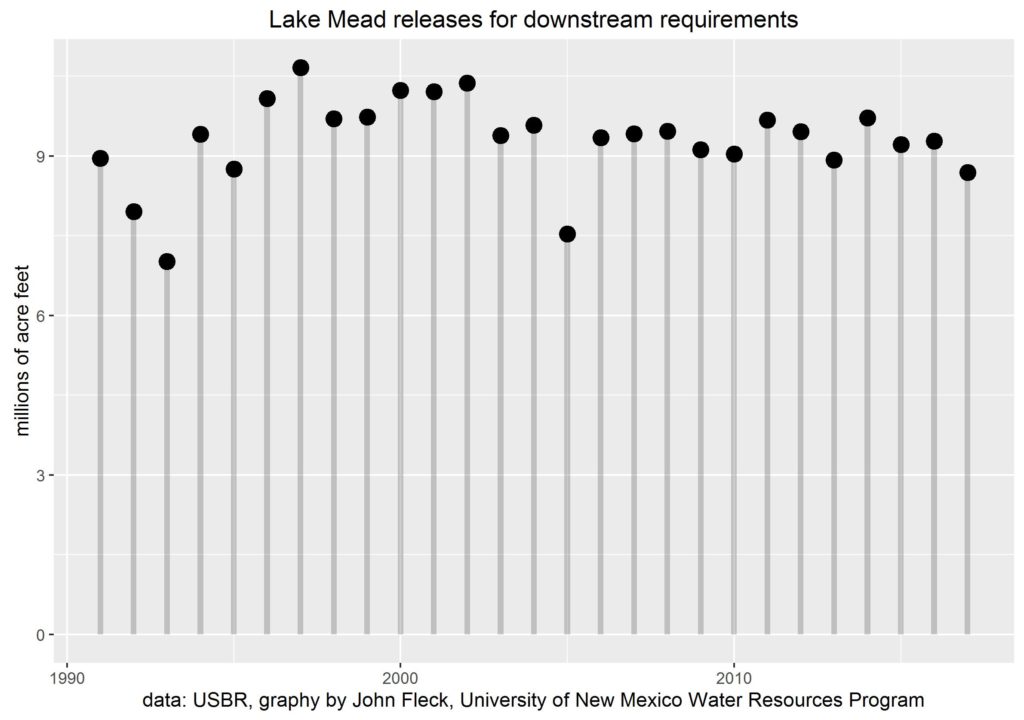
Just as proximity makes people think that Las Vegas is the principal cause of the decline of Lake Mead, it also makes them think that any further decline in the lake will be a problem mainly, or even only, for Las Vegas. But that isn’t true, either. When the pumping plant for the third straw is completed, Nevada will be the only lower-basin user with the infrastructure required to draw lake water from below the level known as “dead pool”—roughly nine hundred feet above sea level, the elevation of the lowest openings in the four intake towers on the upstream side of Hoover Dam. Approximately a quarter of the water remaining in Mead is below that dead-pool line and, therefore, untappable by users below the dam.

This is a fascinating reality. The “dead pool” scenario involves a Lake Mead so low that water can’t get out. But with really deep intakes, Las Vegas will be able to get water if anything is flowing in. At this point, physical infrastructure would trump the Law of the River, and we’d all be wanting to move to Las Vegas.

OK, maybe not that. (I kid, Las Vegas, I love you!)

The article is based on Owen’s new book, which I’m excited to read.

Opening the spigot on the Rio Grande

My friend Lauren Villagran had a lovely piece in this morning’s Albuquerque Journal about what happens when you turn on a river:

Unlike in Albuquerque, where the river is always wet, the wide, sandy bed of the Rio Grande is almost always dry in southern New Mexico below the Hatch Valley until irrigation season begins. Every drop of river water is allocated under a more than century-old treaty – to Texas; then Mexico, and to the onion, chile, alfalfa and pecan farms of southern New Mexico’s Mesilla Valley.

Chasing the river’s advance is a strange thrill, both magical and unsettling.

I’ve known that strange thrill, and she is right in both regards – it is magic to see a river return to its bed, but also unsettling to realize it is doing so in this way only because we periodically turn it off.

In California, another aquifer turns the corner

Ian James on new work by USGS researcher Michelle Sneed on the aquifer beneath the Coachella Valley, west of California’s Salton Sea:

Since 2010, she said, groundwater levels have either stabilized or risen in many parts of the valley, in large part due to replenishment of the aquifer at percolation ponds.

“Every well I’ve looked at, this is the story: Either water levels are coming back up or the water level declines have slowed down,” said Sneed, who spoke during a water forum Tuesday at the University of California, Riverside’s Palm Desert campus.

Sneed, whose latest research has yet to be published, said that while the ground has continued sinking in parts of the valley, the ground level has stabilized in many areas. And in some places, she said, the land surface has risen as imported water has seeped underground to replenish the aquifer.

Sneed has also documented how the ground is rapidly sinking in parts of the San Joaquin Valley, and she said she rarely has an opportunity to present good news about land subsidence.

as war turned to peace

Robert Fleck at Bad Kissingen, Germany, June 1945

Martin Reber, a distant relative, tracked me down to share this picture of my father, for which I will be forever grateful.

We don’t know much about it, other than the scrawled message on the back suggesting it was taken within a few weeks of VE Day as my father’s unit moved into Germany. Dad was an artist, who had hauled his paints with him through war and into peace. He had found a porch, to paint in the natural light.

I have written before about my life amid art – “art as a verb – a thing not that has been done, but rather a thing that people do.”

See how his right hand, his brush hand, is blurred.

the federal role in water infrastructure

There are several federal programs with a demonstrated success in making infrastructure-related investments that support sustainable water use, healthy rivers and facilitate much-needed public-private partnerships. These include WaterSMART at the Department of the Interior; the Rural Utilities Service program at the Department of Agriculture; and the Clean Water and Drinking Water State Revolving Funds at the Environmental Protection Agency (EPA).

Collectively, these and other programs that focus on conservation and watershed improvements are the backbone of making efficient and sound infrastructure improvements that address today’s water resource challenges….

Water resource programs across Interior, Agriculture, EPA and the Army Corps of Engineers (COE) are critical elements of an overall strategy to leverage significant non-federal investments to implement durable solutions that stretch limited supplies, improve watershed health, support economic activity and contribute to investments needed for aging infrastructure.

Unfortunately, the Trump administration’s recent budget framework threatens many of these programs with cuts or elimination at a time when it is most important to support the infrastructure needs of communities. While the details are still unclear, the proposed 31 percent, 21 percent, 16 percent and 12 percent cuts to the EPA, Agriculture, COE and Interior, respectively, leave little room to adequately fund important programs to address the needs identified by ASCE.

That is former Deputy Interior Secretary Mike Connor in The Hill, the whole thing is worth reading.

Why should I conserve just so those other guys can have the water?

This story is a bit of a garble, but it illustrates one of the central challenges in making water conservation deals in the Colorado River Basin.

Here’s how I explained it in my book:

Within the network of state and water-agency representatives working on Colorado River Basin problems, there is a clear recognition that eventually some sort of “grand bargain” will be needed that finds a way to reduce everyone’s water allocation. To keep the system from crashing, everyone will have to give something up. But each of the participants in that core network also understands the dilemma that follows: each must then go home and sell the deal in a domestic political environment that views the river’s paper water allocations as a God-given right.

The story describes a Glendale City Council discussion of leaving water in Lake Mead, at which one of that community’s elected representatives said this:

“We are conserving water only for it to be consumed by other states,” said Councilmember Lauren Tolmachoff.

World Water Day on the shores of old Lake Bonneville

Flying into Salt Lake City this afternoon, I noticed the old shoreline benches of Lake Bonneville, the great Pleistocene inland sea that once filled a big chunk of what we now call the Great Basin. The benches are these big flat topographic features a few hundred feet above the valley floor. One one, south of town, they’ve built a neighborhood, a modern repurposing. It’s one of those geologic features that’s dead obvious from the air, but harder to see when you’re on it.

I’m at the University of Utah for the Wallace Stegner Center 22nd Annual Symposium – Water in the West: Exploring Untapped Solutions. With an hour to kill before dinner, I walked up the hill behind campus where there are signs for the Bonneville Shoreline Trail, which traces the counter of the old shoreline bench here.

I ended up at Red Butte Creek, which emerges from a culvert on the southern edge of campus before winding down to the Jordan River. It’s a little creek, but with the big snowpack to the east it was running full.

Red Butte Creek, Salt Lake City

Happy World Water Day from the Red Butte Creek watershed, on the shores of old Lake Bonneville.

six crossings of the Rio Grande

The Rio Grande through Albuquerque has been rising this week, thanks to a combination of a great snowpack and a quirk in the river’s operating rules.

The snowpack part is obvious – it’s big and melting fast – the rule quirk less so. Under Article VII of the Rio Grande Compact, we cannot store water in most of our upstream reservoirs unless Elephant Butte Reservoir (the downstream reservoir that delivers water to Texas) is above a 400,000 acre foot threshold. It is not, so the rules require the Bureau of Reclamation and the Corps of Engineers, the managers of the upstream dams, to pass all the water. The rule quirk has weird subquirks involving Pueblo communities’ water rights, which I’ll leave as an exercise for the law students in the audience. But the bottom line is that flows through Albuquerque are up by a thousand cubic feet per second today compared to a week ago, because Rules.

six crossings of the Rio Grande

Last night I lay on my couch intently staring at maps on my iPad for more than an hour, plotting. The result – a morning bike ride that looped and twisted and turned to include all six of Albuquerque’s crossings of the Rio Grande.

A bicycle is a great way to see one’s place. The spatial and temporal scale – in a morning I can cover a big chunk of Albuquerque at a speed slow enough to ponder – combined with the physicality of moving your own body across the landscape, builds an intimate geography.

My  friend Andrew has gotten me hooked on Strava, a web-based tool for tracking your bike rides. You slap one of those GPS goobers on your bike, download the data, and the fun begins. (Heatmaps!) I started more than a year ago after Andrew told me that municipal planners use Strava data to help make bike route decisions. Most of my riding the last couple of years has been commuting, and helping planners identify commuting patterns seemed like a useful contribution.

Lately, though, I’ve become enamored with the performative, social aspects of the thing.

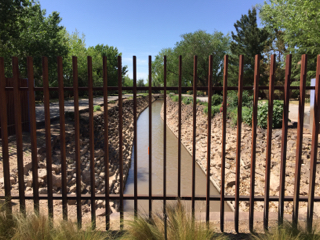
Rio Grande at Bridge Boulevard (yes, we have a bridge named “Bridge”)

Andrew moved recently (boo), but it’s been fun to “watch” him explore his new town via his Strava feed. Strava is designed for the spandex crowd, with things like “suffer scores” and timed interval reports and such, and its Facebook-style use thus lends itself to a kind of public performance. This is not me. I am old, and slow. But with words and pictures it also opens the possibility for little stories. There was comedy, for example, as one of Andrew’s carefully planned routes in his new town failed at a large stairway.

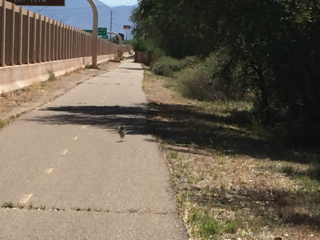
So I planned my route with care, knowing that my Albuquerque friends could take amusement at the zigs and zags and curlycues needed to hit all the bridges as I worked my way back and forth up the Rio Grande Valley. With a picture of the river at each crossing.

My water obsession means our routes, when we bike together, often include detours to get a picture of the Rio Grande. So even though I was riding by myself, this ride had a social element.

I eagerly await their criticism – “There are really seven crossings, John, what about Alameda?” – and the argument that will ensue and the planning for another ride that adds the seventh bridge. Or maybe the eighth, out in Bernalillo?

I’m old and slow, and that’s kind of far, but not out of the question.

Going Down to the Water

My students have all heard me tell this story, many more than once (sorry!), but it was fun to work it through in writing:

Some years ago, through the serendipity of a missed airport connection, I found myself stranded for 24 hours in Prague. I was tired, my mind set in the way of air travel on my destination—home. Prague may be one of Europe’s great cities, but it had not been my plan to visit it. It took me some time to warm to the opportunity my travel mishap had presented.

After stashing my belongings in a room at the airport hotel, I got a map from the concierge and directions for the transit connections to find my way into the old Eastern European city. With no advance knowledge of the city and no particular plan in mind, I emerged from the Malostranská subway station and did what I often do when I start from scratch—I began wandering toward the water….

“Say you are in the country; in some high land of lakes. Take almost any path you please, and ten to one it carries you down in a dale, and leaves you there by a pool in the stream,” Herman Melville wrote in the opening chapter of Moby Dick. “There is magic in it.” It is always down—simple gravity and fluid mechanics mean water occupies a landscape’s lowest spot. It is also instructive. To learn about a new place, I’ve found, you can always start with its water. To know London, start with the Thames and the earliest mariners traveling up its estuary for the first time, searching for a good place to land. But think also through London’s nineteenth century sewage management crisis, when the growing city finally had too much and was forced to organize around the problem of ridding itself of “the great stink.” To know Seattle, explore the wharves of Elliott Bay and learn the history of the Duwamish River—sacred salmon river turned industrial wasteland. To understand Los Angeles, and the Southern California metropolis that surrounds it, is to see the land as a community with little water of its own but the audacity to build three great artificial rivers to make up for its natural shortcomings. Lacking the natural harbors of its urban competitors, Los Angeles built a port.

For Prague, a community that grew up in a place where the river could be crossed, the city’s first water was the Vltava. Knowing nothing else about the city, I could trace the little canal back from a low diversion dam across the river and begin to see how the early community’s members organized themselves around the task of managing their water. “How societies respond to the challenges presented by the changing hydraulic conditions of its environment using the technological and organizational tools of its times,” Steven Solomon wrote, “is quite, simply, one of the central motive forces of history.”

That is the introduction to “Going Down to the Water“, an essay in the latest issue of the Natural Resources Journal, published by the University of New Mexico School of Law. Huge thanks to Colin McKenzie for inviting me to do this piece, and Matthew Ramirez for some crackerjack editing.

Really, thanks y’all, this was the most fun I’ve had writing something in ages. A reminder – I need to write more, it’s fun!

There’s a bunch of really interesting stuff in the new issue, which focuses on water governance. I was especially smitten with this piece by Burke Griggs on the political cultures of irrigation communities, and their relationships to the water law that emerges therefrom.