The shrinking of the American lawn

According to this piece by Andrew McGill of CityLab/The Atlantic, the average American yard has shrunk by 26 percent since the 1970s, as homes get larger while lots get smaller:

The shrinking lawn is actually an economic compromise. Americans want bigger houses, but since every additional square foot balloons the cost, homebuilders are keeping prices affordable by cutting off lawn acreage.

The happy side effect is a reduction in new homes’ consumptive use of water.

My book is now a thing that exists in the physical world

There was a weird moment this afternoon when I was writing something and needed to dig out a reference from my book. (I do this a lot. It’s all there, the book has a lot of footnotes.) For a split second I started to follow the usual path on my hard drive to the final page proofs…. Click…. Pause….

a box of books that came in the mail

a box of books came in the mail

Walk into living room, grab book off table, thumb through it. Yes, there it is, page 6, in the introduction.

I’ve been walking by the stack of books all weekend, reaching out and touching them, sometimes opening one up and reading a page.

During the flurry of attention around the release of Between the World and Me, Ta-Nehisi Coates at one point described the moment of terror when he was in the midst of the hard part of writing, when he realized the risk of abject public failure. To write a book is a deeply arrogant, deeply public act: “Please pay a substantial sum of money for what I have to say and spend hours reading it.” To fail at this is to fail in a very public way. I’m no Ta-Nehisi Coates, so my terror was of a different scale entirely, but it was no less real.

So I pick it up and I read a page and I’m pretty happy, and also relieved. It came out OK.

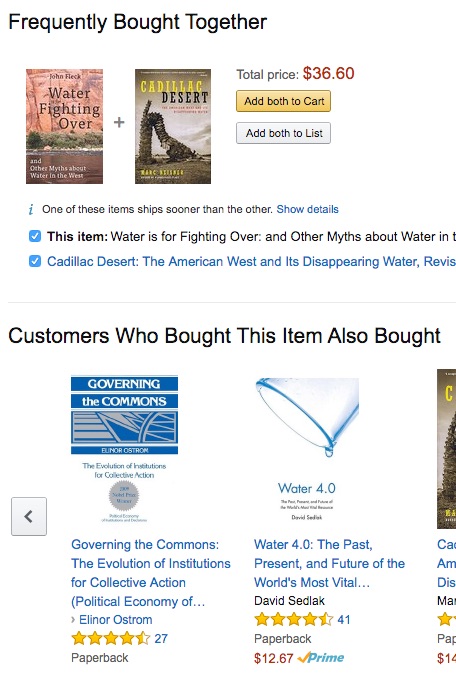
Water is for Fighting Over and Other Myths about Water in the West is available for pre-order, on the bookshelves at your favorite local bookstore Sept. 1.

Elwha Dam Removal – a reminder that changing water management systems is hard

The removal of two dams on the Elwha River, on Washington’s Olympic Peninsula, has been rightly celebrated as a major achievement – returning a river and its fish to their old channel. But there is much to learn, also, about how difficult it is to change the course of a water system when society has come to depend on the old ways.

In this case, it is the community of Port Angeles, at the Elwha’s mouth. To make the project work required construction of a big new water treatment facility. But as Lynda Mapes reports, the new water treatment facility kinda doesn’t work:

It was the most expensive single part of the $325 million Elwha dam-removal project: a $79 million water-facilities project designed and built for the National Park Service that has never worked as originally planned.

Now the park service is ready to hand the plant off to the city of Port Angeles, but the city doesn’t want it, saying it doesn’t work and will cost too much to operate.

The city says it won’t take over the facilities — which include screens, pumps, a water intake, a water-treatment plant and other components — without $16 million in repairs first. The city also wants money to cover higher than anticipated operating costs for 20 years, for a total of $41 million.

The deal here is complicated, but the bottom line is that when you make major changes in a water system, there are winners and losers, the losers generally need to be compensated, and figuring out how to get the compensation right is hard.

Why water management in the Upper Colorado River Basin is so different from the Lower

Mancos Valley irrigation

Mancos Valley irrigation

CORTEZ, CO – The Spring Creek Extension Ditch Company got the OK this week from Colorado’s Southwest Basin Roundtable for a $29,000 grant to replace a 75-year-old siphon on the Spring Creek Ditch, where it crosses the Pine Valley Canal.

The ditch company has been delivering water to farmers southeast of Durango since 1901. There are currently 64 shareholders using its water, irrigating 5,435 acres. The siphon is at risk of failure, and the ditch company’s managers were asking the Roundtable for money to fund a share of the cost of replacement with a new pipe. The Roundtable, created to provide local input to and control over a portion of the state’s water spending, said yes. The ditch users themselves are covering part of the cost, and they’re asking the Colorado Water Conservation Board for the rest.

Upper Colorado River Basin agriculture, Montezuma County, Colorado

Upper Colorado River Basin agriculture, Montezuma County, Colorado

This is bottom up water management, governance at the retail level, and it says a lot about how the Colorado River Basin’s large scale issues cascade down to the local level – or perhaps how actions at the local level accumulate and filter up to the basin scale.

I was at the meeting for bigger picture stuff – a progress report on a study of Upper Basin risk as Lake Powell drops (I am working on this project with folks from the Colorado River District and Basin Roundtables from around the state). After our item, I stuck around to listen to the rest of the agenda, as one does. We New Mexicans are endlessly fascinated by the water management ways of our neighbors to the north. What is this wizardry you call “Roundtables” and “priority enforcement”?

In the Lower Colorado River Basin, where I’ve spent most of my time over the last few years working on a book, water management is a fundamentally distributive task. Water is released from Lake Mead in bulk and then distributed outward at a relatively small number of diversion points, tightly measured and well understood. You have a relatively small number of big water districts, allowing a relatively centralized decision structure. That doesn’t mean it’s easy, but at least the places where action is needed are relatively few.

The Upper Basin is completely different. Water starts in snowpack, trickling down a zillion creeks, gathering in streams and rivers with scads of much smaller diversions grabbing shares of water as it heads down toward the Green and the Colorado and the San Juan, the major tributary rivers that join to form what in the Upper Basin they call collectively the “Big River”. It is a fundamentally decentralized system.

Mancos River watershed

Mancos River watershed

Consider the Mancos River watershed, the next watershed to the east of Cortez. Lissa and I wandered its back roads today looking at farms (as one does) – five acres here, ten acres there, much of it hay and pasture. It’s lovely, green in July, the transitional geography between the Rockies and the deserts of the Colorado Plateau. If you’ve ever been to Mesa Verde, Mancos is the river valley that marks the eastern and southern edge of the park. In the 1990s (the most recent data I could easily find, an assessment done by Peter Stacey of the University of New Mexico), about 12,000 acres were being irrigated with water from some 46 separate diversions in the Mancos watershed, between its headwaters in the La Plata Mountains (a southern bit of the Rockies) and its junction with the San Juan just across the border in New Mexico. That’s 46 diversions in a tiny watershed, and pretty much every tributary in the Upper Colorado River Basin starts out this way – lots of diversion points each taking a relatively small share of the river. Compare that with Imperial County in California, where more than 450,000 acres are being irrigated with three diversions (maybe four if you count the two that serve Bard?).

As we enter into a basin wide discussion about the need to take less water from the Colorado River system – because there is less water in it than we planned for those many years ago – the nature of the conversation is very different if you have a relatively few large diversion points, or a staggering number of small ones.

Repartimientos de agua: New Mexico’s tradition of water sharing

Repartimientos de agua is how community acequia systems operate in times of water scarcity. Custom originally arose out of conflict and the ongoing elastic process of negotiation and reconciliationitself, of meeting year after year to divide the water according to agreements forged in crisis long ago.

Acequieros believe that water scarcity should be shared equitably among irrigators with decision made locally about distribution. This in contrast to the concept of priority calls which can allocate all available water to the most senior user. Historically, Mayordomos have resorted to daily, ditch-by-ditch repartos. Still, in many cases, no one ever got enough water, and there were days when livestock and crops went thirsty.

That’s the New Mexico Acequia Association’s explanation of how some communities here have managed water in drought for a very long time.

Stuff I wrote elsewhere: The Great Decoupling of the West’s Water

This 2010 paper by Peter Gleick and Meena Palaniappan planted the seed, and as I worked on my book I found examples everywhere – geographies and economic communities that are using less water even as they were growing. I blogged about it, as one does, one thing led to another, and when I finished the book manuscript in December I embarked on a deep dive into “decoupling” of the West’s water:

Contrary to the narratives of apocalyptic doom or a need for ever-growing supply as a result of unsustainable water use, these communities have demonstrated an adaptive capacity that has allowed more people and economic activity using less water. This creates opportunity – to grow more food, to move water to cities, and to begin to reclaim some of the surplus for the environment.

My water wonkness is all about narratives, and the “we’re gonna run out of water” narrative seems one of the strongest and most damaging to our ability to solve our problems. A recognition of the opportunities provided by decoupling seems to me to be central to our ability to solve the problem of creating a sustainable and resilient future here in the Southwest.

A big thanks to Ted Nordhaus and colleagues at The Breakthrough Institute for supporting the work, and for some really insightful contributions as I did it.

A new home for some stuff I write now and then

My friend Scot Key offered me double the rate they pay here at Inkstain (this is a joke, we are bloggers, we do it for “exposure”) so I’ve got a new post up over at his Better Burque. We mostly ride bikes and complain about how much this or that sucks, especially poorly designed and executed bicycle infrastructure. (We kid! The new Coal overpass over the railroad tracks is great!) But we also share a fascination with urban planning and economics, so we write stuff.

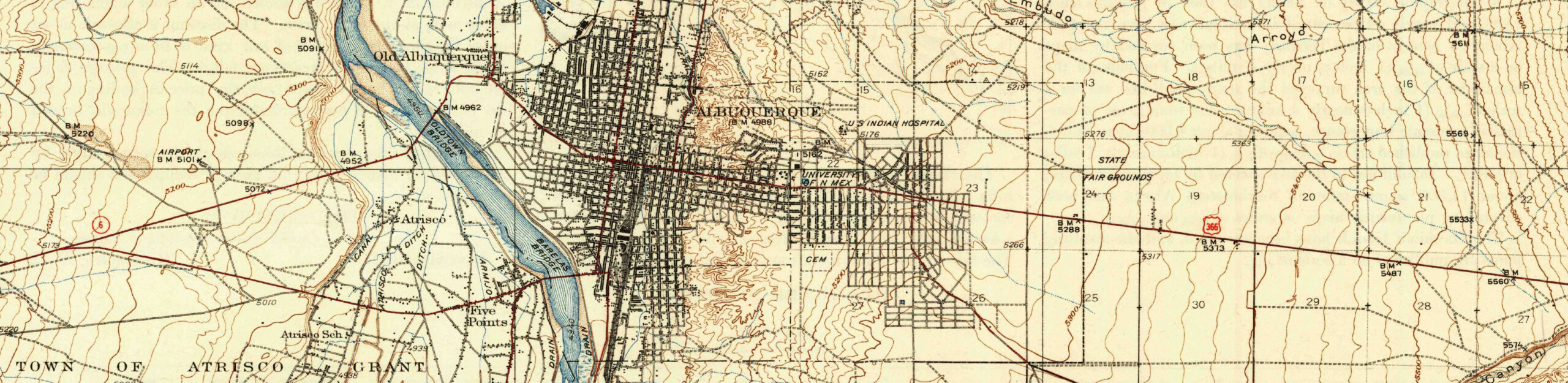
Scot assured me that if I wrote about A.R.T., Albuquerque’s controversial new redesign of old Route 66, I’d get a ton of clicks. I basically think A.R.T’s an OK idea, which seems to have become a controversial position in Albuquerque. But I started small, with Mesa del Sol’s roads to nowhere and the question of whether Albuquerque is creeping toward becoming a steady-state economy, a sort of post-sunbelt growth boom city.

What would that mean?

Green versus green: removing Snake River dams

One of my University of New Mexico Water Resources Program colleagues frequently points out what they call “green versus green issues” – environmental tradeoffs that are often under-examined because our environmental discourse focuses on one set of values without sufficiently incorporating other values.

Today’s inbox missive: removing dams from the Snake River in the U.S. Pacific Northwest:

The steady and reliable dams balance energy from intermittent sources like wind. As wind becomes a larger portion of our energy supply, the load balancing function of the Snake River dams will become even more important, especially since the wind is often strongest in the middle of the night when our need for energy is at its lowest.