Palm Springs, a water conservation success?

Palm Springs, in the deserts of Southern California, would never be mistaken for an actual desert. They dump too much water on their landscaping for that.  But Ian James reports they’re getting better:

May turned out to be a banner month for water conservation in the Palm Springs area, with customers of the Desert Water Agency cutting back by 39 percent and surpassing a state-mandated goal.

Metro Los Angeles – one of the places Californians *do* regulate their groundwater

Steve Scauzillo wrote last week about the Water Replenishment District of Southern California’s decision to invest $110 million in a new wastewater treatment plant, that they might use 21,000 acre feet now discharged to the ocean to recharge regional aquifers instead.

Water Replenishment District of Southern California

Water Replenishment District of Southern California

Formed in the early 1960s, the WRD is the best example of one of the places where Californians do regulate their groundwater. In the rhetoric around California’s groundwater management failures, the Central Basin and West Basin agency, which spans the core of the Los Angeles metro area, is sometimes missed. I suspect that’s because they’ve been doing it for so long it’s just taken for granted. But as California struggles with setting up groundwater management in places it hasn’t done it before, there are lessons to be learned in the places that it has.

I’d love it if you could at this point just buy my book so you could read the chapter about the formation of groundwater governance in this region, but it’s not out yet (preorder now!), so at the risk of giving away important content for free…. Southern Californians created what Elinor Ostrom and colleagues might have called “covenants without a sword“, which is to say binding agreements among water users in the basin to regulate groundwater pumping and collectively act to manage the aquifer through an extensive recharge program along with creation of seawater barriers to prevent saltwater intrusion, but without the heavy hand of the state of California acting as an enforcer (the “sword”). Instead, the water user community polices itself.

West Basin groundwater levels

West Basin groundwater levels

This goes back to the 1930s and ’40s, when communities in West Basin, out near the coast, saw groundwater levels dropping and saltwater intrusion threatening their groundwater supplies. Ostrom’s doctoral thesis documents the struggle to create governance institutions that avoided a “tragedy of the commons”. By the 1960s and ’70s, the communities had set management goals for their aquifer that restricted pumping, managed recharge, and treated their aquifer as a valuable reservoir and storage reservoir that could be used as a sort of “working reserve” that fluctuates up and down in response to the availability of surface supplies. The aquifer is not off limits completely. Rather, it’s managed in conjunction with other supplies to ensure a sustainable water supply for the region.

The Albuquerque example

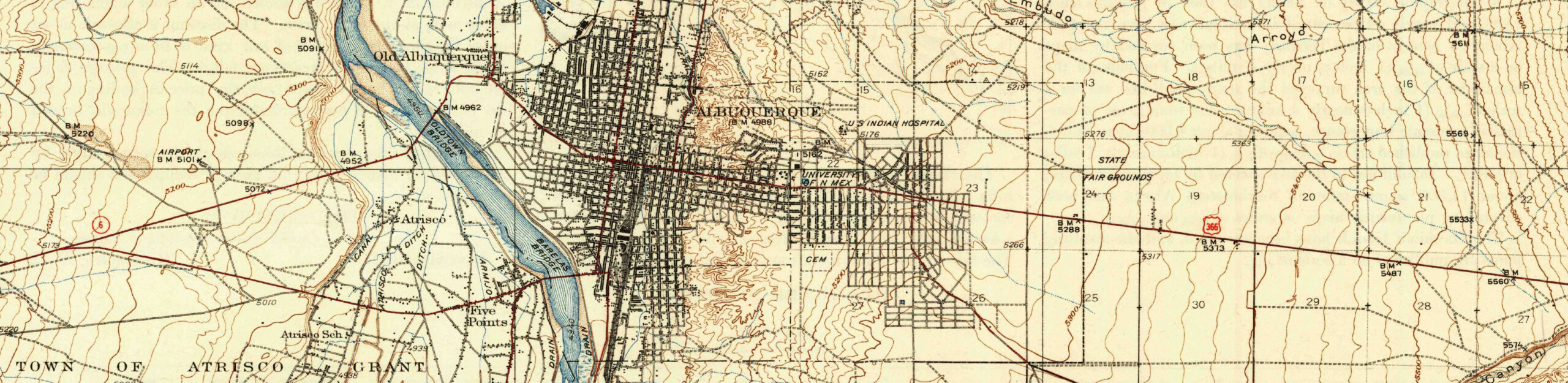
My own city of Albuquerque has been engaged in a successful aquifer management effort over the last decade (I’ve written a lot about this here at Inkstain, and of course pre-order my book for more, Albuquerque’s success is in some ways both the rhetorical starting point and ending point for the book’s argument) that has some similarities. John Stomp, our water utility’s Chief Operating Officer, spoke to my UNM Water Resources Program class last fall about the new Water Resources Management Strategy now in development, which looks increasingly like what they’ve done in West Basin. (disclosure: In my post-journalism career, I’ve recently begun working with the Albuquerque Bernalillo County Water Utility Authority doing some technical writing on the WRMS. Disclosure 2: Some of my smart New Mexico water friends are less enthusiastic than I about Albuquerque’s approach, Dennis Domrzalski explains their concerns here.)

The new wastewater recycling Scauzillo writes about is not the first time they’ve done that. In fact, they’ve been doing that for decades, averaging 55,000 acre feet per year. But they also still use some imported water (Colorado River and State Water Project supplies, which come from Northern California). The new project will mean the replenishment is entirely weaned from that imported water.

on thinking the worst

I think we often think the worst of people, and despair of certain political mechanisms, when they don’t deliver what we want. We fear the consequences of political outcomes that don’t reflect our values or interests and – particularly during a heated referendum in which so many people are involved – get a bit of a shock when we see how many people hold opposing views so passionately. For the people most engaged in debate, this can be a visceral experience that reduces our ability to take a step back and give us more time to consider events and their meaning.

Paul Cairney. He’s talking about Britain’s vote this week, but it seems relevant elsewhere.

Allen Best on the lullaby of spring runoff

Living by a creek in Vail, an open window, the lullaby:

I loved that sound, what Wallace Stegner, in one of his many books, called “The Sound of Mountain Water.” In those same years I often kept my window open at night, lulled to sleep with the sweet discourse of a billion water molecules sloshing, slamming, slithering down the nearby creek, impatient to join the mighty Colorado River about 35 miles away.

The whole piece is lovely and worth your click.

Unsettled questions about Native American water rights in the Colorado River Basin

More than a dozen Native American communities in the Colorado River Basin have yet to have their legal entitlements to a share of the river’s water quantified, according to a new report from the Colorado River Research Group. With the river’s water already over-appropriated (meaning users, largely non-Indian, have built farms and cities that have come to depend on more water than the river seems able to provide in the long run), this is a challenging problem:

Moving forward with efforts to provide the Colorado River tribes with the water needed to sustain communities and build economies is both a legal and moral imperative. The challenge is to do so in a way that embraces creative, flexible, and efficient uses of water, often in partnership with non-Indian water users. Most of the modern progress has come through negotiated settlements, some of which empower the tribes to lease water to off reservation users.

This is most importantly a problem in the Lower Colorado River Basin states, but the CRRG report nicely quantifies the issue throughout the basin, pulling together data from disparate sources in one place. I argue in my forthcoming book (pre-order now!) that failure to include native communities in basin decision making has been a fundamental problem, both in moral terms as well as in terms of practical water management. We have a large group of people legally and morally entitled to water, to borrow the CRRG’s language, that is not yet using it all. This is a huge problem.

New outlook shifts odds slightly toward dry 2016-17 across Colorado River Basin

At the risk of driving faster than is prudent on a twisty mountain road at night, the new 2016-17 climate outlook released yesterday does not look particularly encouraging for the Colorado River Basin:

December-February outlook

December-February outlook

That’s December 2016 – February 2017. Browns mean odds are shifted toward dry.

A reminder that the maps can be a little confusing, so it’s best to paint a word picture of what they colors actually mean. The Climate Prediction Center divides the historical record into thirds – the one third wettest count as “wet”, the one third dry are “dry”, etc. That light brown means that there’s a 33-40 percent chance of dry, so it’s only a slight shift in the odds. For that darker brown draped across my house in central New Mexico, that’s a 40-50 percent chance of dry.

Importantly, the odds also favor warm, which combines pushes our river flows in the direction of dry.

The full maps are here.

Have we stabilized the Colorado River’s water supplies?

It’s a bait and switch. The answer is “no”. (It always is when it ends with a question mark. See Betteridge’s Law of Headlines.) But as I report in my water newsletter, there are some encouraging signs that we’re moving in the right direction.

You can subscribe to the newsletter, which is supposed to come out weekly but rarely does (hey, you get what you pay for!) here.

With Colorado River water, growing peppers

I’m not sure I would be as sanguine as this Coachella pepper packer about the long term availability of water:

The process of producing peppers is both simple and complicated.  “Workers, water, weather–those are our three big headaches,” Aiton says.

Aiton says while water is a concern in the state, it’s not as critical in the Coachella Valley as other parts of California. “Coachella Valley for us is one of the cheapest places to grow water. There’s a huge underground aquifer here. Plus, we have water rights from the Colorado River. So, we’ve been able to withdraw water from that,” he explains.

some thoughts on my rainbow unicorn socks

one of my rainbow unicorn socks

one of my rainbow unicorn socks

Some years ago, my adult child gave me a pair of rainbow unicorn socks.

They’re really nice, comfy socks, but in a complicated way. They are quite literally comfy – thin and stretchy, made of a high quality fabric. More than that, the rainbows and the unicorns are for me an assertion of comfort in queerness, and in particular comfort in and embrace of the queerness of my adult child.

I will never forget the power of my first Pride parade, the exuberance of the simple creation of a safe queer space in a world that still lacks them, that takes non-queerness (in its many points on the non-LGBTQ spectrum) as the norm. There were a shitload of rainbows at that Pride parade. Rainbows mean that to me.

In my newly remodeled career, I speak a lot in public, and I still get a little bit nervous, and I nearly always wear rainbow unicorn socks. People often notice them, comment on them (they’re rainbow unicorns socks!) and I tell them Nora gave them to me. The socks are a reminder of what’s important to me, bestowing a weird goofy confidence at what is often a nervous moment. I’m usually speaking about water policy, so I’m not sure why or how this matters, but it does. A lot. As many introverts do, I put on a mask when I’m on stage, and the socks remind me of who I am.

On this particular Sunday, I know that my rainbow unicorn socks (I now have more than one pair, it’s become an increasingly challenging family tradition for my botmaking artist offspring Nora Reed to find new and different ones) have limited utility. The hate they (I am referring with this pronoun to Nora Reed, the non-gendered pronoun still awkward for me but important) has endured can’t be stopped with my rainbow unicorn socks, and we are reminded on this particular Sunday that many endure much in a world that is still hateful toward those who are different.

The socks are simply this, my little way of carrying the power of that first Pride parade with me and the love shared by a father and his goofy queer child.

the role of science and evidence in decision-making processes

I’m working on a couple of projects right now in which I’m trying to help policymakers effectively communicate complex science (involving drought, climate change, and water availability, but that goes without saying, right?) in political and policy processes. Paul Cairney suggests the constraints:

In debate, evidence is mentioned a lot, but only to praise the evidence backing my decision and rejecting yours. Or, you only trust the evidence from people you trust. If you trust the evidence from certain scientists, you stress their scientific credentials. If not, you find some from other experts. Or, if all else is lost, you reject experts as condescending elites with a hidden agenda. Or, you say simply that they can’t be that clever if they agree with smarmy Cameron/ Johnson.

Cairney’s writing here about Great Britain’s “Brexit” debate, but this generalizes.