At the risk of repeating myself, Lake Mead ended 2015 with a surface elevation 1,080.91 feet above sea level, its lowest year end since it was filling in 1936.
Happy New Year, y’all know what you need to do now.
At the risk of repeating myself, Lake Mead ended 2015 with a surface elevation 1,080.91 feet above sea level, its lowest year end since it was filling in 1936.
Happy New Year, y’all know what you need to do now.
If you care about Colorado River Basin water, it behooves you to pay attention to the snowpack in California’s Sierra Nevada. It’s an entirely different watershed, but 2015 demonstrated how the interconnections in California’s plumbing have left the two inextricably linked.
The tl;dr version of two interrelated points below:
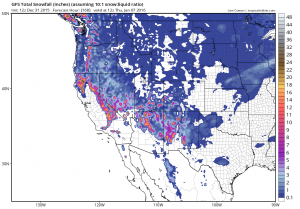
7 -day accumulated snow shows more help on the way for California’s watersheds. GFS model, courtesy Levi Cowan
The good news in California is that, as of yesterday’s theatrical, made-for-media first measurements of the year, the Sierra snowpack is near normal for this time of year. That’s essentially twice as much snow as last year at this time. There’s lots of snow season left to push the numbers up or down, but for now it’s good news. And the current forecasts (see map to the right) call for more of the same.
Less theatrical is the Metropolitan Water District of Southern California’s low key success in running its Colorado River Aqueduct full bore this year, ferrying extra water from Lake Mead to coastal Southern California to make up for the shortfall in 2015 Sierra-fed water supplies. In particular, in addition to Met’s flexibility in water deals within California to move ag water to meet urban demand during the drought, there is 240,333 acre feet of water moving through the aqueduct that would not otherwise be there thanks to a historic 150kaf deal to send Las Vegas water Met’s way to help during the drought, plus another 90,333 acre feet in water that Met had banked in Lake Mead in previous years.
The result is that, at 1.178 million acre feet, Met’s take on the Colorado River this year is projected to be the largest since 2002 (source: USBR water accounting reports, 2015 year-end forecast updated today).
There are two ways of looking at this.
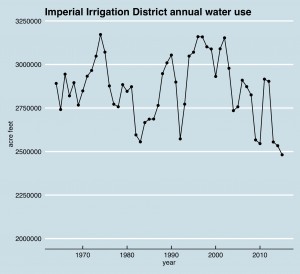
Water use by the Imperial Irrigation District. Data: USBR, graph by John Fleck
The foresight of Southern California’s water management community created diverse sources of supply that have allowed it to weather the unprecedented California drought. One purpose of big multi-year reservoirs is to store water in wet times so that it is available in dry times. Lake Mead has fulfilled that role, dramatically, during California’s current drought. That is a good thing. What good is a reservoir full of water if you can’t tap it when you’re faced with an event as extreme as California’s current drought?
California also has been building increasingly sophisticated water-sharing/transfer deals, including between the Imperial Irrigation District (where water use in 2015 was at record low levels) and metro water agencies.
But risk in California now poses risk in the rest of the Colorado River Basin, because of the interconnections we’ve built. My water supply here in Albuquerque, beyond the eastern boundary of the hydrologic Colorado River Basin, is now linked to snow that falls in California’s Sierra Nevada nearly 1,000 miles (600 1600 km) away.
When I sat down this morning to look at 2015 Colorado River data with an eye toward a year end post, here is what struck me.
So in a slightly sub-par year, and with California taking extra water in response to a historic drought, the Colorado River system remained, in 2015, roughly in balance. Absent California’s problems, net storage would have been up this year.
Importantly, with just 94 percent river flow, Lake Powell is up ~300,000 acre feet from a year ago, suggesting that Upper Colorado River Basin water users consumed less water than nature provided. Mead is down, Powell is up.
Of course, “absent California’s problems” invokes a useless hypothetical, because California did have problems. I could just as easily pose a hypothetical in the opposite direction: What if we hadn’t had that “miracle May” that bailed out an otherwise dismal year in the basin?
Elephant Butte Reservoir, the largest on the Rio Grande, will end 2015 with roughly 322,000 acre feet of water, or about 16 percent full. That’s up from 11.5 percent last year at this time:
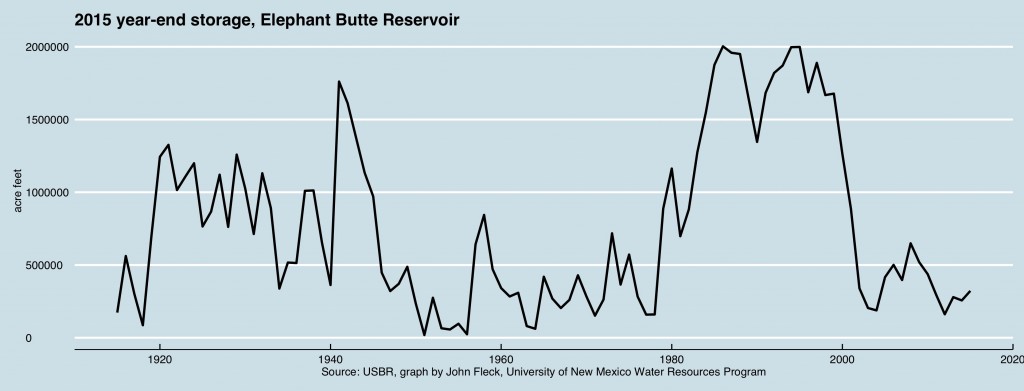
Year-end Elephant Butte storage
Elephant Butte provides water, primarily for irrigation, for southern New Mexico, Texas, and northern Mexico. When Elephant Butte is short, as it has been most recent years, farmers shift to groundwater for their permanent crops (especially pecans) and fallow some of their field crops.
This graph shows the depth and duration of what we call “the drought of the 1950s”. You can see that it really began in the 1940s and we didn’t really pull out of it until the late 1970s. It was a badass.
A reader recently asked the potential impact of a good snowpack this year on the Butte. This graph shows how it took a series of almost entirely good years from 1974 to 1982, with only one bad year mixed in, to refill the reservoir. It’s really big.
Data courtesy USBR water ops.
update: this post was updated to correct a typo on the amount of water in Elephant Butte. 322kaf, not 232kaf
This is fascinating:
A survey finds correlations between utilizing an individual water source (e.g. well or spring) and attitudes toward water management and conservation. Compared to respondents with a shared water source, those with an individual source believe they are segregated from regional water concerns. They are less willing to pay for water management or conservation measures and less supportive of any government intervention in water management. These results suggest that planners and water managers may face resistance to conservation policies or any policy based on the idea of water as a common pool resource. (emphasis added)
That’s from “Individualized water source as an indicator of attitudes about water management and conservation in humid regions” by Kristan Cockerill, Peter A. Groothuis, Tanga McDaniel Mohr, and Courtney Cooper in the Journal of Environmental Planning and Management. (I’ve only read the abstract, my university library doesn’t have a subscription.)
Water is just water, right? What happened when Sierra Madre, a suburb northeast of Los Angeles, switched from local groundwater to imported Colorado River water is a reminder that, well, no:
In 2013, Sierra Madre was forced to begin importing water from the Metropolitan Water District. That led to a new problem. The water source has a different chemistry, temperature and disinfecting agent than the groundwater supply. That started taking a toll on the city’s aging infrastructure.
Residents began to see yellow, foul-smelling water coming from their taps ? the result of iron oxide being released from the inside of old pipes.
When water pipes acclimated to water of a certain pH suddenly get water of a different pH, the chemistry of degunking the inside of the pipes can be a bit of a mess. This is what happened in in the early 1990s when Tucson made a similar switch, as Mitch Basefsky wrote some years ago in Southwest Hydrology (pdf):
Almost immediately following the initial delivery of Colorado River water, the utility began receiving complaints about water that was discolored, smelly, foultasting, or contained rust. Analyses showed that the water contained high levels of iron and other corrosion byproducts from metallic water mains and private plumbing. In essence, the aggressive water was releasing existing corrosion and scale from the pipe walls.

Blue Curve III, 1972, Ellsworth Kelly, courtesy Los Angeles County Museum of Art
Surely some art historian has puzzled through the impact of the GI Bill on the history of American art.
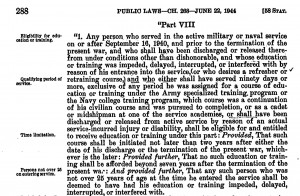
Servicemen’s Readjustment Act of 1944
I noted in the PBS Newshour’s obituary this evening that the late Ellsworth Kelly, after serving in the U.S. Army during World War II, went to art school on the GI Bill. My Dad was part of that generation – a young guy who wanted to make art and got a crack at the education he needed thanks to the “Servicemen’s Readjustment Act of 1944”. The statute’s presumption was that guys like Kelly and Dad “whose education or training was impeded, delayed, interrupted, or interfered with by reason of his entrance into the service” deserved a chance to resume said education.
I have only anecdotes, but know of a wave of artists who got the chance at the years of study and “Masters of Fine Art” degree. My Dad never rose to the level of Kelly, whose abstractions wowed me when I first saw them as a teenager at the Los Angeles County Museum of Art. But Dad had a crack at making a living at art that he never would have had absent the GI Bill. Surely that wave of talent, which otherwise would have gone untapped, had some influence on the trajectory of 20th century art.
One must not forget that the GI Bill was not, in the words of scholar Hilary Herbold, a “level playing field“. Black servicemen may have enjoyed the same benefits on paper as Kelly and my Dad, but in practice the U.S. system of higher education remained a system of unequal access. But for those who benefitted, it was a remarkable opportunity.
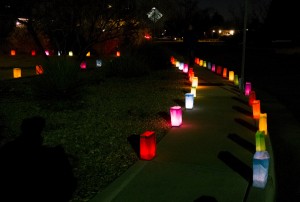
luminarias, Christmas 2015 – “hold others in the light”
Walking after Christmas eve dinner, we came upon a rainbow of luminarias around the corner from our house. The luminaria is a tradition in the southwestern United States, a little paper sandwich bag with a bit of sand in the bottom to weigh it down and a candle to light the way for Christ’s spirit.
The rainbow bags are a recent innovation, of which I approve.
Daughter Nora came over before dinner and helped set out the candles while sister, Lisa, and wife, Lissa, finished making the gyoza. We think of gyoza as Japanese, but they made their way to Japan from China (jiaozi) and to our house by way of a Japanese restaurant in L.A.’s Little Tokyo whose name is long forgotten. The luminarias, so quintessentially Southwestern Spanish-Catholic, are said to have come too by way of China, via Spanish merchants who loved Chinese paper lanterns. It’s all a mashup.
The headline for the post comes from a holiday letter that arrived today. I am not religious, but I was touched by a bit of wisdom my friend Elizabeth Sanford shared in her annual family greeting. “We go forward,” wrote Elizabeth, who is deeply religious, “with a pledge to ‘hold others in the light,’ a Quaker term that we were introduced to this year and have become fond of.”
Elizabeth’s husband, Jim Timmermann, died this year. Jim and I were young together many years ago, with all that entails. I was then, as I am now, crisp and certain in my atheism. Jim was deeply Catholic. We worked together each day to make a newspaper, and we’d wander many days with our lunches to the leafy campus of Fuller Theological Seminary in Pasadena, a couple of blocks from the office.
Our religious differences were far from an impediment to our friendship. Quite the opposite. We were each fascinated with the others’ views. I could never quite understand his faith, and Jim could never quite understand my lack of it. So we talked.
I cannot begin to do justice to Quaker theology, but “holding others in the light” seems to carry its own weight on this quiet holiday evening.
Merry Christmas.
When I was in newspaper journalism, I always viewed the holiday season as a target of opportunity. Papers were relatively fat, propped up by holiday ad content, and news was thin, so editors were desperate for copy. As the end of the year approached, I’d queue up story ideas, knowing that it was a chance to get stuff in the paper that would be a harder sell at any other time of year.
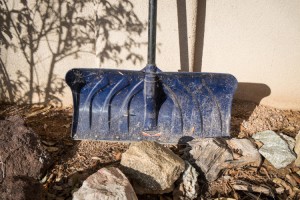
My “arctic blast”
Some of it was substantive, but this also as the birth of my “White Christmas” tradition, an increasingly elaborate annual ritual built around Bing Crosby and the modern pop culture self-creation of American myths. The final edition, published a few days before Christmas last year, was a bittersweet joy – written a few weeks after I had decided to leave three decades of newspaper journalism, but before anyone but family and a handful of close friends knew.
I have a snow shovel.
It’s not just any snow shovel, either. It’s an “Arctic Blast” brand shovel, with an oversized grip for my big puffy red winter mittens. It is covered with cobwebs.
It is my fantasy to get up early on Christmas morning, the last of the luminarias in my Albuquerque neighborhood long burned out, and shovel the walk before visitors arrive.
The joke was always on the romantic notion of snow here in the high desert valley of Albuquerque, matched against climatological reality:
As they do most years, my friends at the National Weather Service crushed my spirit Monday, saying that this wish will likely again go unfulfilled. “If you’re looking for snow to fall on Christmas, it’s probably not your year,” meteorologist Jennifer Palucki said.
Over the years, I’ve riffed several times off of Jody Rosen’s lovely little book White Christmas: The Story of an American Song
Our fondness for a “white Christmas” seems to be one of those curious yet richly rewarding examples of American self-invention, for which we apparently have songwriter Irving Berlin to thank.
“The longing for Christmas snowfall, now keenly felt everywhere from New Hampshire to New Guinea,” music critic Jody Rosen wrote, “seems to have originated with Berlin’s song.”
Rosen, author of the delightful book “White Christmas: The Story of An American Song,” might have added New Mexico to the list.
Written by a Russian Jewish immigrant in celebration of that most secularized of Christian holidays, “White Christmas” became a hit during World War II as a nation craved normalcy. Then it improbably endured, shaping our nostalgia for the Christmas we “used to know” by inventing it.
This morning, I went out in the backyard to strategically pre-position the snow shovel. The GFS forecast model suggests that, by the weekend, I might have a chance to use it:
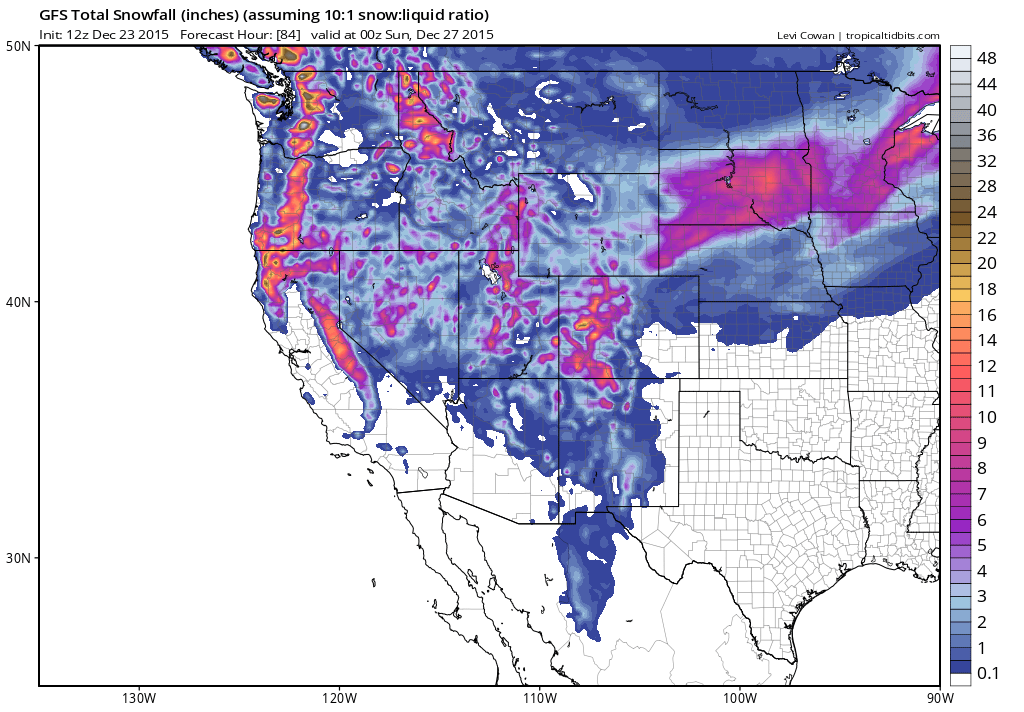
Courtesy Tropical Tidbits
The Rio Grande Water Fund was started in July 2014. In conjunction with its 45 investor partners, the water fund thinned 10,130 acres of forest during its first year.
That’s up from an average of 3,000 acres per year thinned in recent years.
Students in our UNM Water Resources Program have spent time looking at this because a) watersheds are so important to water supply, and b) overcoming the institutional difficulties of dealing with forest health are a great case study in the difficult governance and management problems the students will confront when they go out into the water management world to try to fix things.
This is, as much as anything else, an institutional issue. Forest lands are fragmented across many different ownerships – some private, some federal, some state, some local government. Laura McCarthy at The Nature Conservancy has been been building a new overarching public-private framework, the Rio Grande Water Fund, to try to cross those difficult boundaries.
Water fund partners are a diverse group. They range from Bernalillo County to Kellys Brew Pub, the U.S. Forest Service to the New Mexico Department of Game and Fish, the LOR Foundation to the Taos Ski Valley Foundation, the last of which announced earlier this month that it was donating $125,000 to the water fund.
During the fund’s first year, this coalition put $1 million into actual on-the-ground restoration work in places such as the northern Manzano Mountains, south of Albuquerque, and the Tusas Mountains in Rio Arriba County.
“Every investor and agency has the opportunity to double or triple the impact of their money by coordinating their effort,” McCarthy said. “They see their money go farther because they see it being pooled with other people’s money.”
Will we empty Lake Mead?
Which uses more water, lettuce or bacon?
That and news from the Colorado River Water Users Association’s annual meeting in John Fleck’s water news.
And you can subscribe here.