Grand Junction: A view from higher up in the watershed

The question of what is included in the “Colorado River Basin” is in part a legal one. The seven-state Colorado River Compact of 1922 defined a weird legal geography:

[T]he term “Colorado River Basin” means all of the drainage area of the Colorado River System and all other territory within the United States of America to which the waters of the Colorado River System shall be beneficially applied.

The creates the weird reality that for my entire life outside of five-plus years away at college, I have lived in the legal Colorado River Basin without ever living in the actual watershed of the great river – in suburban Southern California (where we got Colorado River water via the Metropolitan Water District’s Colorado River Aqueduct) and Albuquerque (where we get water via the Bureau of Reclamation’s San Juan-Chama Project).

I spent a really productive day today in Grand Junction, in western Colorado, at the Colorado River District’s annual Water Seminar. This is a working landscape, and there was much useful talk about how to help keep it so in a time of decreasing river flows and pressure from water users elsewhere. (Huge thanks to Eric Kuhn and Jim Pokrandt and the other folks at the River District for inviting me.)

Folks here are looking downstream nervously at the perilous state of Lake Mead. The title of the day’s meeting was “Will What’s Happening in California Stay in California?” Pat Mulroy, late of Brookings Institution, reiterated an argument that she’s been making for some time (an argument with which I agree) that we’ve created one giant interconnected artificial watershed that links the Sacramento Delta in California, via California’s vast plumbing, with the Colorado River system. When Southern California gets less water from the Sacramento System, it has to turn to the Colorado to try to pick up the slack. The resulting water management pressures link that, then, with pressures on water use here in places like Grand Junction.

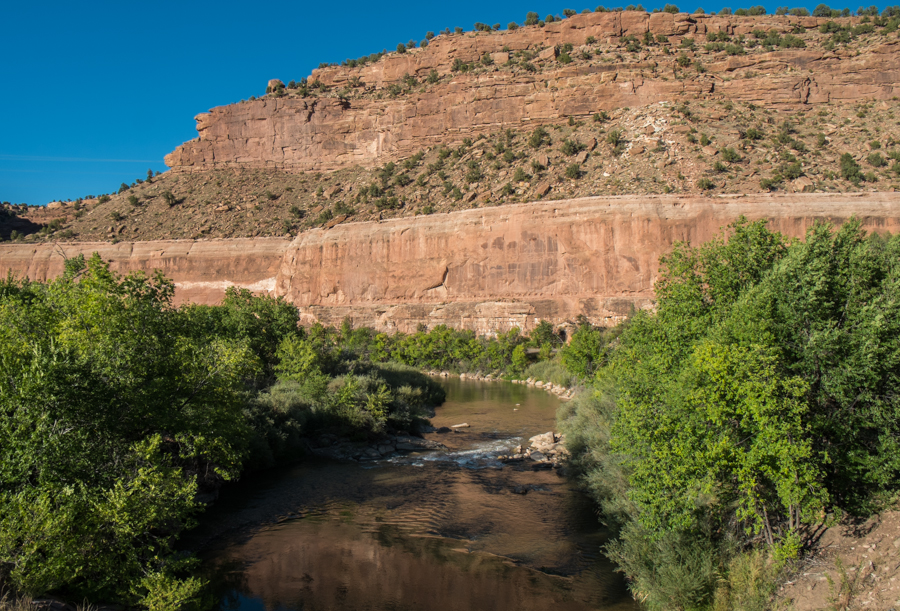
But here, where the Colorado River skirts the southern edge of town, there’s no question that you’re really in the Colorado River Basin. No need for a legal arm-waving to make that clear:
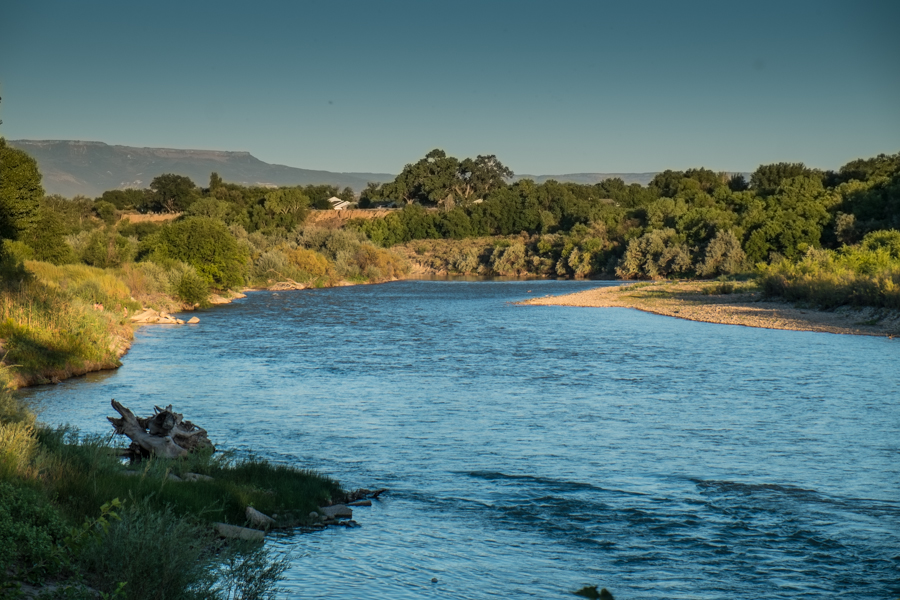
Colorado River at Grand Junction
Colorado River at Grand Junction
Cohen sees signs for Salton Sea optimism

Mike Cohen, writing for National Geographic’s “Water Currents”, explains what’s at stake in the current discussions over what to do to mitigate reduced flows to the Salton Sea as ag water conservation efforts in Imperial Valley grow:

The shrinking Salton Sea will expose tens of thousands of acres of lakebed. The dry lakebed could emit as much as a hundred of tons of dust each day, posing a severe threat to public health. It would also remove one of the last remaining havens for birds and wildlife along this Sonoran Desert stretch of the Pacific Flyway. Some 90 percent of the original wetlands of the Colorado River Delta and central California have dried up or been converted into farm fields, making the Salton Sea a critical link on the Pacific Flyway.

But he’s optimistic:

Fortunately, even allowing for the IID-San Diego County water transfer, a huge volume of water – more than 700,000 acre-feet per year – will continue to flow into the lake. Properly managed, this water could create and sustain tens of thousands of acres of productive habitat, minimize dust, and create recreational and economic opportunities….

Now, after more than 50 years of studies and meetings, the future of the Salton Sea may offer some glimmers of hope.

Worth a click for the full explanation of recent promising developments.


Couldn’t’ve had boat docks here before they built Hoover Dam

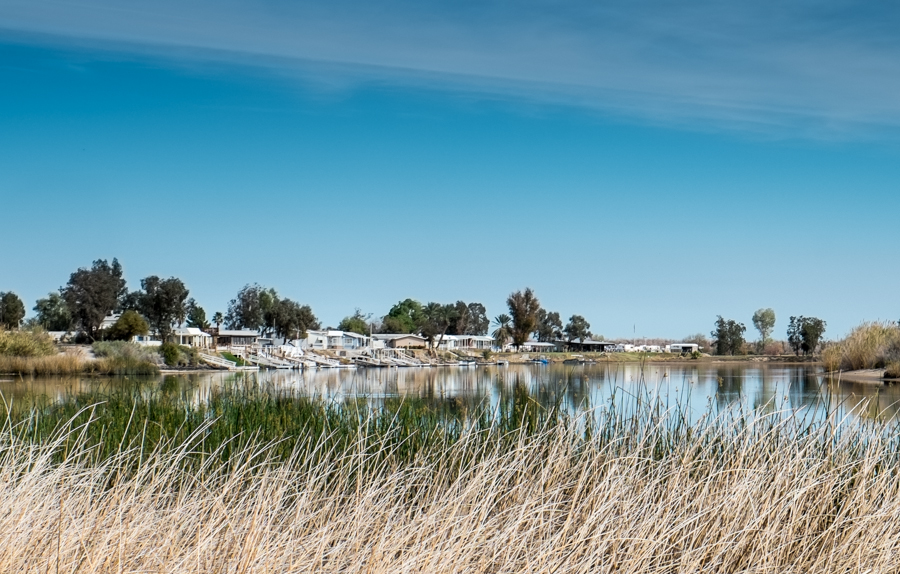
Boat dock neighborhood on the Colorado River, California side, upstream from Palo Verde

Boat dock neighborhood on the Colorado River, California side, upstream from Palo Verde

I don’t remember exactly where this is. It was a short walk down an arroyo from US95, the two-lane that runs north from Blythe along the Colorado River to Parker. The farming here is all on the Arizona side of the river. This was all underwater during the river’s pre-dam spring high flows, big desert valley at low flows. Couldn’t have had boat docks, or alfalfa.

Water markets: “a servant of sound governance, not the master”

Some useful insights from Dustin Garrick on water management lessons the western United States can learn from Australia:

Australia’s experience shows that water markets have an important role to play. But they are a servant of sound governance, not the master. Above all, markets are certainly not free, nor are they self-sustaining. Like a marriage, they take steady work to adjust as values change.

The full piece is worth a read.

California names someone to solve the Salton Sea mess

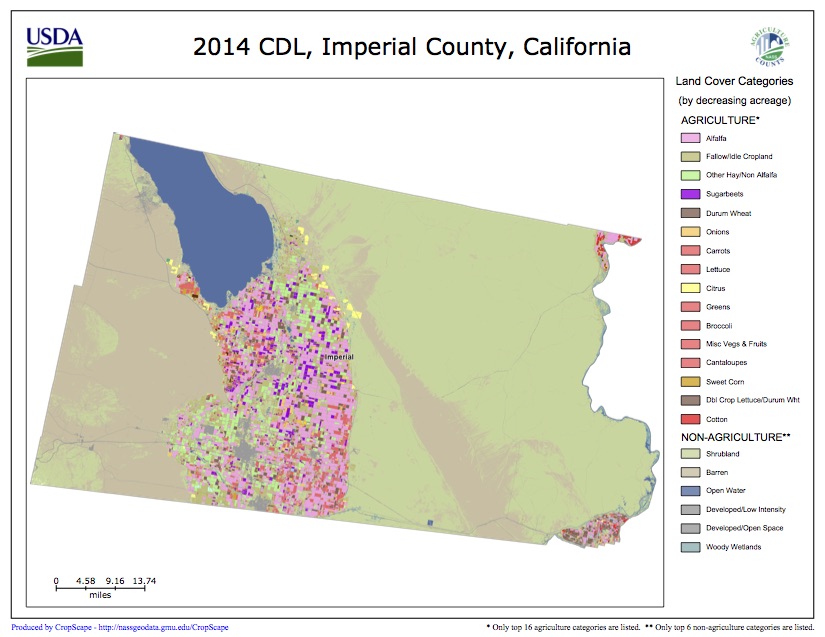
Imperial County 2014 land cover, via Cropscape

Imperial County 2014 land cover, via Cropscape

Just when I think I’ve got the Colorado River Basin’s problems all sorted out, I keep bumping up against this crazy Salton Sea thing.

This USDA Cropscape landcover map really nicely illustrates the geography of the thing. The brightly colored bits are the irrigated agriculture of the Imperial Irrigation District. Agricultural runoff flows to the northwest, into the Salton Sea, which occupies a sink, below sea level.

When inflow equals evaporation, the level of the sea is stable. If we succeed at conserving water, as we all agree needs to happen, the sea shrinks, exposing a dry lakebed and leading to all manner of bad things (air pollution, asthma) that disproportionately impact the relatively low income people who live around the sea, and also the affluent folks out in the palmy golf coursey hip music festivally communities of Coachella and Palm Springs to the west.

So, to sum up, solving the region’s water problems could wreak environmental havoc.

In 2003, the state of California as part of the tangle known as the Quantification Settlement Agreement promised cross my heart and hope to die to deal with the environmental piece if only the farm water managers would go ahead and do the water conservation. The state has thus far done pretty much doodley squat, which understandably makes the folks in Imperial, who have been keeping up their end of the conservation deal, unhappy.

This is a too-long introduction to today’s news, from Sammy Roth at the Desert Sun, that the state has appointed a Salton Sea czar with some Imperial roots and Salton Sea qualifications to try to right the governance ship:

Gov. Jerry Brown said Wednesday he has named Bruce Wilcox assistant secretary for Salton Sea policy, a newly created position within California’s Natural Resources Agency. Wilcox currently oversees Salton Sea-related projects as the Imperial Irrigation District’s environmental manager.

Wilcox will coordinate the many local, state and federal agencies working to limit the public health and ecological disasters brewing in California’s largest lake. Similar appointments have helped the state address other complex, stubborn problems, said Keali’i Bright, deputy secretary for legislation at the Natural Resources Agency.


@thinkpiecebot

There is some irony in my daughter’s latest digital art project being written up in Slate. I know that. But proud dad’s gotta blog, right?

Hilarity generally ensues when Lissa and I try to explain Nora Reed’s digital art to members of our own generation:


Now Jacob Brogan at Slate has taken up the challenge on our behalf:

Something meta about a Slate piece on this

Something meta about a Slate piece on this

Brogan further explains:

Enter @thinkpiecebot, an automated Twitter account that embraces this paradox with a wink and a smile. Created by digital artist Nora Reed, @thinkpiecebot draws on a repertoire of typical provocative subjects—chemtrails, sexting, and pumpkin spice, for example. Reed told me that she has the bot randomly insert items from these lists into constructions such as “Is [SINGULAR THING] Why [GROUP] Can’t [VERB THING]?” The results—pitches for essays that never were but sometimes feel that they could be—are at once familiar and alienating, perfectly capturing the formulaic vacuity of so many Internet-age articles.

More here.

One in five chance of Colorado River shortage in 2017, 50-50 by 2018

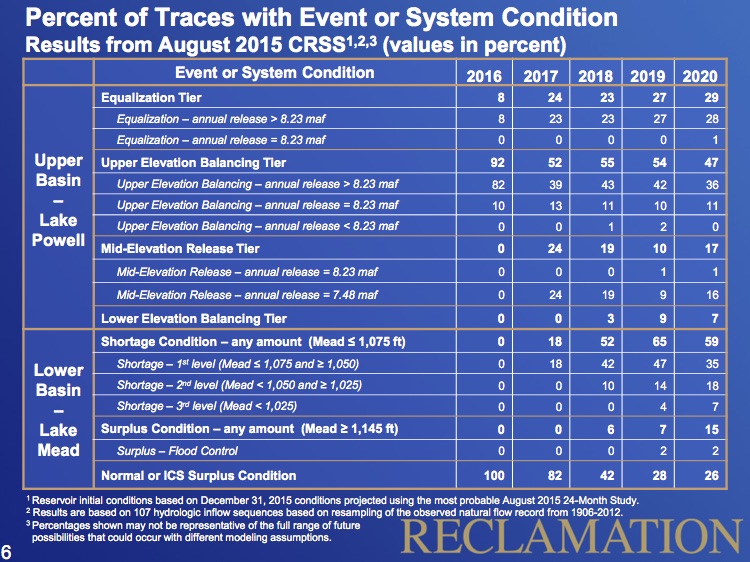
That long, painful drip-drip-drip of “when will we have Lower Colorado River shortage?” has been pushed out again, with a new set of modeling runs from the U.S. Bureau of Reclamation putting the odds at one in five in 2017 and 50-50 by 2018.

Hidden in that “one in five” next year is some good news. Things would be substantially worse (maybe a one in three chance of 2017 shortage) but for some conservation actions by the Central Arizona Water Conservation District (the agency that runs the Central Arizona Project) and the Southern Nevada Water Authority (Las Vegas) that have the effect of leaving significant water in Lake Mead over the next year. Without those steps, the chances of shortage in 2017 would be substantially higher, according to the Bureau’s modeling team. This is good news, showing that the various system conservation efforts are beginning to have measurable impact. Here’s the full table of modeling results:

Chances of shortage, surplus, in the Colorado River as of August 2015, courtesy USBR

Chances of shortage, surplus, in the Colorado River as of August 2015, courtesy USBR

There’s another important caveat. The water conservation efforts modeled here only include those Arizona and Nevada water managers were sure enough about to include in their preliminary 2016 water use planning orders. There are more conservation efforts afoot that could further prop up Lake Mead, reducing the chance of shortfall. The scenarios here are conservative. But you also can see that under the current scenarios, the underlying risk remains – water use downstream of the big Colorado River reservoir remains higher than inflows. The system remains out of balance.

What does “Colorado River shortage” mean?

For details on what happens in “shortage”, see here. Basically, Arizona absorbs the major hit which will for some time bite primarily at the Central Arizona ag sector.

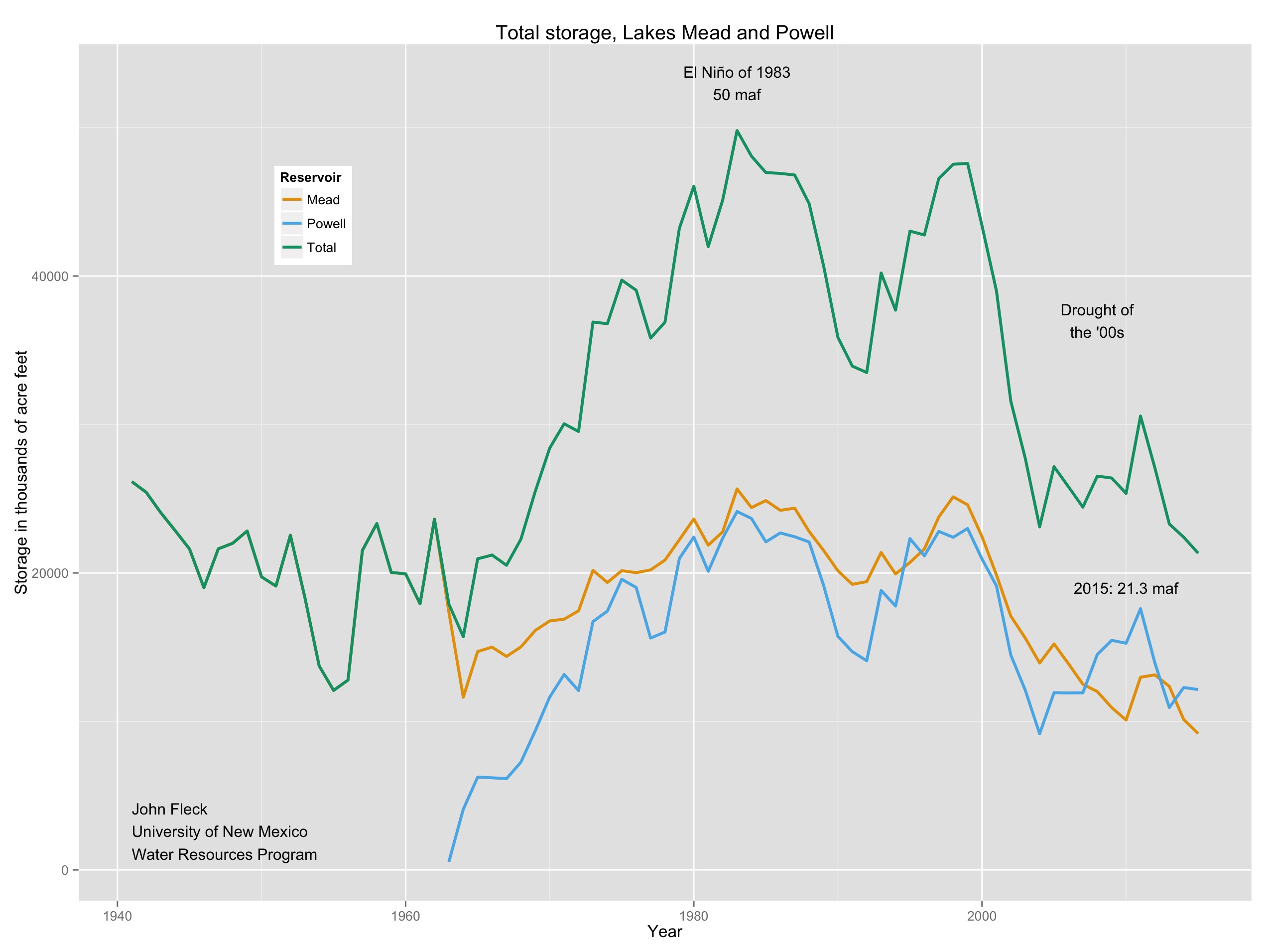
For some historical context, I’ve cleaned up my regular Mead-Powell historical storage graphic. Total storage in the two big Colorado River reservoirs will end the 2015 “water year” (the end September) at a historic low, lower than at any time since they began filling Powell in the 1960s:

Total storage in Lakes Mead and Powell

Total storage in Lakes Mead and Powell

But what are the chances of flooding?

If you really want to feel optimistic, look at the second to the last row. It shows a one in 50 chance that by 2019 we’ll have the reservoirs full enough for “Surplus – Flood Control”. That would be really bad for sales of my upcoming book, but maybe a second volume focused on flood control ops?

Water conservation = less water to move our poo

This is something we’ve seen in Albuquerque over the last two decades of remarkable municipal water conservation success: revenue shortfalls with the old business model of selling water and, ickier, a change in what my UNM colleague Bruce Thomson calls “turd mechanics”. Matt Stevens in the LA Times:

Shorter showers, more efficient toilets and other reductions in indoor water usage have meant less wastewater flowing through sewer pipes, sanitation officials say. With less flow to flush the solids down the system, those solids are collecting and can eventually damage pipes.