Cliff Dahm returns to Sacramento to help sort out the delta mess

I’ve begun putting scare quotes around “retirement” for some of my University of New Mexico water mentors. To that list, add Cliff Dahm, the ecologist and Inkstain brain trust member whose “retirement” party in May paved the way for this:

SACRAMENTO – Dr. Clifford Dahm, an internationally recognized expert in aquatic ecology, climatology, restoration biology, and a professor emeritus of biology at the University of New Mexico, was unanimously appointed by the Council on Thursday (Aug. 27) as Lead Scientist. In making the appointment, Council Chair Randy Fiorini said, “With his broad understanding of water-related science and his background as the former Lead Scientist for the CALFED BayDelta Science Program, Cliff will provide crucial knowledge and scientific leadership as we implement both the Delta Plan and the Delta Science Plan.”

The “Council” is the Delta Stewardship Council. This is familiar terrain for Cliff, who served as chief scientist from 2008 – 2012. Excellent choice, y’all.

Another Southern California ag to municipal water sharing deal takes shape

The Imperial Irrigation District’s board tomorrow will consider an expanded agreement with the Metropolitan Water District of Southern California that would provide additional flexibility for water conservation in the big desert agricultural district and move water to meet near term drought response needs in the region’s coastal cities.

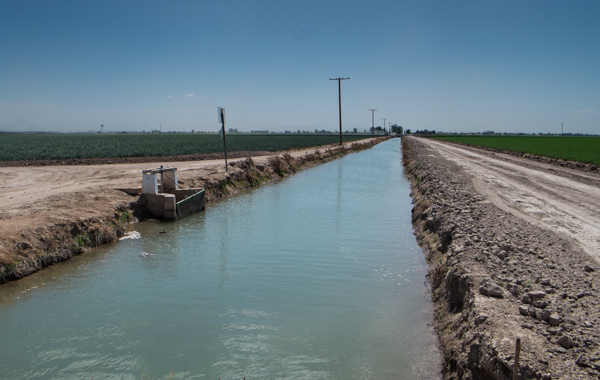
Imperial Valley farming, March 2014, by John Fleck

Imperial Valley farming, March 2014, by John Fleck

The deal uses the “Intentionally Created Surplus” framework established in the 2007 Colorado River operating rules. ICS was a major policy innovation designed to overcome the “use it or lose it” principles baked into the old “Law of the River” operating rules. It allows water users to conserve and bank water without losing it. But the rules as written in 2007 have the feel of an experimental program, with a lot of constraints. Imperial, the largest Colorado River water user with farms spread across more than 400,000 acres of desert adjoining the Salton Sea, has long wanted the ability to expand its ability to use the mechanism beyond the small amount of ICS they were permitted under the 2007 rules.

The new IID-MWD agreement would allow Imperial to do just that, expanding the amount of ICS it is permitted to do in part by “storing” conserved water in MWD’s system. This would have the practical effect of moving water over to Met this year, to help meet the current year’s extreme shortfalls, with the promise of water payback at a future date.

From IID Colorado River Resources Manager Tina Shields’ memo to the board, here are the basic terms of the deal (click on the embedded bit to see Shields’ full report and the agreement itself):


This might sound clumsy, but it’s a great example of how mutually beneficial agreements can be crafted to conserve and share water across institutional boundaries in this polycentric “no one’s in charge” Colorado River governance structure, and how it’s not as simple as just conserving water. You’ve got to get the institutional plumbing built, which is every bit as important as the physical plumbing.

It’s also an example of the iterative learning involved in these arrangements. Following the 2007 agreement that created ICS, people and institutions learned how to use it, and are now expanding its scope incrementally.

“How’s the book going?”

The book’s going well, thanks for asking. See below.

What motivates me

In my new gig as a university lecturer, my colleague and co-teacher Bob Berrens has the gray old faculty members (there are three of us) talk to the students on the opening day of class about what motivates us. It is the first in a series of courses in the University of New Mexico’s Water Resources Program that, when combined with more technical work scattered across campus (hydrology, engineering, earth science, computer modeling and simulation, public policy, and the like) we hope will provide a foundation for these young people to go forth in the world and fix the messes our generation and those who came before us have created.

Here is the story I tell.
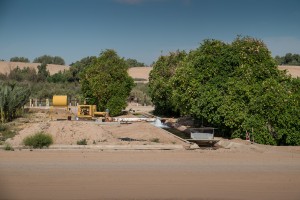
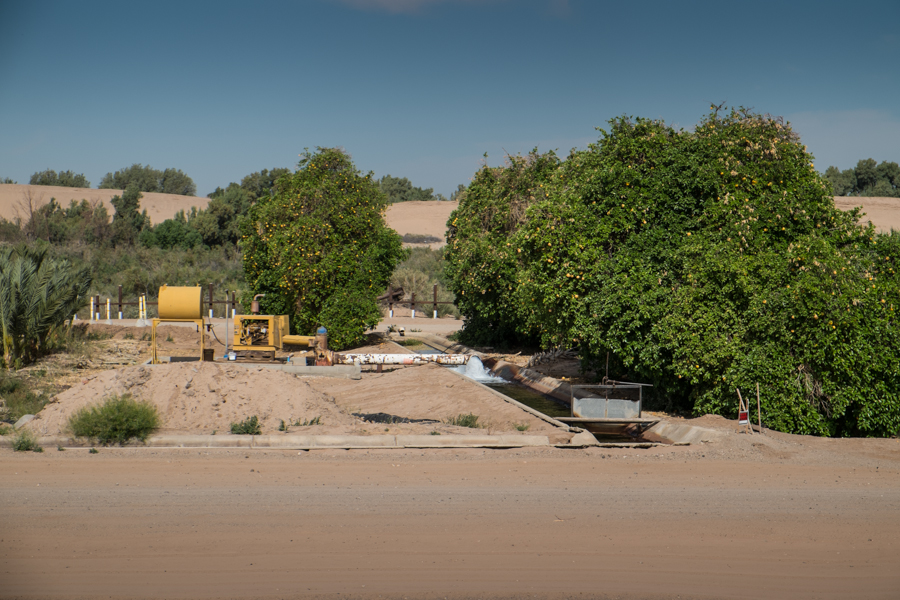
Pumping groundwater on the limotrophe: citrus farming on the U.S.-Mexico border, March 2014, by John Fleck

Pumping groundwater on the limotrophe: citrus farming on the U.S.-Mexico border between Yuma and San Luis, March 2014, by John Fleck

Whenever I go to a place, I invariably end up going down to the water. As humans, we drape our communities around the water, building cities at the point where the river can be crossed, or where we can draw water to drink and irrigate our crops, or flush our waste water back into the river to be carried away. For much of humanity’s history, boats were the most important means of transportation, so we clustered around the ocean, ports, and navigable rivers. And then, as we do, we outgrew those early decisions, with sometimes indelicate results. London’s “great stink” of the summer of 1858 showed the limitations of the Thames as a place to dump the growing city’s shit. San Luis Río Colorado, on the Arizona-Sonora border, shows what happens when we run a river dry. Outside Kettleman City in California, almond farmers are pumping so much water that the ground is sinking.

If you look at the water long enough, you can start to see, in the things that have grown up around it, a marvelously intricate set of feedback loops between the water and the people. In his book City Water, City Life, Carl Smith shows how our very notions of modern municipal governance and community in some sense grew out of the need to get clean water to city people, and safely carry away their shit.

And so I go down to the water, because of my belief that we can always begin to understand the human geography and history of a place by starting with the water.

Getting down to the water

Seven months ago I left a thirty year career as a newspaper journalist to write this book thing y’all keep hearing me yammer about. I’ve been working on it off and on for years, but I realized last December that the only way I could do it right was to remodel my life in such a way that Writing a Book was my only job.
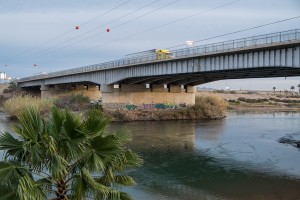
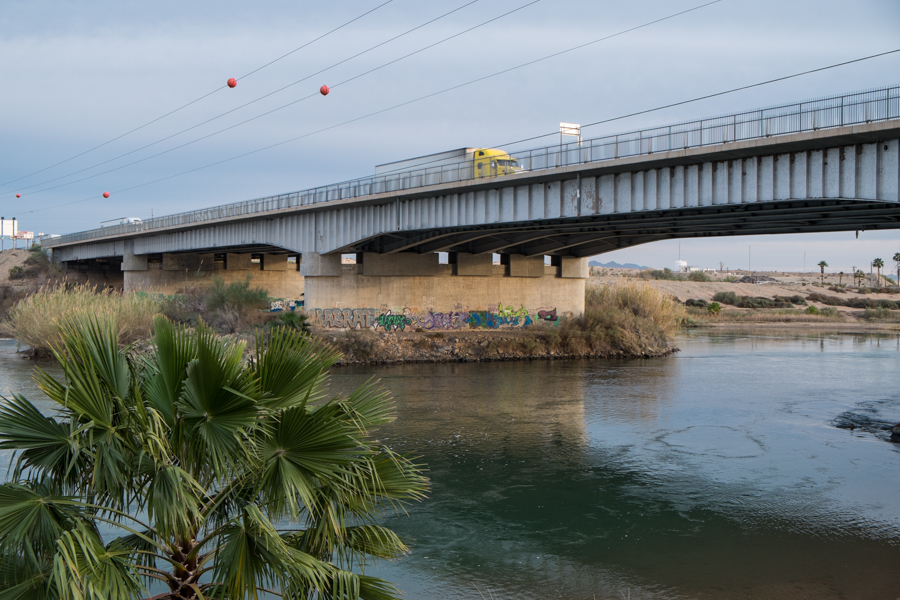
Colorado River flowing beneath the I-10 bridge at Blythe, February 2015

Colorado River flowing beneath the I-10 bridge at Blythe, February 2015

And thus I found myself in the fading light of a February afternoon, after devouring a fast food burger and checking into a cheap motel in Blythe, California, driving east out of town to find my way down to the Colorado River.
This is metaphor, and a clumsy one. I literally have spent many years trying to get down to the water of the Colorado River – beneath the old railroad bridge in Yuma, on the rapids of the Grand Canyon, along the waterskiing mecca of Parker, beside the canals of Phoenix, in the farm fields of Wellton Mohawk, at the intakes of the San Juan-Chama Drinking Water Project here in my home town of Albuquerque. You see in my list the fundamental conceit of my notion of “the water” – the Colorado River as human construct. Fradkin was right when he called it a “a river no more”, if you grant his meaning of “river”. Fradkin, like me, put into the Colorado River at Blythe in a canoe. I called it “little more than a slow-moving lake”. Fradkin had harsher words. But viewed expansively, the Colorado River is a vast human construct today, as much about taking water out of the old river channel and doing new things with it, and for me “getting down to the water” requires embracing and trying to understand it in that way.

The last seven months have been a glorious opportunity to “get down to the water”, both literally in the chance to visit my beloved Colorado River in all its messy glory, and also metaphorically in the chance to talk to smart people and read more deeply than I ever had the chance to as I tried to digest and then share knowledge one newspaper story at a time. I’ve never had so much fun in my life, which is a high bar. I pride myself on being very good at having fun.

Blah, blah, blah, but how’s the book going?
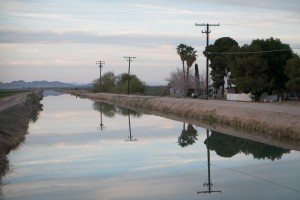
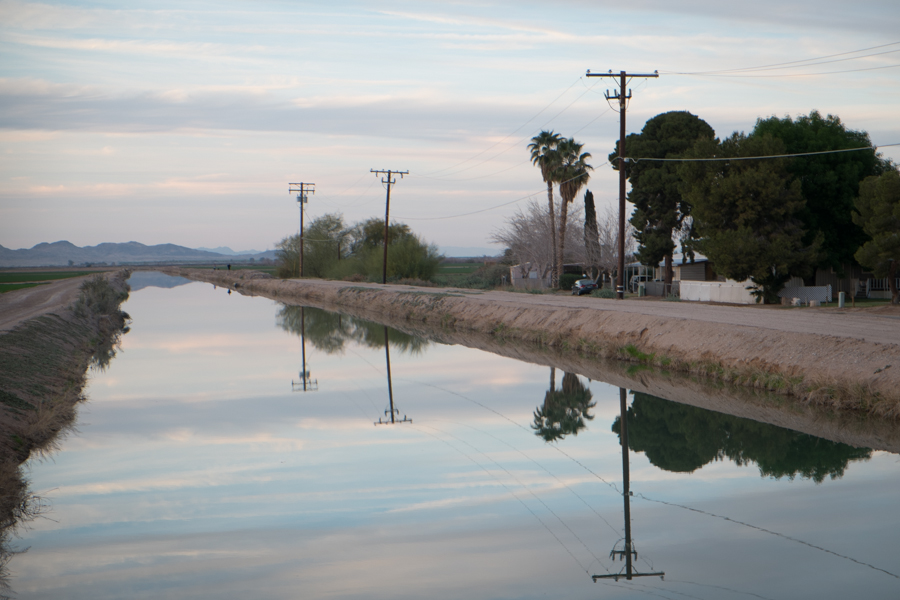
Palo Verde Irrigation District canal, east end of Blythe

Palo Verde Irrigation District canal, of Blythe, by John Fleck

The occasion for all this self-indulgent thumb sucking is a milestone today, completion of the first draft of my book, Beyond the Water Wars. I’m a day early in hitting a self-imposed deadline. The manuscript’s not due until the end of the year, but I set myself this deadline – draft by the end of August – to give myself lots of time to clean things up. I met the milestone in part by cutting myself some serious slack – my definition of “completion” and “first draft” are loose. There are holes left that require more reporting, research, and thought, but they’re now clearly constrained. There’s a lot of muddy thinking yet to be clarified. And a lot of what I’m written bears some resemblance to the Thames of 1858, if you know what I mean.

But I can finally see the whole thing.

Writing a book turns out to be harder than I thought, because of the way my understanding has deepened and shifted as I worked. It is especially hard because one of my central premises, what I’ve called the “no one’s in charge-ness” of the Colorado River and the West’s water management, does not lend itself to narrative. The properties of emergence in complex adaptive systems, of which this is one, lack storylines in the same way that hierarchies and linear dynamics do. William Blomquist, in his superb (and frustratingly hard-to-find – thank you UNM interlibrary loan!) work on Southern California water management Dividing the Waters, bids us look closely as we think about contemporary water management at the question of whether we are seeing “diverse order” or merely chaos.

My book’s central premise draws on the definition of “resilience” I learned from my UNM colleague Melinda Harm Benson: the ability of a system to absorb a shock while retaining its basic structure and function. Here, this means the communities that have draped themselves around the Colorado River, and it poses a central dilemma. If the risk is that we have built too much of everything – too much Phoenix, Las Vegas, and Albuquerque, too much Imperial, Maricopa County, and Yuma agriculture – for the water available, how might we retain those basic structures under the shock of drought and climate change and, therefore, less water?

As it slowly emerges from the muck, my book makes a narrative argument for “diverse order”, an adaptive capacity found in the messy, flexible governance that will allow us to get by on less water, and share. Wallace Stegner said it better:

One cannot be pessimistic about the West. This is the native home of hope. When it fully learns that cooperation, not rugged individualism, is the quality that most characterizes and preserves it, then it will have achieved itself and outlived its origins. Then it has a chance to create a society to match its scenery.

It’s also telling stories about the river in its many forms. As the sage of the Lower Colorado once said, “We all have our stories about the river.”
In pursuit of resilience, it helps to be rich

“Resilience”, as defined by these folks, is a useful framework for understanding drought and water management. The goal is a system that can withstand shock and retain its basic structure and function. For example by that metric, as Charles Fishman has pointed out, California during the current drought has demonstrated resilience.

New Orleans and Katrina is a counter example, a resilience failure.

Writing in this week’s Nature, Erwann Michel-Kerjan points to something that’s quite important:

A ‘five capital’ — 5 C — metric is essential. Physical capital includes the indirect products of economic activity, such as infrastructure; financial capital assesses financial protection and diversity of income sources; human capital pertains to the education, skills and health of people; social capital accounts for social relationships, leadership and governance structure; and natural capital includes land productivity, water and biological resources and actions to sustain them.

If you look at California’s resilience successes and failures in this regard, you can see a pattern. Places like Monson, which Brett Walton wrote about last week, are poor. They lack resilience. Places like Southern California’s Inland Empire, as Fishman pointed out, have built resilience into their water management, but it hasn’t come cheap.


The Las Vegas water conservation model

Sammy Roth, a reporter for the Desert Sun in Palm Springs, took a trip this month to Las Vegas to share with his California readers how they do the water conservation thing in urban Nevada:

When it comes to saving water, Sin City has the Coachella Valley beat.

Las Vegas can credit its water frugality to a combination of fines, rigorous enforcement, generous grass-removal incentives and aggressive education campaigns. Developers aren’t allowed to build homes with grass in the front yards, and golf courses pay huge penalties when they exceed their water budgets. Conservation ads have featured a man getting kicked in the groin for spraying too much water on his lawn.


The Las Vegas “decoupling”

I’ve shared this before, some of the data I’ve been accumulating during my book research, but it bears repeating – a really remarkable decoupling of water use from Las Vegas’s economic and population growth:


Las Vegas Colorado River water use

Roth makes a point that I’ve heard a lot in my conversations about the Las Vegas conservation success story – that the visceral experience of watching nearby Lake Mead drop has helped Las Vegas-area residents grasp their water risk:

For Las Vegas and its suburbs, drought is easy to visualize.

The city depends on nearby Lake Mead for the vast majority of its water supply, and over the last 15 years the reservoir’s water levels have been dropping. Images of the white “bathtub ring” around the lake’s edge, which shows how high the water used to be, have become synonymous with crippling drought in the Southwest.

El Niño and New Mexico’s Rio Grande

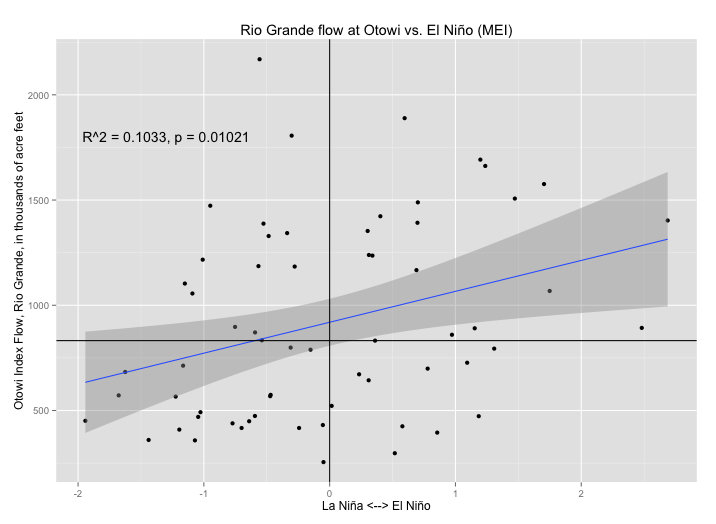
Does the looming El Niño mean we can expect a big year on the Rio Grande? Not necessarily. The scatter in the data is huge, but hidden in the data is a bit of a nudge in the direction of wet:

El Niño vs. Rio Grande flow in New Mexico

El Niño vs. Rio Grande flow in New Mexico, analysis by John Fleck, UNM Water Resources Program

That’s native flow at Otowi, the key Rio Grande measurement point north of Albuquerque. There’s a statistically significant relationship – El Niño years get more flow (p = 0.01). But the effect is small (R^2=0.1). So best to say that El Niño has a small positive effect overlaid on a huge amount of regular variability.

All five of the biggest El Niño years in my dataset were wet, but that’s such a small sample that you should wag your finger at me for even pointing it out.

The horizontal black line is the median of the dataset.

Data sources and notes:

  • Otowi Index Supply from New Mexico Interstate Stream Commission that I happened to have laying around (OIS is the actual gaged flow at Otowi minus the imported San Juan-Chama water)
  • El Niño historic data from Klaus Wolter’s Multivariate ENSO Index. I used mid-winter Dec-Jan MEI. Eyeballing the data, the choice of months doesn’t seem significant, but see “limitations” below.
  • Years plotted 1950-2012

Limitations:

  • I was a philosophy major in college.

In Monson, Calif., where the drought problem is really a poverty problem

Brett Walton returns to Monson, Calif., to visit a community losing its water, and finds some signs of hope, but serious problems yet:

An unincorporated rectangle of land in Tulare County, tiny Monson, home to no more than 200 people, became an international symbol of the rural heartache that is flowing from California’s drought wound. Surrounded by acres of Central Valley vineyards, pomegranate trees, and orchards of peaches and almonds, the community’s shallow domestic wells had no chance against the competition: some of the nation’s most lucrative farmland. Tulare County is the nation’s richest county measured by farm sales — $US 8 billion in 2014 — and irrigators pumped enormous volumes of groundwater, without restriction,from great depths to keep their fruit and nut assets alive and producing. Lower and lower the water table dropped as the electric pumps whirred. Soon, sand began spilling from faucets and toilets.

In California, clarifying what we mean by “drought”

Preparing for a lecture for next week for the University of New Mexico Water Resources Program class I’m co-teaching, I’m having the students read this piece by my drought guru Kelly Redmond:

Most concepts of drought involve a water balance. This implies that both supply and demand must be considered, as well as the question of whether there is “enough” (and, enough for what?). Thus, through time I have come to favor a simple definition; that is, insufficient water to meet needs. (emphasis added)

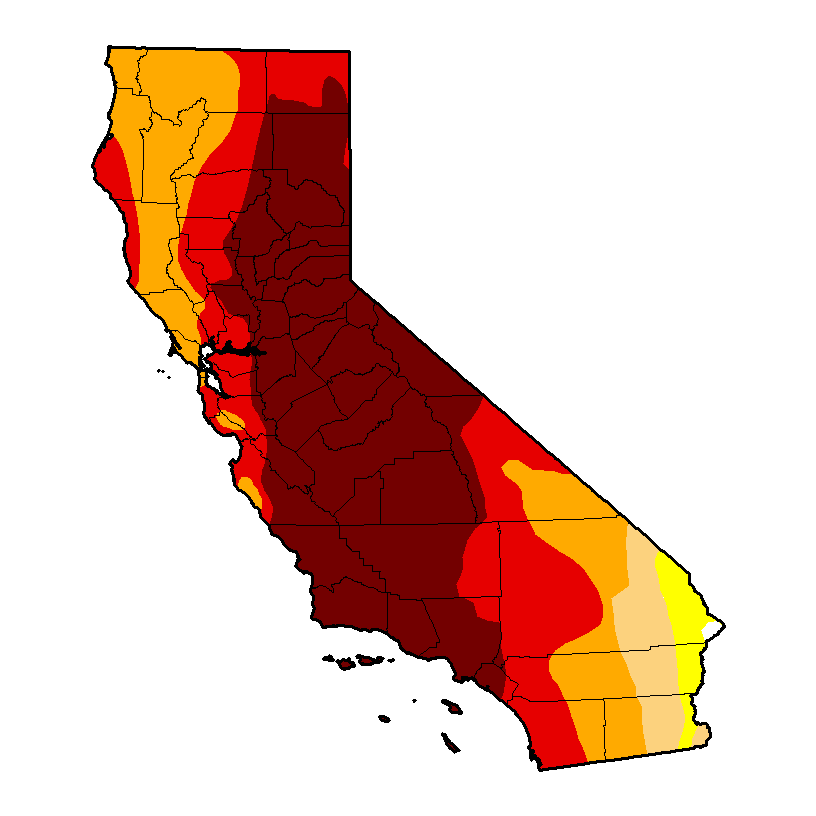
California drought monitor

California drought monitor

I’ll be talking some of the quantitative drought metrics, like the Palmer Drought Severity Index, or the Standardized Precipitation Index, or How Much Water Is In That Big Reservoir. But Kelly’s point is that the key is to understand how systems (people, ecosystems, etc.) are actually using the water. This helps clarify what we mean by “drought” beyond simply “OMG look at that big ugly red Drought Blob of Death that landed on California!”

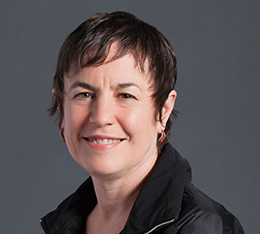
A second reading assignment is a new white paper by Ellen Hanak and colleagues at the Public Policy Institute of California that does the clarifying work by getting specific about the question of who’s really being forced to go without water, or facing reduced supplies of water, or creating future risks. Hanak and colleagues push this forward with a useful thought experiment: what if California’s drought continues?

Ellen Hanak, Public Policy Institute of California

Ellen Hanak, Public Policy Institute of California

Given the pervasive nature of the red blob in public discourse, one important starting point is the PPIC team’s observation that California’s major municipal areas are doing pretty well, and should continue to do so:

Urban areas are in the best shape, thanks to sustained investments in diversified water portfolios and conservation.

Farmers, they note, have done remarkably well in adapting, especially by crop shifting and fallowing, though excessive groundwater pumping, especially in the Central Valley, may be adaptive in the short run and maladaptive in the long run, what with the surface of the earth actually sinking because they’re pumping so much and so on.

The two greatest problem areas the PPIC team found are rural communities and natural systems. Rural communities lack the resources of L.A. or San Francisco to buy their way into deeper resilience:

Many rural households rely on shallow domestic wells or small, poorly funded community water supply systems.

Natural systems also are suffering:

The most acute and severe impacts of this drought so far are on California’s freshwater habitats and forested lands and on the biodiversity they support. These impacts stem, in part, from the severity of the drought and its combination of low flows and heat. More than a century of water and land practices have increased vulnerability by undermining the natural capacity of these ecosystems to handle occasional droughts.

The environment doesn’t have the same kinds of adaptation tools as other sectors—it generally can’t pump more groundwater in dry times, for example. But this troubling situation also reflects less investment in building drought resilience for the environment. California was unprepared for this environmental drought emergency and is now struggling to implement stopgap measures.

As a communicator, I’ve long struggled with the inadequacies of the word “drought” for two reasons. The first is its binary nature – we’re either in it or we’re not. “Is the drought over?” That’s wrong, but pervasive, because when it’s used out in the wild, in public discourse, I can’t control the meanings regular people take from the word. The second is its hidden imprecision. We use it in water policy and practice discussions without realizing that we may be using the same word but not meaning the same thing. Trying to unpack the word and explain its many shades of meaning for the WRP students is therefore a really fun exercise.

From Peter Gleick, an optimistic take on California drought response

Peter Gleick in the Sacramento Bee:

As California swelters and burns through the fourth year of the worst drought in 1,200 years, nonpartisan and bipartisan efforts have been increasingly effective. A multibillion-dollar bond measure passed by voters last year is providing funds for drought relief and new supply and conservation programs. Water utilities are expanding investments in water recycling and reuse. Farmers are growing more food with less water. In short, Californians are stepping up in a crisis to do things differently.