#CharlestonSyllabus

In one of those wonderful emergent social media moments yesterday, a suggested reading list emerged on Twitter, hashtagged #CharlestonSyllabus.

I have two personal contributions.

I’ve written previously in this space about Edward Baptist’s The Half Has Never Been Told: Slavery and the Making of American Capitalism. It’s a powerful economic history arguing that America’s great wealth was built on the backs slaves, and a moral history arguing that the great technological innovation at the heart of our nation’s wealth was, at its root, torture. It is painful and one of the finest books I have read.

I’m now in the midst of Adam Rothman’s Beyond Freedom’s Reach: A Kidnapping in the Twilight of Slavery. It tells the story of emancipation through the life of Rose Herera, a New Orleans slave whose children were taken from her as slavery’s decline was upon us. Was it kidnapping, or were they property? It is microhistory, shedding light on the great moral struggle through one richly told story.

Keisha Blain and colleagues at the African American Intellectual History Society have curated a large list here, and explain the backstory behind the hashtag’s emergence.

San Juan-Chama project shortfall (trust me, it’s good news!)

For the second year in a row, New Mexico’s San Juan-Chama Project contractors (the biggest of which are the Albuquerque and Santa Fe metro areas) won’t get their full allocation of Colorado River Basin transboundary deliveries this year. But with the amazingly wet May and June, it could have been a whole lot worse.

I’m going to be on the Children’s Hour on KUNM tomorrow (Albuquerque public radio), so I’ve popped for a couple of days into “journalist” mode and made a round of calls to my New Mexico water posse to see how things are going. People are near giddy over the wet weather, because things looked like they were going to be so awful this year. But I’m also getting repeated reminders that while, yes, things are good, we still have some deep problems.

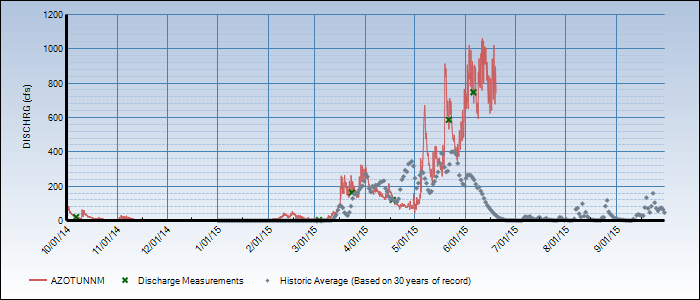
The Azotea Tunnel, which carries San Juan-Chama Project water, is running full right now, at a point in the year when it is usually dropping toward a trickle:

Azotea Tunnel, courtesy  CDWR

Azotea Tunnel, courtesy CDWR

The mid-June allocation for SJC contractors was 50 percent of normal, but that was based on the June 1 water supply. We’ve continued to get more since then, so it now looks like the final allocation could be more like 70 percent or more. That’s great news compared to where things were a couple of months ago (I lost a bet based on thinking the April allocations would merely be bad, when in fact they were awful). No longer awful, but worth remembering that at 70 percent, this is only the second year in history that San Juan-Chama contractors haven’t gotten a full allocation.

Last year was the first. Drought is deep, and a wet spring and early summer isn’t enough to fix it.

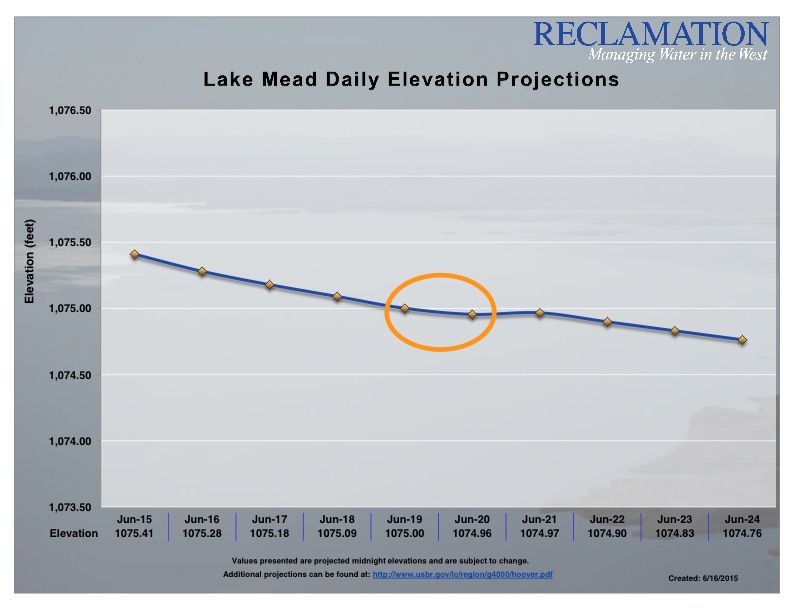
Friendly reminder: don’t freak out when Lake Mead drops below 1,075

Lake Mead at 1,075. Source: USBR

Lake Mead at 1,075. Source: USBR

Your friendly reminder: don’t freak out when Lake Mead drops below surface elevation 1,075 in the next few days. We don’t have a Lower Colorado River Basin “shortage”* yet, and likely won’t have for a couple more years.

What counts is the August forecast of the January 1 level. Mead is forecast to drop below 1,075 this summer, but is almost certain, absent some sort of “water knife” attack to release water from the dam, to be back above 1,075 by August. Here’s the pertinent language from the 2007 Interim Surplus Guidelines (pdf):

In the development of the AOP, the Secretary shall use the August 24-Month Study projections for the following January 1 system storage and reservoir water surface elevations to determine the Lake Mead operation for the following Calendar Year….

In years when Lake Mead content is projected to be at or below elevation 1,075 feet and at or above 1,050 feet on January 1, a quantity of 7.167 maf shall be apportioned for consumptive use in the Lower Division States of which 2.48 maf shall be apportioned for use in Arizona and 287,000 af shall be apportioned for use in Nevada in accordance with the Arizona-Nevada Shortage Sharing Agreement dated February 9, 2007, and 4.4 maf shall be apportioned for use in California.

The June forecast (pdf) projects 1,083 on Jan. 1. That’ll could go up again in the next few months’ forecast reports because June has continued to be wet in the Upper Colorado River Basin. We’ve gone from a year that was projected to be below 50 percent to a possible “normal” (median) flow this year into Lake Powell. That’s 1.4 million acre feet above the June 1 forecast.

Yay.

* I think I’m going to start putting scare quotes around the word “shortage” after a conversation with a smart friend who points out that the word implies some deviation from what ought to be. We need to get used to variability as the normal state of affairs in the Basin, which sometimes includes less water.

Santa Barbara starting back down desal path

Living near the ocean, in terms of water supply, is a blessing, but maybe an expensive one? The Santa Barbara, Calif., city council yesterday (Tues. 6/16/2015) voted to spend the $$$ to restart its old desalination project:

The City Council agreed to spend $3.7 million in the design phase of the project. However, this is just a fraction of the amount of money that will be needed to power up the entire desalination plant.

Restarting the desalination plant will cost approximately $55 million, and more than $4 million a year to operate it.

Santa Barbara Water Resources Manage Joshua Haggmark says that’s a sizable amount of money, however, based on the information he has, restarting the desalination plant is the only choice the City has.

Ocean water desalination in affluent coastal communities is a bit of a yo-yo: build plant in drought, don’t need it on the wet side of the cycle. Lather, rinse, repeat, as the Pacific Institute’s Amanda Pebler explained last summer:

The idea of building seawater desalination plants during a drought is not a new one. In 1991, a desalination plant in Santa Barbara was constructed in response to the 1987-1992 drought. Once the plant was completed, abundant rainfall rendered the plant cost-inefficient, and it shut down in 1992. Currently, costs to restart the plant are being assessed as the technology and infrastructure are dated and would incur new capital investment. Likewise, six seawater desalination plants were built in Australia in response to the Millennium Drought. Today, four out of the six plants are left idle due to the availability of cheaper alternatives. These examples should serve as cautionary tales.

More good Pacific Institute background here. (pdf)

Kenney on the West’s water problems

The University of Colorado’s Doug Kenney, who tends to be pessimistic about the Colorado River Basin’s water management problems, did find something optimistic to say in a Guardian op ed today:

The situation isn’t hopeless. In Southern California, for example, the massive Imperial Irrigation District transfers water to drought-stricken communities in Los Angeles and San Diego. And on the Colorado River, the states today seem much more inclined to bargain than to litigate as some states run short while others are fine…. There’s just enough flexibility in the system, and just enough financial incentives, to allow some water to be reallocated through water markets, but such efforts are slow, costly and controversial. And political leaders have been given just enough rope to speak of modest reforms, but only if they can guarantee no reduction to their constituent’s current water supplies. (Emphasis added, that last point seems really important.)

Doug’s not as optimistic as I am about the potential for progress down this path:

[I]n a region facing drought, climate change and population growth simultaneously, the pace of change and the ambition of the proposals are too modest to head off some needless pain and suffering.

The full piece, which explains the roots of the mess, is worth a read, as is Doug’s work with the Colorado River Research Group and the Colorado River Governance Initiative.

(Disclosure: Kenney and the University of Colorado Getches-Wilkinson Center at which he is based have twice covered my travel expenses to participate in their annual summer conferences, including a really great one last week.)

One California policy response to rural water problems

California, in the depths of drought, is pushing for a modest policy initiative that could help deal with the problem of poor rural communities running short of water.

In the depth of New Mexico’s 2013 drought, I got really interested in the communities that were, and more importantly were not, running out of water. What was the difference?

The root answer, of course, was water. There wasn’t very much of it around. But given that reality facing so many communities, what separated those that were, and those that were not, running out? The answer I found was this vague thing folks have taken to label “capacity”. All the communities running out were rural, and rural is mostly far less affluent than urban here in New Mexico.

In a similar drought a decade earlier, more than 50 rural communities had run out of water – dry enough that they needed to truck water to fill their needs. In 2013, far less trucking was needed. What had happened in the interim? The answer is capacity building. There was a concerted effort, with outside funding (state and federal) to help communities. There wasn’t any one size fits all. Sometimes it meant supply diversification (a second well). Sometimes it meant better maintenance of the well. And sometimes it meant banding together, creating interconnections between neighboring systems. All that takes money, both for physical capital and also for human capital.

That’s the sort of thing state officials in California are pushing for:

The Brown administration is pushing late-emerging budget legislation to let state officials force the consolidation of troubled water systems with larger, better-funded agencies, with the goal of improving Californians’ access to safe drinking water after four years of drought.

Proponents say the measure would help people around the state, many of them poor, who depend on small agencies that have little wherewithal to deal with water shortages and quality problems.

Lower Colorado shortage now unlikely in 2016, maybe not in 2017

Our big wet May looks to have all but eliminated the possibility of a Lower Colorado River Basin shortage in 2016, and it now looks like a better than 50-50 chance we won’t have one in 2017 either, according to the U.S. Bureau of Reclamation’s monthly outlook, published this afternoon (pdf).

A shortage is triggered if Mead drops below a surface elevation of 1,075 feet above sea level on Jan. 1. Details here on the criteria and timing of shortage declaration – it doesn’t happen simply when it hits 1,075, but rather when it starts a new year at 1,075. The latest forecast calls for Mead to be at 1,081.58 on Jan. 1, 2016, and 1,077.59 on Jan. 1, 2017.

There are still big problems, but May’s amazing weather appears to have put them off for a bit. The forecast suggests that, based on current inflows from upstream, Lake Mead is just gonna keep on dropping. They call it the “structural deficit“, a formula that allocates more water to downstream users (California, Nevada, and Arizona) during a “normal” year than flows in from upstream. But “normal” really involves a range of possible inflows, and the big May means some bonus water in Mead over the next 18 months.

Lake Powell is now forecast to end the 2015 with a surface elevation 15 feet higher and 1.3 million acre feet fuller than forecast a month ago, according to the U.S. Bureau of Reclamation’s monthly outlook, published this afternoon (pdf). We’ll have a more detailed probability calculation later this week, but this significantly reduces the chance of a Lower Colorado River
Update on Arizona v. California

Tony Davis asked Arizona officials if they had any actual evidence that California was trying to steal their water. Their official statement:

“ADWR is not aware of any California efforts intended to take a portion of Arizona’s water supply directly. However, any changes to Colorado River operations could affect everyone who relies on the River. ADWR is always cognizant of that possibility and will consider the possibility that a proposal could have unintended consequences for Arizona water users.”

“ADWR fully supports the statements made by Governor Ducey. California has put themselves into a dire situation and we anticipate that the federal government will want to help California, which could come at Arizona’s expense. As the governor stated, Arizona should not be punished for doing the right thing.”

Background here

Water policy innovation in Paolo Bacigalupi’s “The Water Knife”

The Water Knife

The Water Knife

Fiction can provide a useful framework for thinking through alternative approaches to real problems. In that regard, I’m enjoying Paolo Bacigalupi’s new novel The Water Knife.

Set in the near future Colorado River Basin, the book makes water management seem genuinely exciting. I’ll avoid spoilers, but try to give some flavor.

The opening scene involves the general counsel for the Southern Nevada Water Authority winning a court curtailment order against an Arizona community whose junior water right use is apparently interfering with Las Vegas’s senior supply. The lawyer hands off the paperwork to the SNWA water rights enforcement team, which takes to the sky in a squadron of armed helicopters and blows up the junior users’ water treatment plant. This assures that water is not taken out of priority.

Bacigalupi here calls on a couple of important water policy tools that advocates frequently point to in discussing possible solutions to our water problems. The first is clear adjudication of water rights priorities, determining who stands where in line with respect to their neighbors when water runs short. This is currently unevenly applied in the western United States. The second is the idea of interstate movement of water – in this case Nevada claiming priority over an Arizona user. This is sometimes advocated, though not currently allowed under the law.

These tools, while beyond the way we currently do things, are not conceptually new. People have talked about them for years. The real policy innovation is the part where water agencies employ armed militias to blow stuff up. This is not currently permitted under the “Law of the River”.

Water nerds are gonna love this book.

Water for the 1 percent

Oh my, this Rob Kuznia piece in the Washington Post. People will click:

Drought or no drought, Steve Yuhas resents the idea that it is somehow shameful to be a water hog. If you can pay for it, he argues, you should get your water.

People “should not be forced to live on property with brown lawns, golf on brown courses or apologize for wanting their gardens to be beautiful,” Yuhas fumed recently on social media. “We pay significant property taxes based on where we live,” he added in an interview. “And, no, we’re not all equal when it comes to water.” (emphasis gleefully added)