We’re using less water
The latest USGS “Estimated Use of Water in the US” is out. It says we’re using less water. From 2005-10, a 13 percent drop. “Peak water” happened back in 1980:
There are lots of caveats. This analysis uses “withdrawals” rather than “consumptive use”. So if a power plant sucks up river water for cooling, that counts as “use” even if most of it is returned to the river. Farmers withdraw a lot, and return some via groundwater seepage and drains. The withdrawal-consumption distinction is really important for water policy, as I tried to explain here.
This big drop also spans the Economic Shitstorm of 2008. Part of the drop could be related to that.
I think a lot of work needs to be done by people smarter than I to sort out the implications of the above two caveats. But those notwithstanding, I think the new data supports the hypothesis (“slogan”?) I’ve been pushing recently: When one has less water, one uses less water. We’re pretty adaptable, we humans.
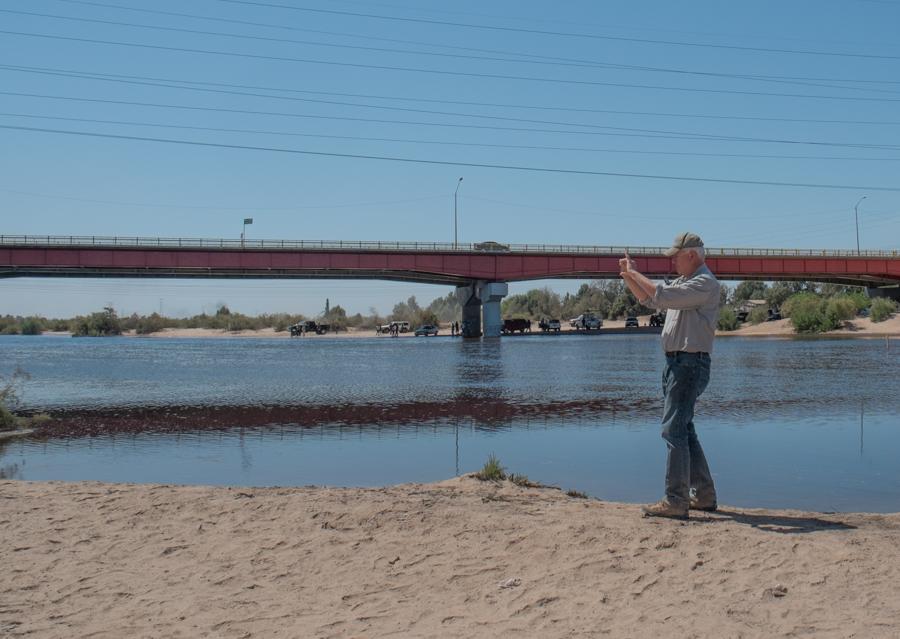
Sewage treatment plant, Albuquerque
Water is photogenic, even at a sewage treatment plant.
This is from a tour this afternoon of the Albuquerque Bernalillo County Water Utility Authority’s Southside Wastewater Reclamation Plant with a couple of University of New Mexico faculty colleagues and a bunch of students, including the graduate students in the Water Resources Program, where I’m an adjunct faculty member. The plant treats about 50 million gallons per day of sewage. Its discharge is the third largest tributary to the Rio Grande, after the Conejos River in Colorado and the Rio Chama in northern New Mexico.
Stuff I wrote elsewhere: ASR in New Mexico
I had a lovely afternoon yesterday walking alongside the Bear Canyon Arroyo in Albuquerque’s northeast heights, talking with fellow water nerds Katherine Yuhas and Amy Ewing, and watching water flow in New Mexico’s first operational aquifer storage and recovery project (behind a Google surveywall):
Nearly 3,000 gallons a minute of water began spurting from a pipe into Bear Canyon Arroyo in Albuquerque’s Northeast heights this week as part of New Mexico’s first operational project to store water in an underground aquifer.
“The whole goal of doing this is to store water when we have excess in the winter to build a drought reserve,” said Katherine Yuhas, water conservation officer for the Albuquerque Bernalillo County Water Utility Authority.
Starbucks’ new Vonnegut cups
My daughter noticed the new Starbucks Vonnegut cups:
Really psyched about the Starbucks Vonnegut cups: "This is a picture of an asshole" pic.twitter.com/cKfwReOUFK
— Norapinephrine (@NoraReed) November 2, 2014
State-level “water resource fees”
About a decade ago, New Mexico state Rep. Mimi Stewart introduced legislation to collect a “water resource fee” on all water use in the state – $2 per acre foot for ag, $20 per acre foot for municipal and most other water users. (details in a 2003 talk by Steward here – pdf) The idea was to generate revenue to fund water capital and management needs. “We’re going to have to come up with more money for water somewhere, sometime,” Stewart said back then, “and I think it is time we start telling the public, our constituents, that water has to be paid for because it
costs a lot to deliver it.” I haven’t run down the details of what happened (I wasn’t covering water back then), but I’m told it didn’t get much traction. People don’t like to voluntarily pay more for stuff, I guess. One of the weaknesses of Democracy, and why, for example, we haven’t raised the gas tax since 1993.
This feels a lot like severance taxes on oil and gas production, which are commonly done in New Mexico and elsewhere, but for some reason it’s a lot harder to do with water.
There’s some renewed chatter about doing this in New Mexico, though only from talking heads like me outside the government, not those inside the government who actually have to pass bills and get people to vote for them. So for now, think nothing of it. But it’s the reason I was so interested in this item, about what sounds like tentative talk in California about something similar:
The water plan released Thursday emphasizes securing more stable funding for water projects. It suggests an unspecified state water fee on water users as one possible source of additional funding.
So, lazyweb style, are there other states that already do something like this?
Here’s what ag water conservation might look like
A lovely fall day in the Rio Grande Valley, on Albuquerque’s west side. The green field in the lower left of this picture is alfalfa. The scraggly brown stuff in the middle and right foreground is a part of the same field left fallow this year.
The cottonwoods, God love ’em, suck up water no matter what human water managers do.
A Halloween treat: Lake Mead’s not quite as empty as we expected
I was wrong when I wrote in April that Lake Mead would continue to set “lowest ever for this point in the year” records for all of 2014. As I write this, with a few hours left in October, Mead’s surface elevation is 1,082.79 feet above seal level. That is more than five whole inches above the last really dry year, 2010! (data here)
But don’t get too excited. There’s a one in ten chance that Lake Mead will drop into the low 1,060s by the summer of 2016, according to the Bureau of Reclamation (data here, in pdf). That’s still above the trouble point for Vegas, which starts to have difficulty getting its water out of the lake at 1,050. But Southern Nevada Water Authority managers worry about water quality impacts well before that point (see these pdf/slides for an April 2010 presentation by Todd Tietjen of the Southern Nevada Water Authority for more on the issues involved). Here’s a chart, though it stops in January 2016, before things get really scary. On the plus side, there’s more upside than downside in the range of possible outcomes here:
Sustainability, Texas style
What economists call “weak sustainability” is the notion that, as you deplete some stock of natural capital, you reinvest in some stock of replacement capital. An example might be taking some of the surplus from extracting oil and gas and investing in solar or wind energy so you’ve still got some supply of energy when the fossil fuels run out. But it doesn’t have to be a direct substitution. One of my friends loves to argue for taking some of the money you get from oil and gas revenue and investing it in early childhood education – building up human capital. Here’s the OECD definition for weak sustainability:
All forms of capital are more or less substitutes for one another; no regard has to be given to the composition of the stock of capital. Weak sustainability allows for the depletion or degradation of natural resources, so long as such depletion is offset by increases in the stocks of other forms of capital (for example, by investing royalties from depleting mineral reserves in factories).
Texas is not the sort of place where you think of sustainability as a guiding policy, but while they likely would flee from such a greenie-sounding label, that appears to be exactly what they’re doing to fund improved water infrastructure, Brett Walton reports:
Last year, lawmakers created a $US 2 billion water fund with surplus money from oil and gas revenues. Low-interest loans from the fund will finance both water-conservation initiatives and water-supply projects that are included in the state’s $US 53 billion water plan.
The case for dumping prior appropration
The case for dumping prior appropriation, the doctrine under which the first water users have the highest priority rights – Travis Stills:
The 21st century water-use debate must move past “I got it first,” which children on the playground know is patently unreasonable and unfair.