Here’s a good example of why fixing the west’s water problems is going to be so difficult.
Phoenix wants to do something really simple. It currently has more Colorado River water than it needs, and it would like to just leave its unused apportionment in Lake Mead. This seems like a no-brainer – Phoenix gets to stash some water now as a hedge against things getting worse. Las Vegas should love this, because more water in Lake Mead means less risk to Las Vegas’s water intakes, which are increasingly vulnerable as Mead drops. In general, this helps reduce the risk of a shortage declaration by propping up Lake Mead’s levels. What’s not to like?
Except, under the rules, Phoenix cannot do this.
A member of the Inkstain brain trust, who I’ll call “Deepwater”, recently pointed me to an interesting body of academic literature on “the anticommons”. We all know about the “tragedy of the commons”, where multiple users all have access to the same common pool resource, creating a risk of overgrazing of a pasture or overpumping of an aquifer. The anticommons is a sort of reverse version of this, where multiple actors have the ability to block attempts to come up with sane solutions to the tragedy of the commons. Here’s Lea-Rachel Kosnick’s explanation:
The commons can lead to the “Tragedy of the Commons,” where uncoordinated utilization of a good can lead to its overuse, and symmetrically, the anticommons can lead to the “Tragedy of the Anticommons,” where poor collective management can lead to suboptimal use of the resource…. The anticommons approach explains much of the inefficiency and waste that currently occurs with water use in the United States today.
Phoenix’s current inability to stash unused water in Lake Mead is a great example of how this works.
As Peter Culp and colleagues note in a new paper out this week suggesting new approaches to western water management (it’s really good, suggested reading, pdf), Phoenix has already been a big part of the western municipal water conservation craze:
Thanks to investments in water efficiency, many of the West’s largest cities, such as the City of Phoenix, use less water today than they did several decades ago—despite the doubling or tripling of their populations during that period.
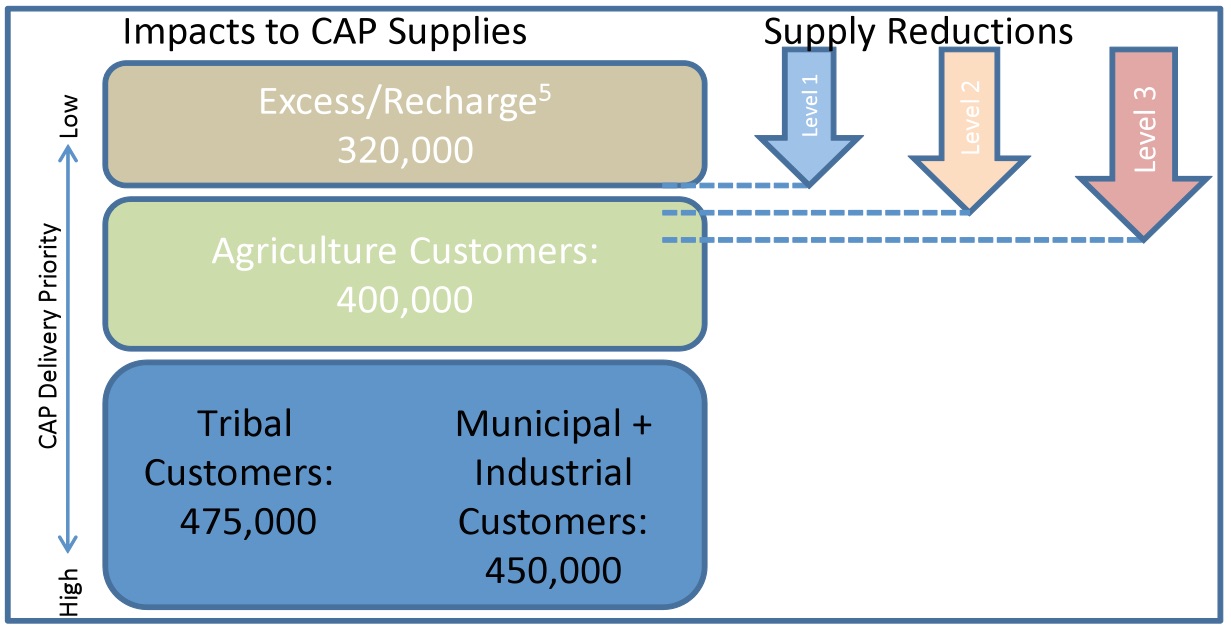
That creates a dilemma that may sound surprising – Phoenix is legally entitled to more Colorado River water than it is using. Phoenix currently has rights to 186,557 acre feet per year of water via the Central Arizona Project, the big aqueduct that carries Colorado River water uphill to the state’s populated middle. But Phoenix is only currently using ~130,000. First, good for Phoenix for not using it all. But what to do with the surplus?
The simplest thing, it seems, would be to just leave it in Lake Mead, right? Ah, but this is the Colorado River. It’s not simple. This is one of those areas where the rules by which we allocate and distribute water are crazy weird and difficult to explain to folks outside the water world who just want things to work sensibly. This does not work sensibly, but the rules are what they are.
Prior to 2007, water use on the Lower Colorado River among Nevada, California, and Arizona was pretty much use-it-or-lose-it. The 2007 shortage sharing guidelines, an agreement among the states and the federal government, created a new management widget that changed that, called “Intentionally Created Surplus.” Lower Basin water users holding contracts with the Bureau of Reclamation could conserve water, jump through some bureaucratic hoops, and leave the water in Lake Mead for later. By the end of 2013, there was 1.1 million acre feet of ICS water in Lake Mead. In other words, this new institutional widget encouraged Lower Basin water users to conserve enough water to raise Mead’s elevation by something like 10 feet.
But Phoenix can’t use the ICS mechanism, because it is not a direct contractor. It gets its water instead through the Central Arizona Project, which as holder of the contract is the only one eligible for ICS. So CAP can store water in Mead, but Phoenix can’t. Next week, the Phoenix City Council will discuss efforts underway to change that. From the staff report (see below for the full document):
[T]he seven Basin States are engaged in negotiations to address declines in Lakes Mead and Powell. As part of this effort, the City is in preliminary discussions with the Arizona Department of Water Resources (ADWR) and Central Arizona Project (CAP) to explore the possibility of storing some of the City’s water in Lake Mead to improve current reservoir levels.
I’ll leave it to others who better understand Arizona’s crazy water politics to explain why these folks are palavering rather than just doing this, but one fruitful area of inquiry might involve what happens to the excess water once it’s in the CAP system and Phoenix doesn’t use it. CAP may have institutional motivation to do something else with it?
Phoenix does have a smart alternative, announced earlier this month – a deal with Tucson, which is downstream on the CAP and has a big groundwater recharge operation, to stash some of the Phoenix excess underground. Later, when, if and when Phoenix wants the water, it would do a paper water swap, using some of Tucson’s CAP water while Tucson pumps the stored groundwater to replace it.
Here’s the full Tucson City Council meeting staff report, which has some other neat things in it:
Phoenix drought planning
 discusses the efforts at length) shows how hard this can be.