My daughter noticed the new Starbucks Vonnegut cups:
Really psyched about the Starbucks Vonnegut cups: "This is a picture of an asshole" pic.twitter.com/cKfwReOUFK
— Norapinephrine (@NoraReed) November 2, 2014
My daughter noticed the new Starbucks Vonnegut cups:
Really psyched about the Starbucks Vonnegut cups: "This is a picture of an asshole" pic.twitter.com/cKfwReOUFK
— Norapinephrine (@NoraReed) November 2, 2014
About a decade ago, New Mexico state Rep. Mimi Stewart introduced legislation to collect a “water resource fee” on all water use in the state – $2 per acre foot for ag, $20 per acre foot for municipal and most other water users. (details in a 2003 talk by Steward here – pdf) The idea was to generate revenue to fund water capital and management needs. “We’re going to have to come up with more money for water somewhere, sometime,” Stewart said back then, “and I think it is time we start telling the public, our constituents, that water has to be paid for because it
costs a lot to deliver it.” I haven’t run down the details of what happened (I wasn’t covering water back then), but I’m told it didn’t get much traction. People don’t like to voluntarily pay more for stuff, I guess. One of the weaknesses of Democracy, and why, for example, we haven’t raised the gas tax since 1993.
This feels a lot like severance taxes on oil and gas production, which are commonly done in New Mexico and elsewhere, but for some reason it’s a lot harder to do with water.
There’s some renewed chatter about doing this in New Mexico, though only from talking heads like me outside the government, not those inside the government who actually have to pass bills and get people to vote for them. So for now, think nothing of it. But it’s the reason I was so interested in this item, about what sounds like tentative talk in California about something similar:
The water plan released Thursday emphasizes securing more stable funding for water projects. It suggests an unspecified state water fee on water users as one possible source of additional funding.
So, lazyweb style, are there other states that already do something like this?
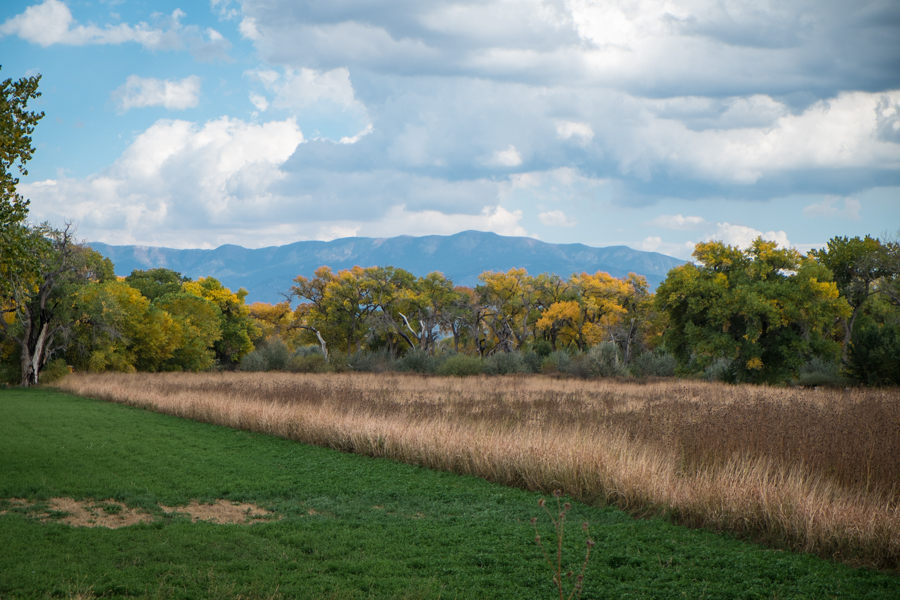
fall in the Rio Grande Valley
A lovely fall day in the Rio Grande Valley, on Albuquerque’s west side. The green field in the lower left of this picture is alfalfa. The scraggly brown stuff in the middle and right foreground is a part of the same field left fallow this year.
The cottonwoods, God love ’em, suck up water no matter what human water managers do.
I was wrong when I wrote in April that Lake Mead would continue to set “lowest ever for this point in the year” records for all of 2014. As I write this, with a few hours left in October, Mead’s surface elevation is 1,082.79 feet above seal level. That is more than five whole inches above the last really dry year, 2010! (data here)
But don’t get too excited. There’s a one in ten chance that Lake Mead will drop into the low 1,060s by the summer of 2016, according to the Bureau of Reclamation (data here, in pdf). That’s still above the trouble point for Vegas, which starts to have difficulty getting its water out of the lake at 1,050. But Southern Nevada Water Authority managers worry about water quality impacts well before that point (see these pdf/slides for an April 2010 presentation by Todd Tietjen of the Southern Nevada Water Authority for more on the issues involved). Here’s a chart, though it stops in January 2016, before things get really scary. On the plus side, there’s more upside than downside in the range of possible outcomes here:
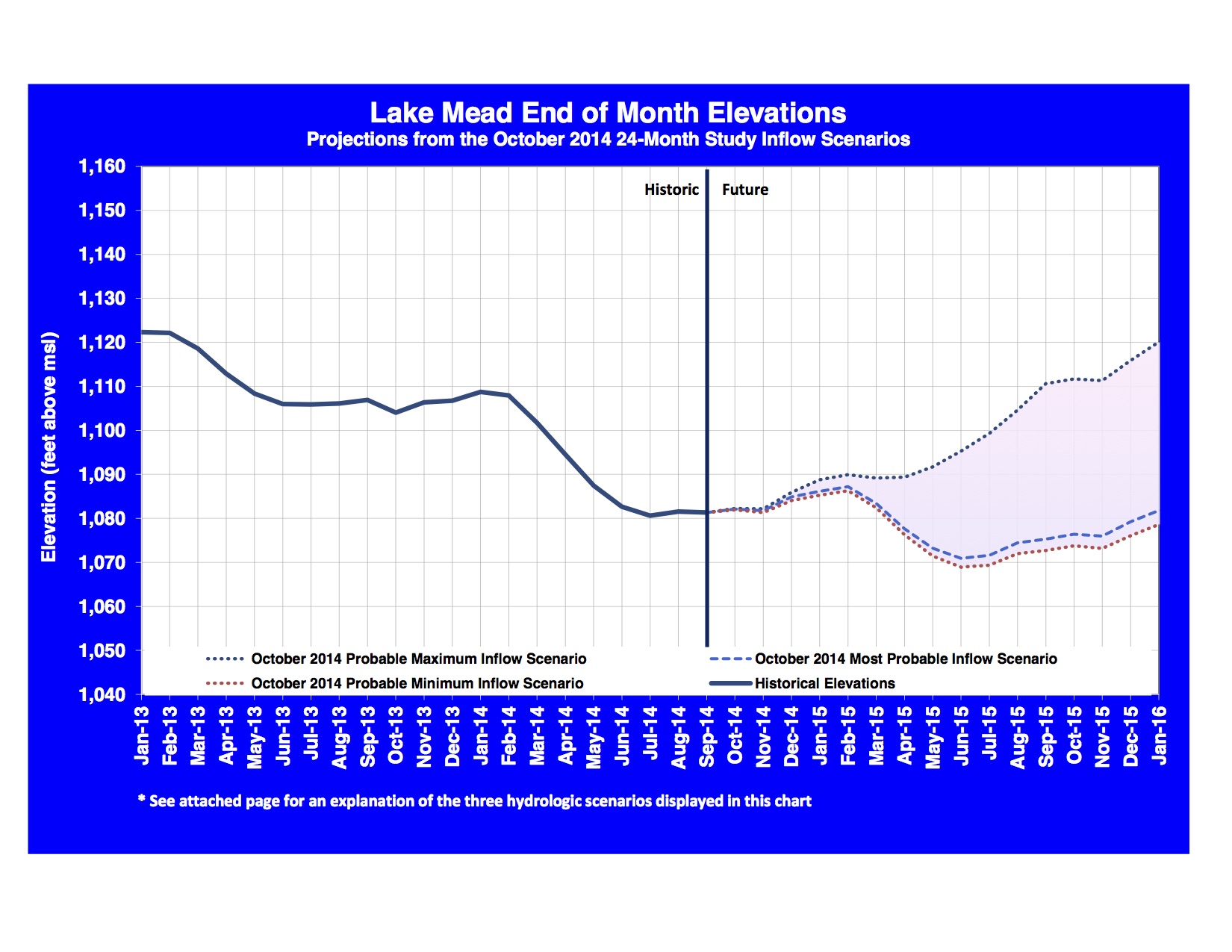
Lake Mead projected elevations, courtesy USBR
What economists call “weak sustainability” is the notion that, as you deplete some stock of natural capital, you reinvest in some stock of replacement capital. An example might be taking some of the surplus from extracting oil and gas and investing in solar or wind energy so you’ve still got some supply of energy when the fossil fuels run out. But it doesn’t have to be a direct substitution. One of my friends loves to argue for taking some of the money you get from oil and gas revenue and investing it in early childhood education – building up human capital. Here’s the OECD definition for weak sustainability:
All forms of capital are more or less substitutes for one another; no regard has to be given to the composition of the stock of capital. Weak sustainability allows for the depletion or degradation of natural resources, so long as such depletion is offset by increases in the stocks of other forms of capital (for example, by investing royalties from depleting mineral reserves in factories).
Texas is not the sort of place where you think of sustainability as a guiding policy, but while they likely would flee from such a greenie-sounding label, that appears to be exactly what they’re doing to fund improved water infrastructure, Brett Walton reports:
Last year, lawmakers created a $US 2 billion water fund with surplus money from oil and gas revenues. Low-interest loans from the fund will finance both water-conservation initiatives and water-supply projects that are included in the state’s $US 53 billion water plan.
The case for dumping prior appropriation, the doctrine under which the first water users have the highest priority rights – Travis Stills:
The 21st century water-use debate must move past “I got it first,” which children on the playground know is patently unreasonable and unfair.
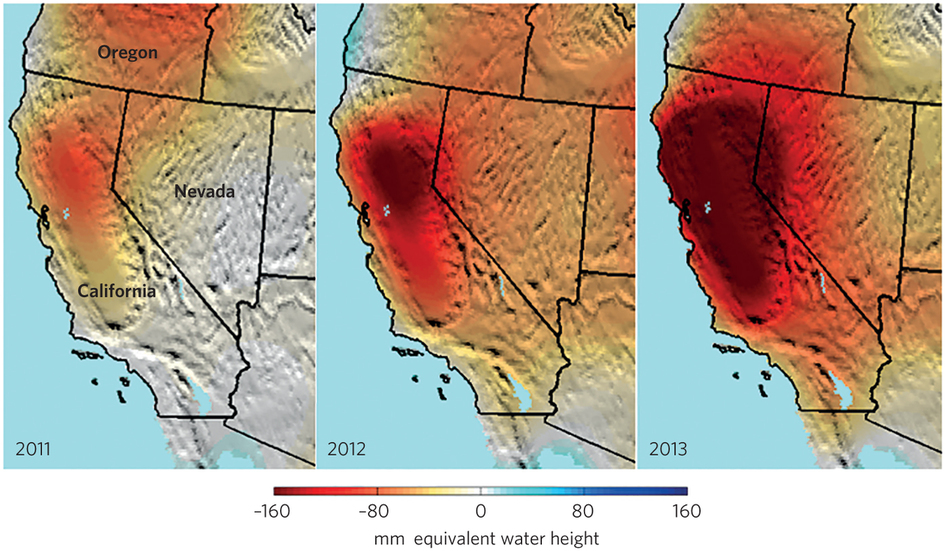
Dry season water storage anomalies in California, courtesy Jay Famiglietti/NASA/Nature
Jay Famiglietti in Nature Climate Change (paywalled):
The irony of groundwater is that despite its critical importance to global water supplies, it attracts insufficient management attention relative to more visible surface water supplies in rivers and reservoirs. In many regions around the world, groundwater is often poorly monitored and managed. In the developing world, oversight is often non-existent.
The result has been a veritable groundwater ‘free for all’: property owners who can afford to drill wells generally have unlimited access to groundwater. Some countries, such as India, for example, even subsidize electricity costs for pumping to encourage greater agricultural productivity at the expense of falling aquifer levels.
Dr. Famiglietti offers some policy recommendations:
I am endlessly fascinated (and frustrated) by the mess that is societal risk perception. Here (behind a Google survey wall), a look at efforts to regulate septic systems in Bernalillo County, primarily on the kind-of-rural fringes of the Albuquerque metro area:
As groundwater contamination problems go, the stuff leaking from septic systems isn’t terribly sexy. Give me a gas station’s leaking underground storage tank any day, or an old electronics plant, or Kirtland Air Force Base’s sloppy aviation fuel handling. That I can get excited about.
But waste leaking from an aging home septic system?
That, says University of New Mexico engineering professor Bruce Thomson, is precisely the problem.
“It’s groundwater contamination that’s happening all around us, and we’re not paying any attention,” said Thomson, an expert in treating human waste who delights in describing his academic specialty as “turd mechanics.”
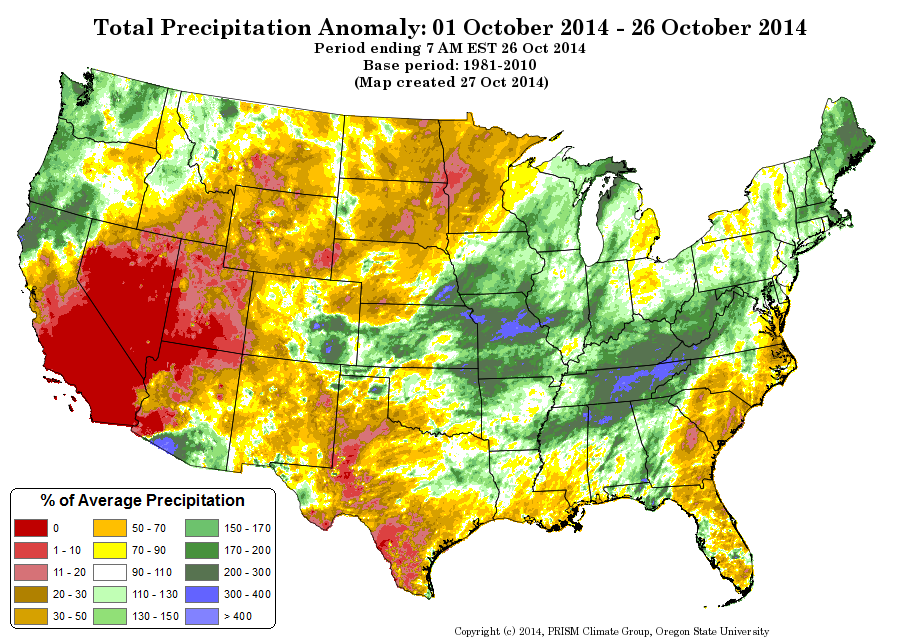
PRISM October ’14
+ @jfleck if there ever was a water year/ winter when we needed snow in our SW headwaters, this is it… Odds only ok.
— Jonathan Overpeck (@TucsonPeck) October 28, 2014
Contra Porterville in California, where poor farmworkers with few options are running out of water, on the fringes of Tucson it’s those who chose to sprawl onto the edge of a relatively affluent community, beyond municipal utilities and dependent on a marginal aquifer, who are now seeing their wells running dry. Tony Davis:
In the Tortolita foothills, Glenn Phillips has plenty of competition for water. About 70 wells, drilled since the early 1980s, are registered with the state water department in a one-mile-wide swatch north of Cougar Canyon Trail, between Como Drive on the east and Seifert Estates Road on the west.
They range from 150 to 1,250 feet deep, with bedrock less than 400 feet.
One of the area’s first wells was dug in 1979 by Charles Hill, now 61, whose home now backs up against Phillips’. A computer scientist who designs and writes applications for computers at the University of Arizona, Hill and his wife moved here from Tucson three months after their marriage because they wanted to live under dark skies and see the stars.