Big Foot and the Two Grey Hills Rug

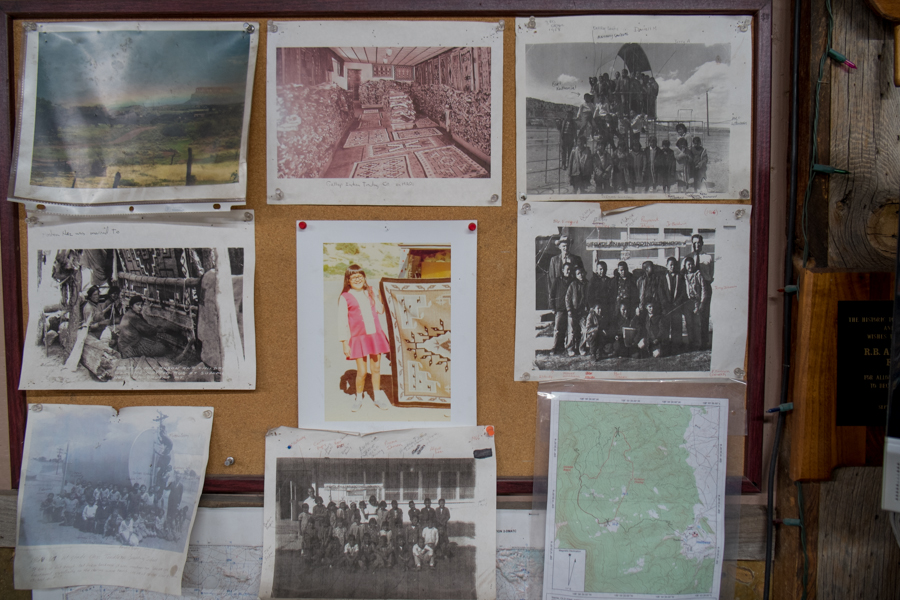
Delores Brown, center, holding one of her mother's rugs in a picture taken a long time ago.

Delores Brown, center, holding one of her mother’s rugs in a picture taken a long time ago. From the bulletin board at the Toadlena Trading Post

tl;dr Lissa and I met a man today who saw Big Foot in the foothills of the Chuska Mountains on the Navajo Nation west of Newcomb, New Mexico. He could neither hear nor speak, but we have no reason to doubt his story. Lissa misplaced her purse, which was easily found, and we bought a Two Grey Hills rug. The ice cream man no longer delivers to Toadlena. These things are all connected.

TOADLENA – Of this much I am sure. Arthur J. Belone from Toadlena Mountain saw Big Foot on the piñon-juniper hillside behind the Toadlena Trading Post in the foothills of the Chuska Mountains on May 14, 2013. There were two inches of snow on the ground.

Because Arthur can neither hear nor speak, the details are murky, but we have no reason to doubt Arthur’s story. He gestured easily to his ears and mouth to make clear the communication challenge, but didn’t hesitate to initiate a conversation anyway. He pointed to his foot, raised it, and gestured with his hand to indicate the size of a much larger foot. Then he pointed to the hillside.

We were sitting on a low wall outside the Toadlena Trading Post, 12 miles off US 491 near Newcomb on the Navajo Nation in northwestern New Mexico. The trading post is one of those old stone buildings that in this part of the country sit at the intersection between traditional culture and the cash economy. Inside, in a warren of rug rooms, are gorgeous Two Grey Hills weavings.

Delores Brown, who was minding the store, said the ice cream man no longer delivers here, at the end of this long road. When we stopped by late in the afternoon to recover Lissa’s misplaced purse, we had just missed Delores’s mother and sister, who had been by a few minutes earlier to bring the ice cream. Her mother, Violet Brown, is a weaver of some renown, as was her grandmother, the late Yazzie Blackhorse. But I am getting ahead of myself.

Arthur J. Belone's are the shoes of a runner

Arthur J. Belone’s are the shoes of a runner

Arthur had the lean build of a runner – Delores mentioned marathons – but he sadly pointed to his knee. He carried a Bic ballpoint, tucked into a glasses case clipped to the collar of his t-shirt from the 15th Annual Toadlena Challenge (8k and 2 mile). He used the pen when gestures fell short. “I can’t run any more,” he wrote in the margin of a copy of the Navajo Times Lissa had been carrying.

It was via that technique – his ballpoint or my mechanical pencil, and Lissa’s Navajo Times or my yellow Rite in the Rain notebook – that he clarified the Big Foot story – the date, the depth of snow. He also shared some family history that I won’t go into, and described either deer or elk coming down from the mountains, hopping the fence and eating crab apples from the orchard across the road. Delores described Arthur as being remarkably chatty for a man who can neither hear nor speak. I could not disagree.

It was only several hours later, when we had stopped at the Saturday flea market up the road in Shiprock, that Lissa realized she must have left her purse in one of the rug rooms where we had been sitting on the floor laying out rugs and dreaming. It wasn’t all that much bother, because we were just wandering, so we wandered back down US 491 to the turnoff north of Newcomb and headed back out the road to Toadlena. There had been sheep on the road earlier. We hoped to see them again.

Delores was happy to see us. She said she’d been uncomfortable poking through Lissa’s purse to figure out who it belonged to, found a phone number and left a message. It wouldn’t have helped. The cell phone was in the purse. And then Delores started telling stories – about the few grandmothers who still go up in the mountains in the summer with the sheep, about the time her mother tried to teach her to weave, about snakes and growing squash, about the ice cream problem and that it was too bad, we’d just missed meeting her mother.

Lissa asked if they had any of her mother’s weavings. Delores said yes. And so it was that we became the owners of a beautiful Violet Brown weaving.
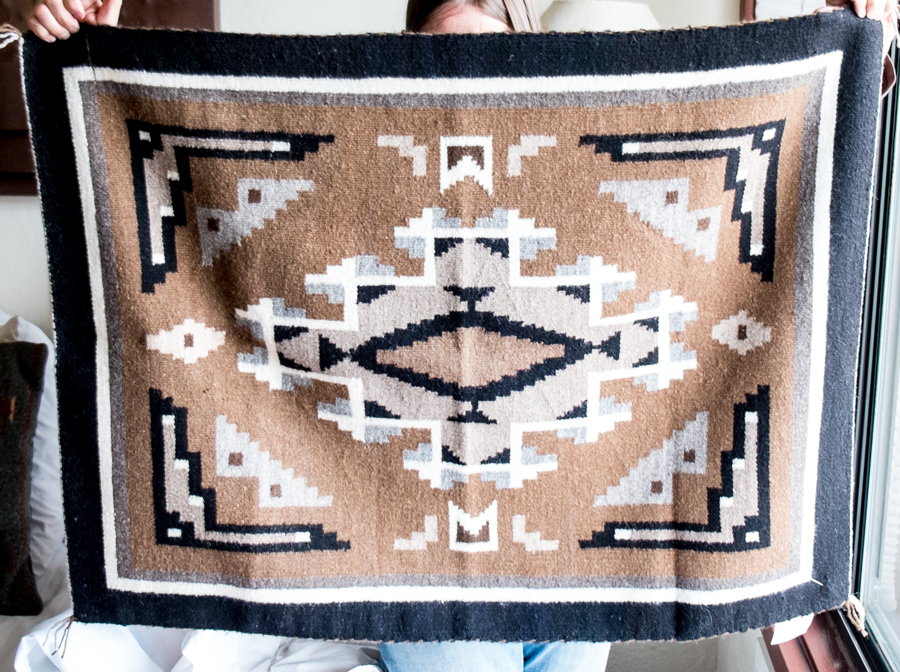
Violet Brown weaving

Violet Brown weaving

“Mummy Lake” – we always want it to be about water

The "Mummy Lake" or "Far View Reservoir" site at Mesa Verde, which is probably not about water. May, 2014

The “Mummy Lake” or “Far View Reservoir” site at Mesa Verde, which is probably not about water. May, 2014

Lissa and I stopped this morning at Mesa Verde’s “Mummy Lake”, more recently renamed “Far View Reservoir,” on account of apparently there was never any mummy. Now we learn, thanks to science, that there was probably never a reservoir or lake, either:

The structure at Mesa Verde National Park known historically as Mummy Lake and more recently as Far View Reservoir is not part of a water collection, impoundment, or redistribution system. We offer an alternative explanation for the function of Mummy Lake. We suggest that it is an unroofed ceremonial structure, and that it serves as an essential component of a Chacoan ritual landscape.

That’s from “Mummy Lake: an unroofed ceremonial structure within a large-scale ritual landscape”, by Benson et al., Journal of Archaeological Science, Volume 44, April 2014, Pages 164–179.

Joseph Castro did a nice writeup on the research, which is how I found out about it. Castro explains that Benson and colleagues concluded that there likely would never have been enough water to fill it, and the features originally thought of as canals to collect and distribute water would likely have plugged up with sediment or leaked over cliffs if they were actually used to collect or distribute water.

Petroglyph Point

L. Heineman at Petroglyph Point, Mesa Verde, May 2014

L. Heineman at Petroglyph Point, Mesa Verde, May 2014

There’s an easy grace in spending a warm spring Friday afternoon with my partner of more than 30 years, looking at things we’ve looked at a million times before.

Vollman on the economics of Imperial Valley farming

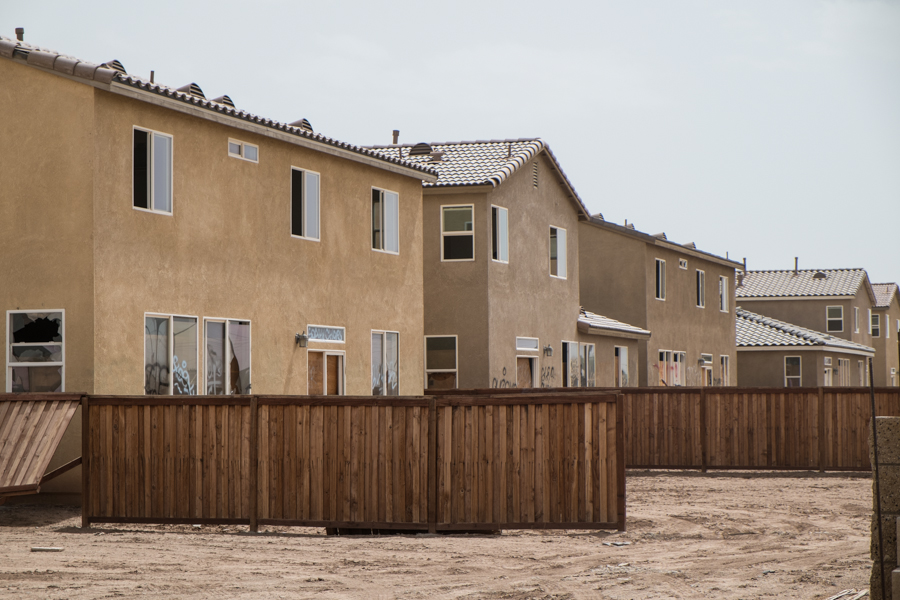
Imperial Valley housing development, east of Brawley, March 2014

Imperial Valley housing development, east of Brawley, March 2014


Driving up through the Imperial Valley in March, I chanced upon this example of the fading hopes of the town of Brawley.

In his maddeningly intriguing book Imperial, William Vollman briefly slips out of the obtuse into this rare moment of clarity:

When I began to study the history of the period, my mind remained unbiased by knowledge. All I knew was that somehow Imperial County had altered from being one of the richest bits of farmland in the United States to the poorest county in California, and I couldn’t fathom how.

Ghost ship in the blue haze

Shiprock in the distant haze, seen from Far View, Mesa Verde, May 2014, by John Fleck

Shiprock in the distant haze, seen from Far View, Mesa Verde, May 2014, by John Fleck


I was a little kid when I first saw Shiprock, the great volcanic neck on the northeastern edge of Navajo country, and I’ve been staring at it from all conceivable angles, in fascination, ever since.

Most days you can see it through the distant haze from Mesa Verde, the plateau to the north, but only just barely, mysteriously.

Clarence Dutton, in his 1882 “Physical Geology of the Grand Cañon District“, wonderfully described the quality of the light:

Those who are familiar with western scenery have no doubt been impressed with the peculiar character of its haze or atmosphere in the artistic sense of the word and have noted its more prominent qualities. When the air is free from common smoke it has a pale blue color which is quite unlike the neutral gray of the east.

Stuff I wrote elsewhere: El Niño and the carnival barker

I’ve tried lots of different things to try to communicate the inherent uncertainties (at all time scales) in the forecast business. Here’s another stab at the problem:

I feel a little like a cheap carnival barker foretelling you this, but FYI, it looks like El Niño is coming.

New Mexico water managers, grappling with their fourth straight year of drought, have a tired look in their eyes. Mention El Niño and you’ll see a spark of life. That is because the Pacific climate pattern with the lyrical name is associated with wetter weather.

Step right up folks, come see the Amazing El Niño, bringer of moisture to the parched state of New Mexico! You’ll thrill to its crashing thunderstorms, its snowpacked mountains and brimming rivers!

But you saw what I did there, right? “Is associated with wetter weather.” Already with the weasel words. The carnival barker in me is excited, but the cautious journalist in me has been talking with cautious scientists. El Niño comes with no guarantees.

Mead, Powell to end year at lowest storage since 1968

The total combined storage in Lake Mead and Lake Powell at the end of September (the close of the “water year”) will be the lowest since 1968, when Powell was first being filled, according to the latest U.S. Bureau of Reclamation “24-Month Study” (pdf).

The current forecast calls for Lake Mead’s elevation to be 1,077.93 feet above sea level on Dec. 31, 2015, which is less than three feet above the trigger level for a shortage in 2016. That’s a little less than last month’s number. (See here for the background on how the shortage decision is made.)

Here’s the data:

water in the desert

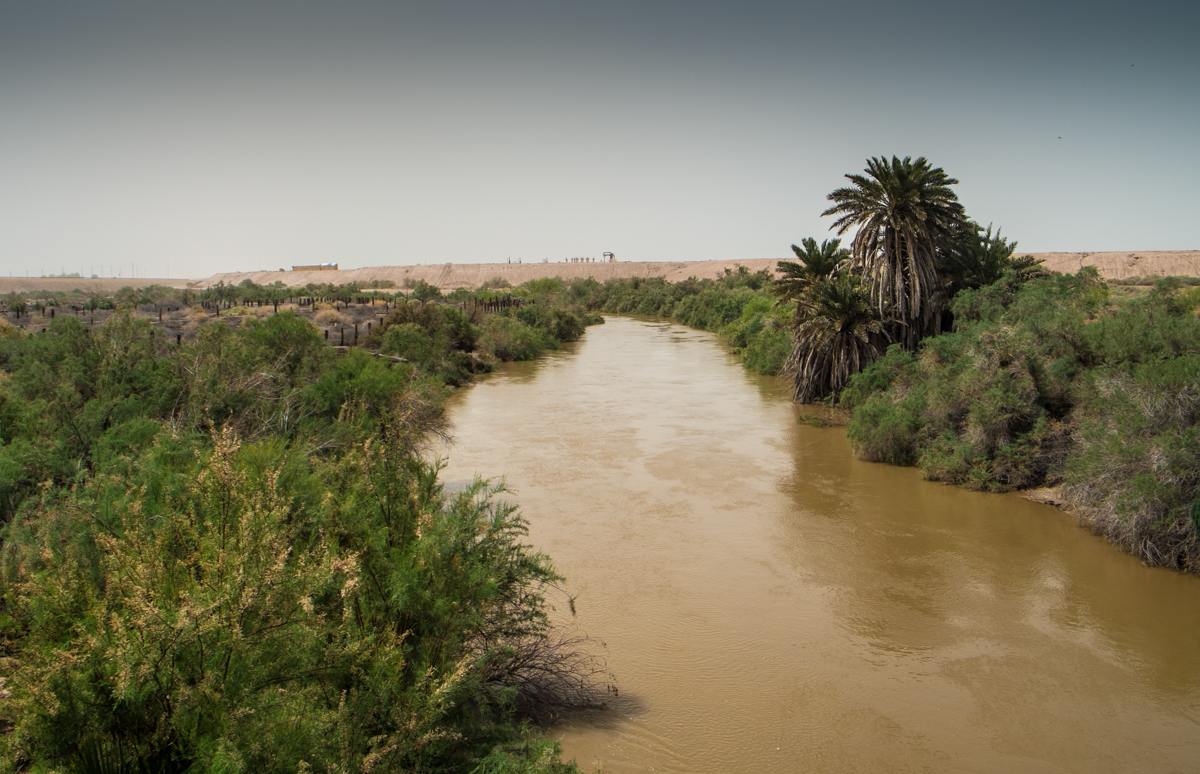
New River outside Brawley, Calif., March 2014, by John Fleck

New River outside Brawley, Calif., March 2014, by John Fleck

But man has in measure changed the desert conditions by storing the waste waters of the mountains and reclaiming the valleys by irrigation. His success has been phenomenal. Out of the wilderness there have sprung farms, houses, towns, cities with their wealth and luxury. But the cultivated conditions are maintained only at the price of eternal vigilance. Nature is compelled to reap where she has not sown and at times she seems almost human in the way she rebels and recurs to former conditions. Two, three; yes, at times, four years in succession she gives little rain. A great drouth follows. Then the desert breaks in upon the valley ranches, upon the fields of barley, the orchards of prunes and peaches and apricots. Then abandoned farms are quite as plentiful as in New England and once abandoned but a few years elapse before the desert has them for its own.

John Van Dyke, The Desert, 1901

Canoeing the Rio Grande pulse flow

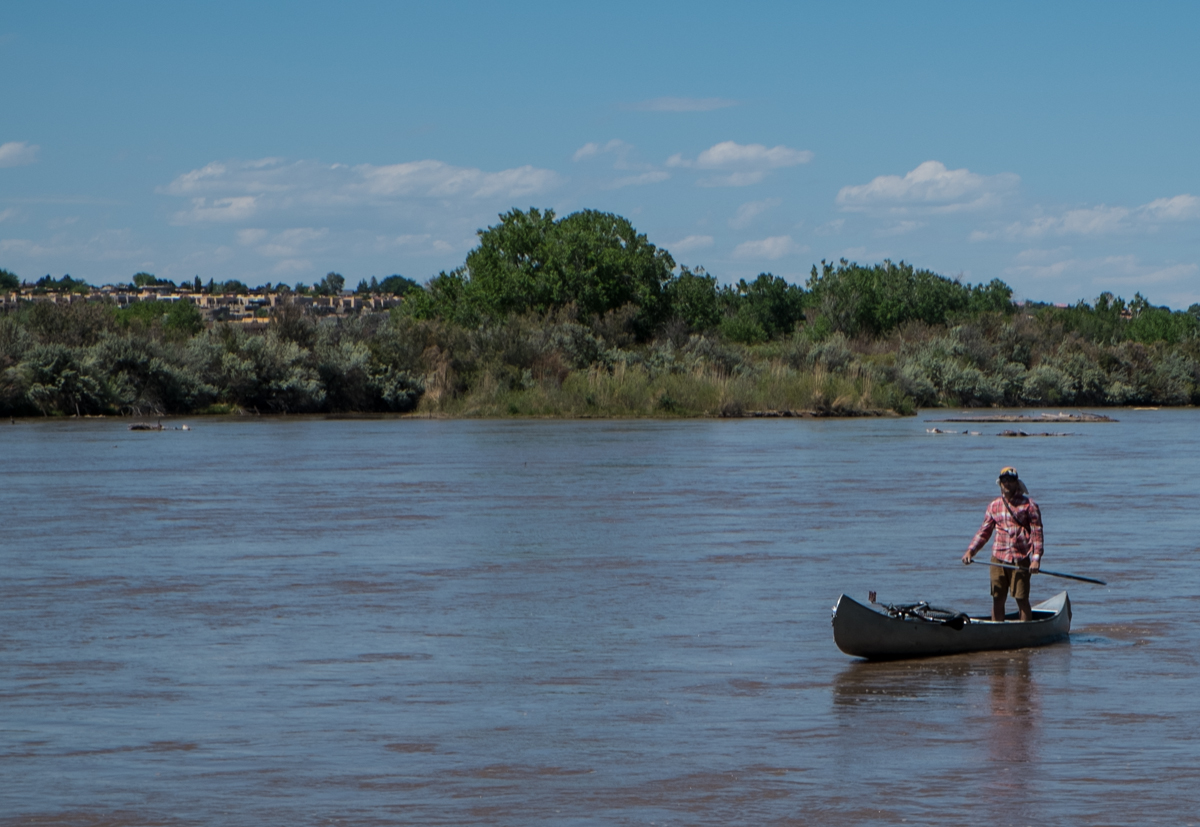
This guy paddled past today as I was standing with friends on the bank of the Rio Grande, watching the high flows of this week’s environmental pulse flow through central New Mexico.

Guy with canoe, bicycle,  trailer, on the high flow of the Rio Grande, May 10, 2014

Guy with canoe, bicycle, trailer, on the high flow of the Rio Grande, May 10, 2014


If you look closely, you can see a bicycle in the front of his canoe. As he rode by, he explained that when he gets to the takeout, he puts the canoe on a trailer behind the bike and tows it back up to where he left his car.

There’s a bike trail along the river the whole way. This seems quite clever.