Actual blog comment spam:
I all the time used to study paragraph in news papers but now as I am a user of web therefore from now I am using net for articles or reviews, thanks to web.
Actual blog comment spam:
I all the time used to study paragraph in news papers but now as I am a user of web therefore from now I am using net for articles or reviews, thanks to web.
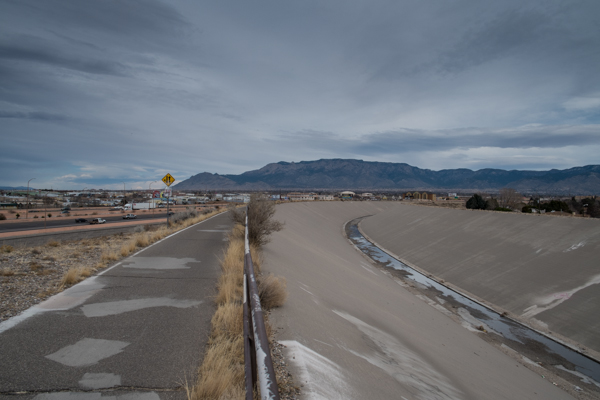
Landscape, Interrupted I, by John Fleck
One of my favorite Albuquerque views is from the bike trail by what we call the “Big I”, the interchange of two interstates in the middle of town. The trail runs along the northwest bank of a flood control channel, and the geography is such that you’re at the highest point around, including (mostly) the freeways. The result is a nearly 360-degree horizon – the Manzano and Sandia mountains to the east, the Jemez to the north and Albuquerque’s volcanoes to the west.
But when I stopped today to try to photograph it for this blog post instead of just enjoying it as I rolled by, I noticed something that I’d never seen before in the hundreds of times I’ve done that ride. There is a tremendous amount of city interrupting the view of the landscape. For years, my eye and brain have been clearing all that clutter away. The view of the volcanoes was the most striking example:
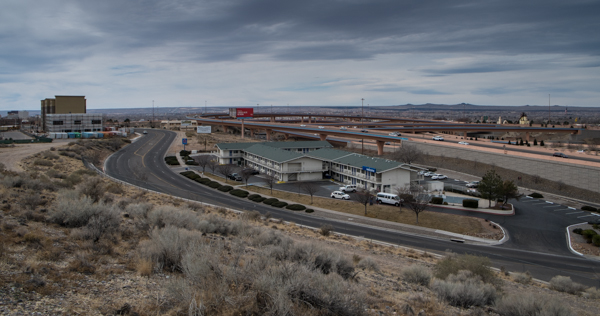
Landscape, Interrupted II, by John Fleck
Those little bumps on the horizon, toward the right side of this picture. Those are the volcanoes. There’s a lot more city in the way than I realized.
From the Daily Herald in Provo, Utah:
“This is a very, very important issue and we are trying to offer some leadership in this regard and brought in people to give direction,” Freeze said of the summit. “We want what is best for our communities and families. We all realize that, like it or not, our region and state is going to grow. There is nothing we can do to stop that.”
Given the limited supplies of water, what ever are Utahns to do?
The experts said Utah County would have to learn to conserve water and even suggested residents might have to give up eating meat.
tl;dr While Northern California flounders, Southern California’s drought planning kicks in as Met taps into its Lake Mead water savings bank

California Poppies
Brett Walton, writing about President Obama’s visit to California’s drought-stricken Central Valley, captured that state’s water policy dilemma:
“It can’t just be a matter of there’s going to be less and less water so I’m going to grab more and more of a shrinking share of water,” Obama continued. “Instead what we have to do is all come together and figure out how we all are going to make sure that agricultural needs, urban needs, industrial needs, environmental and conservation concerns are all addressed.”
That is a tall order, requiring a radical reinvention both of California’s water supply hardware and its operation – changes that politicians, environmentalists, and farmers have fought over for decades. Indeed, the drought has catalyzed a consensus that something should be done, but there is little agreement about the details.
Yes, but… To the south, the fruits of some years of wrestling over these issues has left a more orderly process for dealing with the current mess.
The Colorado River Interim Guidelines for Lower Basin Shortages and Coordinated Operations for Lake Powell and Lake Mead, approved in 2007, allowed Lower Colorado River Basin users to take a variety of steps to conserve or otherwise increase water supply, banking the resulting savings in Lake Mead for use when needed:
The primary purposes of ICS are to: (a) encourage the efficient use and management of Colorado River water; and to increase the water supply in Colorado River System reservoirs, through the creation, delivery and use of ICS; (b) help minimize or avoid shortages to water users in the Lower Basin; (c) benefit storage of water in both Lake Powell and Lake Mead; (d) increase the surface elevations of both Lake Powell and Lake Mead to higher levels than would have otherwise occurred; and (f) assure any Contractor that invests in conservation or augmentation to create ICS that no other Contractor will claim the ICS created by the Contractor pursuant to an approved plan by the Secretary.
We don’t have the final 2013 accounting yet, but at the end of 2012 the Metropolitan Water District of Southern California had banked 579,786 acre feet of water in Lake Mead. Overall, the Lower Basin water contractors as a whole had banked 1.2 million acre feet in Mead (p. 44 here, pdf).
This year, with California State Water Project deliveries reduced to a trickle (is “zero” a “trickle”?), MWD has said it plans on tapping into some of its ICS water in Lake Mead, to the tune of about 200,000 acre feet (though a final decision has not been made). The U.S. Bureau of Reclamation granted MWD approval to store more ICS water in Mead this year, but according to a staff report to MWD’s board last week (pdf) that appears unlikely:
Due to dry conditions in California, however, it is unlikely Metropolitan will store water in Lake Mead this year, and has initially planned to withdraw water from its storage account in Lake Mead.
I’ve argued that a century of fighting over the Colorado River has created a robust framework for water management decisions on the Lower Colorado that makes it much less difficult to handle trouble in times like this.
From Brett Walton, a visit to California’s Central Valley to witness Stein’s Law in action:
David Zoldoske, who has worked at Fresno State for 31 years, sees this as the future of agriculture in the Central Valley. Fewer acres will be irrigated, less groundwater will be pumped.
Walton’s entire piece is worth reading. Wikipedia has a nice brief explanation of Stein’s law.

Pumpkin sculpture by L. Heineman, photographed by John Fleck, February 2014
California Congressman Devin Nunes, in this morning’s New York Times:
“Global warming is nonsense,” Mr. Nunes said. He criticized the federal government for shutting off portions of California’s system of water irrigation and storage, and diverting water into a program for freshwater salmon. “There was plenty of water. This has nothing to do with drought. They can blame global warming all they want, but this is about mathematics and engineering.”
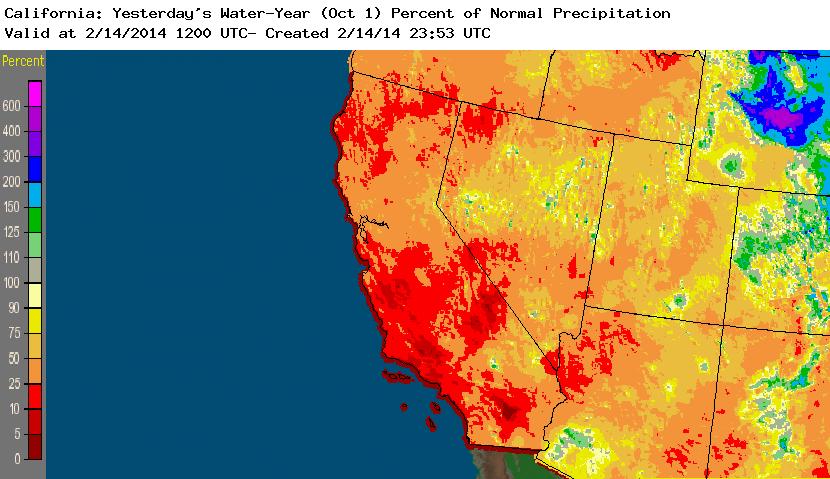
Percent of average precipitation, Oct. 1 2013 – Feb. 14, 2014, courtesy NWS
How is it even possible to start a water policy conversation when a politician so willfully ignores reality?
Given the tension from Texas’s legal complaints against New Mexico regarding the impact of New Mexico groundwater pumping on Texas Rio Grande supply (see Texas v. New Mexico and Colorado), this El Paso Water Utilities pump house feels to some like a middle finger raised in New Mexico’s direction. It’s just inside the Texas border, atop the Mesilla Bolson – the very aquifer the Texas lawyers are claiming New Mexico pumpers are hitting too hard:
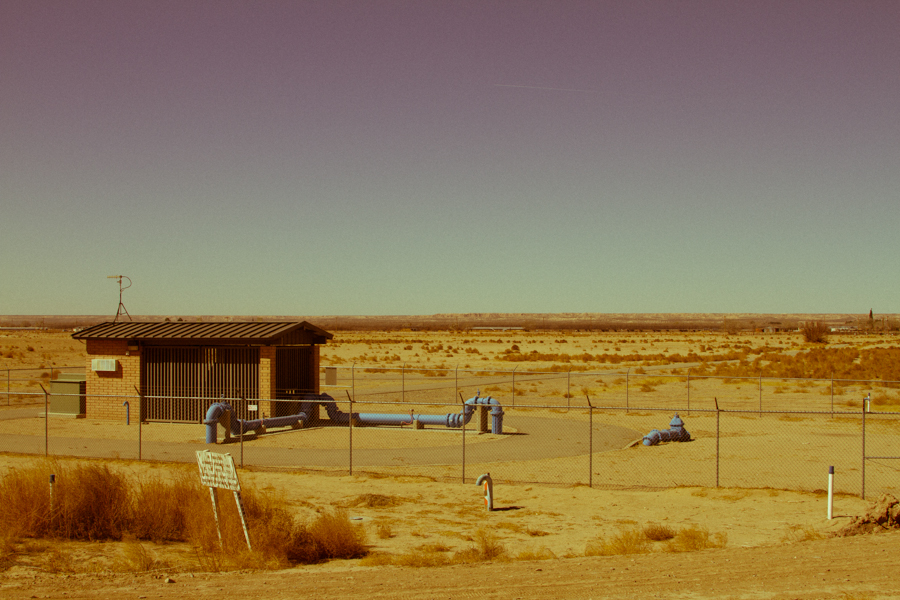
Texas pumps, near Las Cruces, March 2013, by John Fleck

Governing the Commons
As we watch Californians floundering over drought, or sometimes not floundering, it’s worth revisiting Elinor Ostrom’s Governing the Commons
The initial steps were taken in the shadow of a court order. Elections and public hearings were held at key stages. The solutions to the pumping race, however were not imposed on the participants by external authorities. Rather, the participants used public arenas to impose constraints on themselves. (emphasis in original)
This is not some fresh, revolutionary approach. It happened back in the 1930s and ’40s. And the system set up still works.
Meanwhile, Jennifer Medina reports on the alternative approach in California’s Central Valley:
This year, Ms. Woolf’s farm will be forced to rely entirely on the ground wells it owns, pumping what they need to keep the existing crops healthy. But there is no way to know how much water is available underground — and with neighboring farmers doing the same, it is only a matter of time before the wells run dry.
“It’s like a bank account that is going to run out, and you don’t know when,” Ms. Woolf said, standing near her fields of garlic, where workers were laying rubber irrigation tubes under the murky cloudless skies. “With no rain, we’re not recharging what we’re taking. Nobody wants to do it this way, but you make the decision where to plant just based on where you can get the water to for as long as it lasts.”
So, to summarize: If communities get together and take responsibility for the finite nature of their aquifers, their water can be reliably managed to last. If they don’t they water as long as it lasts and then, I guess, they’re done. Either way. Their choice.
OtPR:
I have absolutely no sympathy for this predicament. It could not be more directly or more blatantly self-inflicted.

Hearst Castle Neptume poo, CC via Jim Epler
Here at Inkstain, we’ve long believed that our drought and water coverage has suffered from a lack of Lady Gaga-related items. Today, thanks to the LA Times, we can correct this shortcoming. The story, fittingly enough, involves Hearst Castle and what is apparently a leaking swimming pool:
[P]ark officials and the singer came up with a plan. Gaga would pay for water to be pumped from an on-site irrigation storage facility to fill the cracked pool, which was leaking up to 5,000 gallons of water per day.
The water will be returned after the photo shoot, officials said, and the cost of the transfer will be picked up by Gaga.
There is more, including a plan to repair the leaking pool and some sort of public service announcement.
If I was a better blogger, I would have found a photograph of Lady Gaga (whose real name is Stefani Germanotta) for which publication rights are not encumbered. I recommend a Google image search (may not be SFW).