Some fine lawyer language in the Virginia marriage ruling

Government interests in perpetuating traditions, shielding state matters from federal interference, and favoring one model of parenting over others must yield to this country’s cherished protections that ensure the exercise of the private choices of the individual citizen regarding love and family.

Ultimately, this is consistent with our nation’s traditions of freedom. “[T]he history of our Constitution … is the story of the extension of constitutional rights and protections to people once ignored or excluded.” United States v. Virginia, 518 U.S. 515, 557 (1996). Our nation’s uneven but dogged journey toward truer and more meaningful freedoms for our citizens has brought us continually to a deeper understanding of the first three words in our Constitution: we the people. “We the People” have become a broader, more diverse family than once imagined. Justice has often been forged from fires of indignities and prejudices suffered. Our triumphs that celebrate the freedom of choice are hallowed. We have arrived upon another moment in history when We the People becomes more inclusive, and our freedom more perfect.

Almost one hundred and fifty four years ago, as Abraham Lincoln approached the cataclysmic rending ofour nation over a struggle for other freedoms, a rending that would take his life and the lives of hundreds of thousands of others, he wrote these words: “It can not have failed to strike you that these men ask for just. . . the same thing—fairness, and fairness only. This, so far as in my power, they, and all others, shall have.

The men and women, and the children too, whose voices join in noble harmony with Plaintiffs today, also ask for fairness, and fairness only. This, so far as it is in this Court’s power, they and all others shall have.

full pdf here, and the whole thing is worth reading
Water policy implications of Steinbeck

And it never failed that during the dry years the people forgot about the rich years, and during the wet years they lost all memory of the dry years. It was always that way.

John Steinbeck, in East of Eden

This famous quote came up today in Circle of Blue‘s conference call/seminar on California drought. A frequent message drawn from Steinbeck’s words is that we must do better – that we must teach people not to forget when the wet times return.

I’d suggest a different lesson to draw from Steinbeck’s wise description of climate variability in the Salinas Valley. What if the real message is that people will forget, and that what we as a society need to do is develop a politics and policy around our water that is robust to that inevitability?

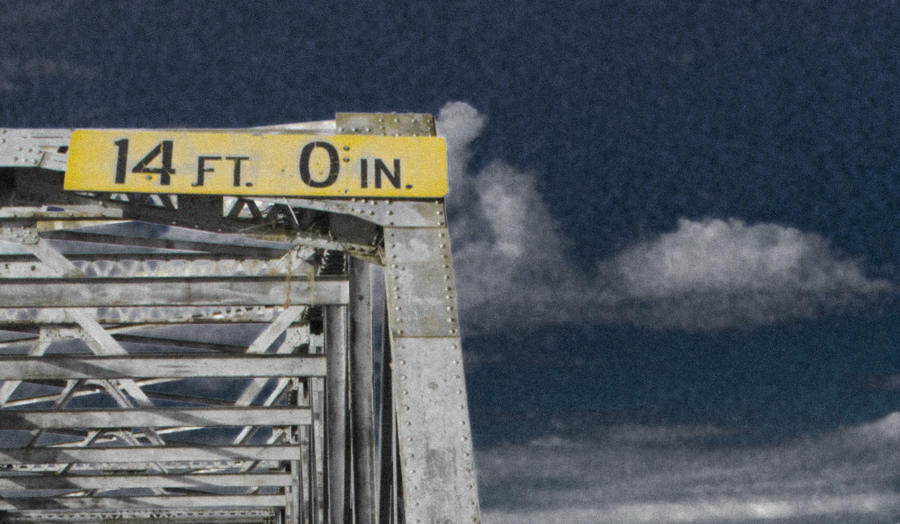
14 FT. 0 IN.

Rio Puerco Bridge, September 2013, by John Fleck

Rio Puerco Bridge, September 2013, by John Fleck


I love the old steel girder bridges. They really feel like they’re getting you somewhere, like you’re not taking the crossing for granted.

Stuff I wrote elsewhere: a critique of the Gila diversion

From the morning paper, Norm Gaume’s critique of a proposal to divert water from the Gila:

New Mexico is overestimating the amount of water available from a proposed Gila River diversion and underestimating the cost and technical difficulty of the project, according to the former head of the state agency involved.

The project, as currently formulated, is “fatally flawed,” former New Mexico Interstate Stream Commission head Norm Gaume said in an interview Monday.

More background from my colleague Lauren Villagran on a fascinating old-school debate over whether to build a dam or not.


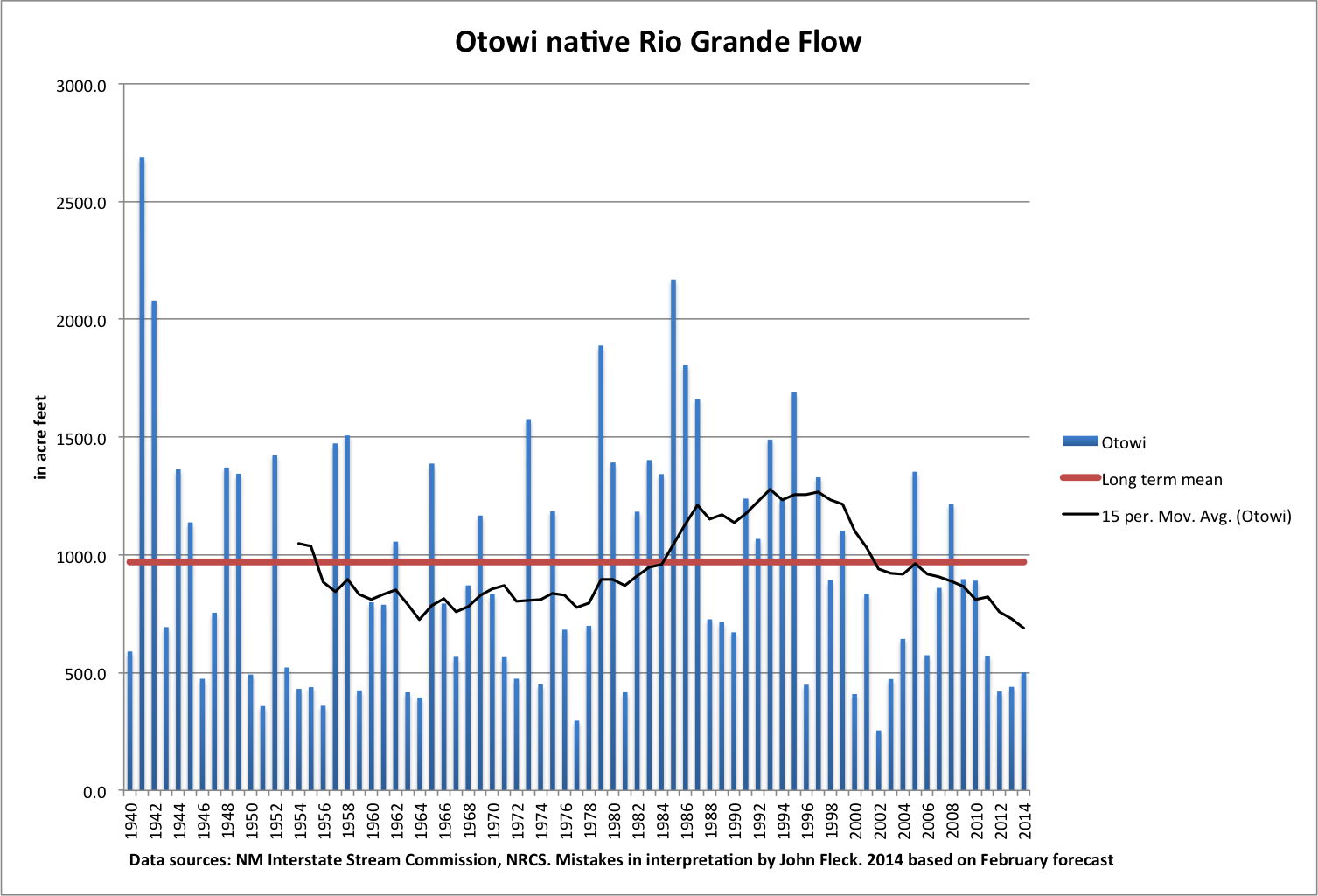
Long term drought: just two years since 1999 have been above average on the Rio Grande

Danger. Journalist doing math. There be dragons:

Otowi flow

Otowi flow

Otowi is the Rio Grande’s gateway to central New Mexico. Located between Santa Fe and Los Alamos, it’s the point where the river has picked up pretty much all the snowmelt it’s going to get, absent some minor contributions from the Jemez Mountains. It’s also a key point for calculating the relative water obligations of New Mexico and Texas under the Rio Grande Compact, which means there’s a nice, easy-to-access spreadsheet on my hard drive that I try to keep updated.

This evening I took a shot, based on the Feb. 1 NRCS forecast, at estimating 2014 flow. The last time we had four consecutive dry years on this scale was 1953-56. The last time we had six consecutive dry years was never, at least not in the Compact record, which goes back to 1940. I shall pursue a longer record and get back to you.

Update: Based on data from the TreeFlow folks, which I am dangerously number-crunching myself (see disclaimer at the top about dragons), the last time we had a losing streak this long on the Rio Grande was 1873-83.

It’s not like California hasn’t had the time to get in front of this problem

California is entering its fourth drought in as many decades. Yet even now, some communities lack water meters to track how much water people are using and to charge them accordingly.

Many of those households don’t even receive monthly water bills. They pay for water through yearly assessments attached to their property taxes, which may be rolled into their monthly mortgage payments.

via Alex Breitler

Parade crowd size watch: Seattle 12th person edition

So yeah, Seattle won the big pointyball game, and lots of people came out for a parade to celebrate. But are we surprised to learn that parade organizers overestimated the crowd size?

“There is civic pride that goes into estimating these numbers. They tend to be overstated wildly,” says Steve Doig, the Knight Chair in Journalism at Walter Cronkite School of Journalism and Mass Communication at Arizona State University, who has covered the subject of crowd estimation.

“Or maybe it’s from a cop who looks around and says, ‘My God, there must be 700,000 people here.’?”

Previous Inkstain coverage of crowd size estimates here.


Stuff I wrote elsewhere: headed toward ESA litigation on the Rio Grande

From this morning’s newspaper, we appear to be headed toward Endangered Species Act litigation this year on the Rio Grande:

Human water diversions have left the Rio Grande ecosystem with too little water to maintain the minnow and other species that depend on the river’s flow, including the valley’s iconic cottonwoods, said Jen Pelz, Wild Rivers Program coordinator for WildEarth Guardians.