California’s water policy failings on display, but is there a lesson of success here as well?

tl;dr While Northern California flounders, Southern California’s drought planning kicks in as Met taps into its Lake Mead water savings bank

California Poppies

California Poppies

Brett Walton, writing about President Obama’s visit to California’s drought-stricken Central Valley, captured that state’s water policy dilemma:

“It can’t just be a matter of there’s going to be less and less water so I’m going to grab more and more of a shrinking share of water,” Obama continued. “Instead what we have to do is all come together and figure out how we all are going to make sure that agricultural needs, urban needs, industrial needs, environmental and conservation concerns are all addressed.”

That is a tall order, requiring a radical reinvention both of California’s water supply hardware and its operation – changes that politicians, environmentalists, and farmers have fought over for decades. Indeed, the drought has catalyzed a consensus that something should be done, but there is little agreement about the details.

Yes, but… To the south, the fruits of some years of wrestling over these issues has left a more orderly process for dealing with the current mess.

The Colorado River Interim Guidelines for Lower Basin Shortages and Coordinated Operations for Lake Powell and Lake Mead, approved in 2007, allowed Lower Colorado River Basin users to take a variety of steps to conserve or otherwise increase water supply, banking the resulting savings in Lake Mead for use when needed:

The primary purposes of ICS are to: (a) encourage the efficient use and management of Colorado River water; and to increase the water supply in Colorado River System reservoirs, through the creation, delivery and use of ICS; (b) help minimize or avoid shortages to water users in the Lower Basin; (c) benefit storage of water in both Lake Powell and Lake Mead; (d) increase the surface elevations of both Lake Powell and Lake Mead to higher levels than would have otherwise occurred; and (f) assure any Contractor that invests in conservation or augmentation to create ICS that no other Contractor will claim the ICS created by the Contractor pursuant to an approved plan by the Secretary.

We don’t have the final 2013 accounting yet, but at the end of 2012 the Metropolitan Water District of Southern California had banked 579,786 acre feet of water in Lake Mead. Overall, the Lower Basin water contractors as a whole had banked 1.2 million acre feet in Mead (p. 44 here, pdf).

This year, with California State Water Project deliveries reduced to a trickle (is “zero” a “trickle”?), MWD has said it plans on tapping into some of its ICS water in Lake Mead, to the tune of about 200,000 acre feet (though a final decision has not been made). The U.S. Bureau of Reclamation granted MWD approval to store more ICS water in Mead this year, but according to a staff report to MWD’s board last week (pdf) that appears unlikely:

Due to dry conditions in California, however, it is unlikely Metropolitan will store water in Lake Mead this year, and has initially planned to withdraw water from its storage account in Lake Mead.

I’ve argued that a century of fighting over the Colorado River has created a robust framework for water management decisions on the Lower Colorado that makes it much less difficult to handle trouble in times like this.



“If something cannot go on forever, it will stop.”

From Brett Walton, a visit to California’s Central Valley to witness Stein’s Law in action:

David Zoldoske, who has worked at Fresno State for 31 years, sees this as the future of agriculture in the Central Valley. Fewer acres will be irrigated, less groundwater will be pumped.

Walton’s entire piece is worth reading. Wikipedia has a nice brief explanation of Stein’s law.

Nunes: “There was plenty of water.”

California Congressman Devin Nunes, in this morning’s New York Times:

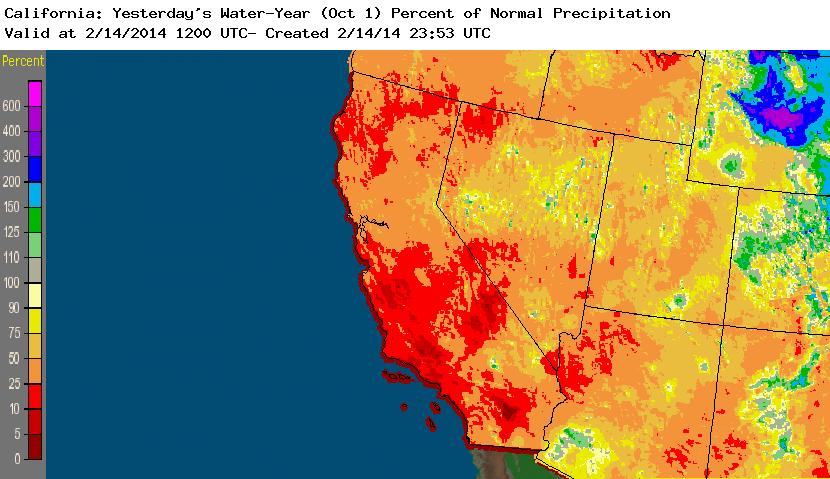
“Global warming is nonsense,” Mr. Nunes said. He criticized the federal government for shutting off portions of California’s system of water irrigation and storage, and diverting water into a program for freshwater salmon. “There was plenty of water. This has nothing to do with drought. They can blame global warming all they want, but this is about mathematics and engineering.”

Percent of average precipitation, Oct. 1 2013 - Feb. 14, 2014, courtesy NWS

Percent of average precipitation, Oct. 1 2013 – Feb. 14, 2014, courtesy NWS

How is it even possible to start a water policy conversation when a politician so willfully ignores reality?

They’re pumpin’ down in Texas

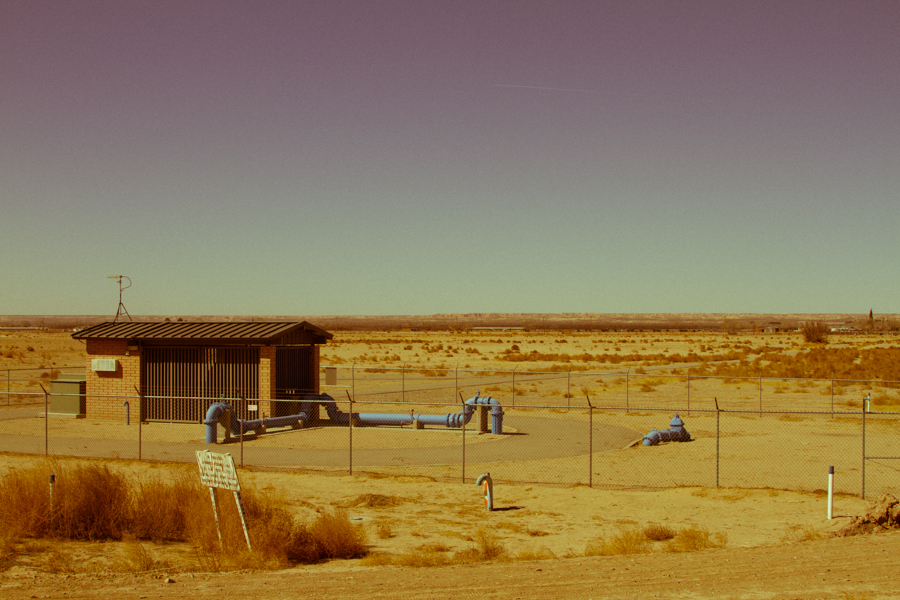
Given the tension from Texas’s legal complaints against New Mexico regarding the impact of New Mexico groundwater pumping on Texas Rio Grande supply (see Texas v. New Mexico and Colorado), this El Paso Water Utilities pump house feels to some like a middle finger raised in New Mexico’s direction. It’s just inside the Texas border, atop the Mesilla Bolson – the very aquifer the Texas lawyers are claiming New Mexico pumpers are hitting too hard:

Texas pumps, near Las Cruces, March 2013, by John Fleck

Texas pumps, near Las Cruces, March 2013, by John Fleck


Losing the groundwater pumping race to the bottom: your choice

Governing the Commons


As we watch Californians floundering over drought, or sometimes not floundering, it’s worth revisiting Elinor Ostrom’s Governing the Commons. In it, Ostrom tells the story of communities in the San Gabriel Valley, east of Los Angeles, coming together to manage their groundwater at a time when a race to the bottom was underway that, absent collective action, would have drained the critical common pool resource:

The initial steps were taken in the shadow of a court order. Elections and public hearings were held at key stages. The solutions to the pumping race, however were not imposed on the participants by external authorities. Rather, the participants used public arenas to impose constraints on themselves. (emphasis in original)

This is not some fresh, revolutionary approach. It happened back in the 1930s and ’40s. And the system set up still works.

Meanwhile, Jennifer Medina reports on the alternative approach in California’s Central Valley:

This year, Ms. Woolf’s farm will be forced to rely entirely on the ground wells it owns, pumping what they need to keep the existing crops healthy. But there is no way to know how much water is available underground — and with neighboring farmers doing the same, it is only a matter of time before the wells run dry.

“It’s like a bank account that is going to run out, and you don’t know when,” Ms. Woolf said, standing near her fields of garlic, where workers were laying rubber irrigation tubes under the murky cloudless skies. “With no rain, we’re not recharging what we’re taking. Nobody wants to do it this way, but you make the decision where to plant just based on where you can get the water to for as long as it lasts.”

So, to summarize: If communities get together and take responsibility for the finite nature of their aquifers, their water can be reliably managed to last. If they don’t they water as long as it lasts and then, I guess, they’re done. Either way. Their choice.

OtPR:

I have absolutely no sympathy for this predicament. It could not be more directly or more blatantly self-inflicted.

Lady Gaga, California drought

Hearst Castle Neptume poo, CC via Jim Epler

Hearst Castle Neptume poo, CC via Jim Epler

Here at Inkstain, we’ve long believed that our drought and water coverage has suffered from a lack of Lady Gaga-related items. Today, thanks to the LA Times, we can correct this shortcoming. The story, fittingly enough, involves Hearst Castle and what is apparently a leaking swimming pool:

[P]ark officials and the singer came up with a plan. Gaga would pay for water to be pumped from an on-site irrigation storage facility to fill the cracked pool, which was leaking up to 5,000 gallons of water per day.

The water will be returned after the photo shoot, officials said, and the cost of the transfer will be picked up by Gaga.

There is more, including a plan to repair the leaking pool and some sort of public service announcement.

If I was a better blogger, I would have found a photograph of Lady Gaga (whose real name is Stefani Germanotta) for which publication rights are not encumbered. I recommend a Google image search (may not be SFW).

Some fine lawyer language in the Virginia marriage ruling

Government interests in perpetuating traditions, shielding state matters from federal interference, and favoring one model of parenting over others must yield to this country’s cherished protections that ensure the exercise of the private choices of the individual citizen regarding love and family.

Ultimately, this is consistent with our nation’s traditions of freedom. “[T]he history of our Constitution … is the story of the extension of constitutional rights and protections to people once ignored or excluded.” United States v. Virginia, 518 U.S. 515, 557 (1996). Our nation’s uneven but dogged journey toward truer and more meaningful freedoms for our citizens has brought us continually to a deeper understanding of the first three words in our Constitution: we the people. “We the People” have become a broader, more diverse family than once imagined. Justice has often been forged from fires of indignities and prejudices suffered. Our triumphs that celebrate the freedom of choice are hallowed. We have arrived upon another moment in history when We the People becomes more inclusive, and our freedom more perfect.

Almost one hundred and fifty four years ago, as Abraham Lincoln approached the cataclysmic rending ofour nation over a struggle for other freedoms, a rending that would take his life and the lives of hundreds of thousands of others, he wrote these words: “It can not have failed to strike you that these men ask for just. . . the same thing—fairness, and fairness only. This, so far as in my power, they, and all others, shall have. ”

The men and women, and the children too, whose voices join in noble harmony with Plaintiffs today, also ask for fairness, and fairness only. This, so far as it is in this Court’s power, they and all others shall have.

full pdf here, and the whole thing is worth reading

Water policy implications of Steinbeck

And it never failed that during the dry years the people forgot about the rich years, and during the wet years they lost all memory of the dry years. It was always that way.

John Steinbeck, in East of Eden

This famous quote came up today in Circle of Blue‘s conference call/seminar on California drought. A frequent message drawn from Steinbeck’s words is that we must do better – that we must teach people not to forget when the wet times return.

I’d suggest a different lesson to draw from Steinbeck’s wise description of climate variability in the Salinas Valley. What if the real message is that people will forget, and that what we as a society need to do is develop a politics and policy around our water that is robust to that inevitability?

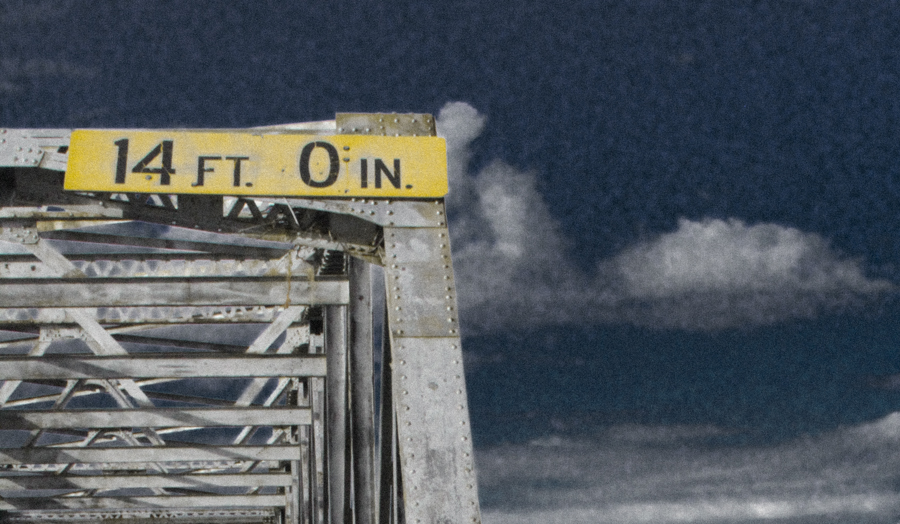
14 FT. 0 IN.

Rio Puerco Bridge, September 2013, by John Fleck

Rio Puerco Bridge, September 2013, by John Fleck


I love the old steel girder bridges. They really feel like they’re getting you somewhere, like you’re not taking the crossing for granted.